
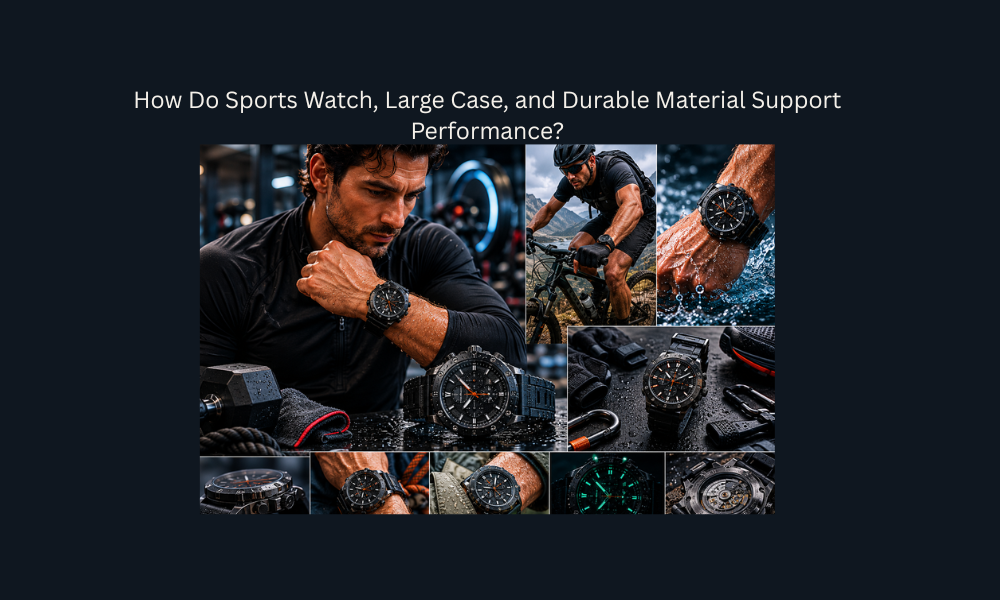
How Do Sports Watch, Large Case, and Durable Material Support Performance?
Executing true Sports Watch Performance requires a structured evaluation framework that prioritizes high-impact material science, large-case legibility, and internal shock mechanisms over arbitrary aesthetic trends. Purchasing extreme niche sports watches without evaluating their heavy, protruding case dynamics leads to severe ergonomic fatigue and catastrophic mechanical failures during actual athletic use. This guide provides the framework for defining environmental hazards, evaluating the weight deltas of advanced composites, optimizing strap stability, and utilizing a quantitative scoring checklist to finalize your athletic tool.
How to define the core baseline for your sports watch performance
Defining the core baseline for your Sports Watch Performance establishes the primary athletic or high-impact outdoor environment the timepiece must survive before evaluating specific diameters or metallurgy.
- Rule: Performance demands structural integrity over formal elegance.
- Reason: The extreme kinetic shock, water pressure, and blunt impact of outdoor sports will instantly destroy a delicate, high-polish dress watch. Understanding these purpose-built watch categories prevents the costly mistake of subjecting a delicate luxury piece to the destructive forces of rugged environments.
- Example: Defining your goal as “heavy outdoor activity” immediately prioritizes a highly durable, shock-resistant resin case over a slim, polished gold one.
Why does a large case profile anchor your sports watch performance
Understanding why a large case profile anchors your Sports Watch Performance requires establishing how specific millimeter dimensions ($42\text{mm}+$) directly contribute to instant legibility while housing critical internal protective mechanisms. Athletic timepiece utility demands instant readability, which larger dials facilitate. The extra volume is mathematically required to mount thicker sapphire crystals and suspension spacers for the movement. This guarantees the sport watch endurance baseline is met by allowing the necessary space for physical shielding against impact.
What makes durable materials essential to your sports watch performance
Determining what makes durable materials essential to your Sports Watch Performance involves weighing the impact resistance, physical weight, and corrosion tolerance of rugged metals and composites against your specific physical activities.
Carbon / Resin
Titanium (Gr.5)
Stainless Steel
Are water and shock resistance viable for your sports watch performance
Evaluating if water and shock resistance are viable for your Sports Watch Performance requires determining your absolute minimum requirements for depth ratings and internal movement shielding. Assessing alternative physical protections ensures the timepiece structural resilience is sufficient for your needs.
- Shock Resistance (e.g., Incabloc): Protects the microscopic balance wheel pivots from snapping during blunt force impacts. → Risk: Mechanical watches will always be significantly more fragile than solid-state digital quartz, regardless of the internal shock protection deployed.
- $200\text{m}+$ Water Resistance: Thick internal gaskets and threaded screw-down crowns protect against dynamic aquatic pressure spikes. → Risk: Adds significant thickness and physical weight to the total case profile. If your primary active environment involves sustained submersion, prioritizing professional dive capability becomes far more critical than evaluating generalized outdoor impact resistance.
Do specialized bezels and high-contrast dials impact your sports watch performance
Analyzing how specialized bezels and high-contrast dials impact your Sports Watch Performance injects commercial realism by evaluating the actual in-the-field usefulness of timing bezels, chronographs, and luminous paint.
Is assessing ergonomic strap fit critical for your sports watch performance
Assessing ergonomic strap fit is critical for your Sports Watch Performance to prevent severe athletic frustration caused by heavy, oversized cases becoming unstable during physical exertion.
- Rule: A loose sports watch is a dangerous sports watch.
- Reason: If a heavy $44\text{mm}$ case slides down your wrist during a hike, it acts as a lever, causing severe forearm fatigue and becoming highly prone to striking rocks.
- Example: Opting for a micro-adjustable, fitted FKM rubber strap or an elastic parachute-style NATO strap to lock the heavy case tightly against an expanding, sweaty wrist. Exploring specialized strap construction reveals exactly how different tension systems mitigate top-heavy case wobble during rapid, repetitive arm movements.
How to conclude your sports watch performance with this final execution checklist
Concluding your Sports Watch Performance with this final execution checklist provides a strong, objective closure that transforms the physical features into an actionable scoring system.
Execution Checklist
Support Appendix: Advanced Sports Watch Troubleshooting & FAQ
This appendix integrates troubleshooting seamlessly into the task flow to resolve advanced performance confusion and buying friction regarding heavy tool watches.
-
Q: Why are dedicated sports watches so inherently thick?
A: The thickness is rarely aesthetic. It is physically required to house thicker sapphire crystals, anti-magnetic soft-iron inner cages (Faraday cages), shock-absorbing movement spacers, and heavy-duty threaded water gaskets.
-
Q: Should I choose a mechanical or quartz movement for intense sports?
A: For truly high-impact, violent sports (motocross, tennis, shooting), a solid-state quartz or digital module (like a G-Shock) is universally superior. Mechanical sports watches are incredibly resilient, but their physical gears and delicate hairsprings can still break under extreme, sudden G-forces.
-
Q: Can a large sports watch be worn comfortably every single day?
A: Yes, if the material density is low enough. A massive $44\text{mm}$ stainless steel watch will cause severe wrist fatigue if worn $12\text{ hours}$ a day at a desk. That exact same $44\text{mm}$ watch made of Grade 5 Titanium will feel virtually weightless, making it an excellent, low-fatigue daily driver.
Conclusion
By systematically evaluating oversized legibility, shock-absorbent movement protection, and highly durable case materials, you elevate your purchase from a purely aesthetic choice to a strategic investment in Sports Watch Performance. Prioritizing specialized structural specifications—while strictly mitigating the ergonomic risks of a heavy timepiece—ensures your watch serves as a reliable, indestructible tool in the most demanding physical environments.