
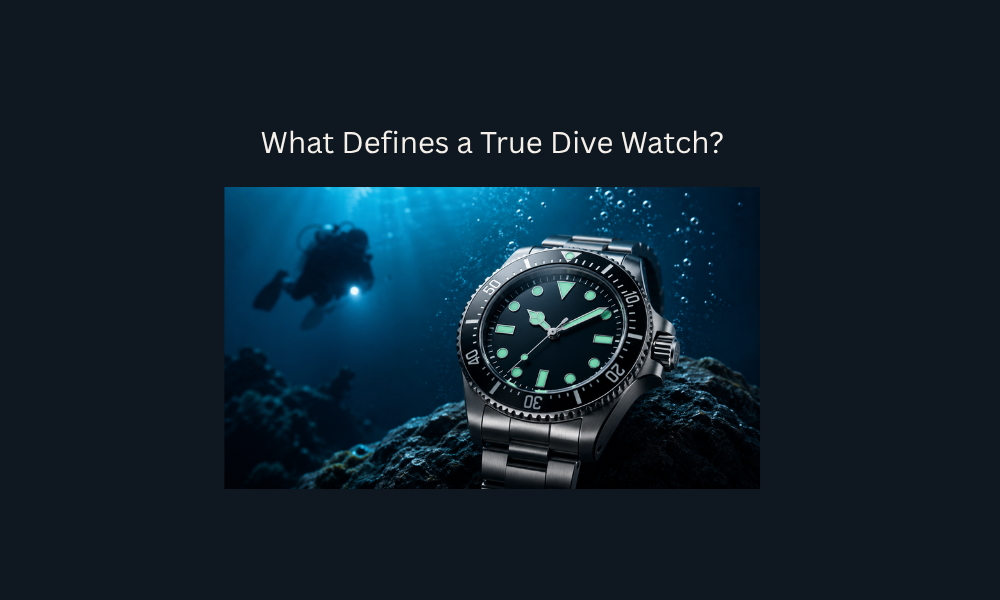
What Defines a True Dive Watch?
A rotating bezel and a sporty dial do not automatically make a watch safe for scuba diving. A true dive watch is defined by functional engineering requirements designed for underwater use, not simply by the visual language associated with diving watches.
Under ISO 6425, a true dive watch must combine minimum water resistance with a secured diving-time indicator, underwater legibility, a visible running indicator, and resistance to environmental stresses such as magnetism, shock, corrosion, and temperature changes. These requirements separate a genuine underwater timing instrument from a watch that merely looks like one.
How a True Dive Watch Differs from a Standard Dive-Style Watch
A true dive watch is designed and tested as a functional underwater timing instrument. A dive-style watch, sometimes called a “desk diver,” may copy the appearance of a professional diver without meeting the same engineering or testing requirements.
That distinction matters because underwater reliability depends on more than case styling. Pressure resistance, sealing, elapsed-time control, visibility, and durability must continue working together during prolonged submersion.
The boundary between a cosmetic dive-style aesthetic and a functional true dive watch
Many watches borrow visual features traditionally associated with dive watches.
These may include:
- rotating bezels,
- oversized hour markers,
- dark dials,
- luminous hands,
- thick cases,
- and prominent depth markings.
Those features can make a watch look suitable for diving without proving that its case, seals, crown, timing system, or movement have been engineered for the conditions encountered underwater.
A functional true dive watch must go beyond appearance.
Its seals must resist water ingress under pressure. Its timing system must remain protected against accidental manipulation. Its display must remain readable in darkness, and the watch must continue functioning after the environmental tests required by the applicable standard.
A desk diver can reproduce the aesthetic markers of a dive watch while lacking those underlying protections.
Why a 100m water-resistance rating alone does not define a true dive watch
A minimum 100-meter depth rating is part of the ISO 6425 framework, but the number printed on a dial or caseback is not enough by itself to establish that a watch is a true dive watch.
Water resistance addresses only one part of underwater performance.
A qualifying dive watch must also satisfy additional functional requirements involving:
- elapsed-time measurement,
- protection against accidental timing changes,
- underwater visibility,
- a visible running indicator,
- magnetic resistance,
- shock resistance,
- corrosion resistance,
- and prescribed testing procedures.
A standard watch may therefore carry a 100-meter water-resistance rating without conforming to the complete dive-watch standard.
The distinction is between being water resistant and being designed as a complete underwater timing instrument.
The critical role of the ISO 6425 standard in defining a true dive watch
ISO 6425 provides the international framework used to define watches intended for diving.
Instead of judging a dive watch by appearance alone, the standard focuses on functional performance.
It establishes requirements covering areas such as:
- minimum depth capability,
- pressure testing,
- elapsed-time indication,
- visibility in darkness,
- resistance to external forces,
- magnetic resistance,
- shock resistance,
- and environmental durability.
This creates a practical boundary between watches that borrow dive-watch styling and watches designed to perform the actual job.
| Feature | Dive-Style Watch (“Desk Diver”) | True Dive Watch (ISO 6425 Standard) |
|---|---|---|
| Water Resistance | 30m to 100m (Standard testing) | Minimum 100m (tested to 125% of rated depth) |
| Crown Mechanism | Push-pull | Screw-down or functionally secured equivalent |
| Timing Indicator | Bidirectional or fixed / friction-fit | Secured against inadvertent rotation (e.g., unidirectional bezel) |
| Luminescence | Hands only (or none) | Markers, hands, and visible running indicator |
| Testing Standard | Testing varies by manufacturer; ISO 6425 conformity is not implied. | 100% individually pressure tested in water |
Why Water Resistance and Pressure Ratings Protect a True Dive Watch
Water resistance in a true dive watch is not merely a specification printed on the dial. It depends on the structure of the case and the ability of multiple sealing points to resist water ingress while the watch is exposed to pressure.
The crystal, caseback, crown, gaskets, and other openings must work together as a sealed system.
How a minimum depth rating protects a true dive watch during submersion
ISO 6425 establishes a minimum 100-meter depth rating for a dive watch.
Many modern dive watches are rated to 200 meters or more, but higher depth ratings do not replace the underlying requirements of the standard.
Pressure testing also includes an overpressure margin.
A watch rated to a particular depth is tested in water at 125% of its rated pressure. A 100-meter-rated watch, for example, is tested to pressure corresponding to 125 meters.
The purpose is to verify that the case and sealing system retain their integrity beyond the stated operating depth rather than failing immediately at the printed rating.
How crown sealing and setting-device resistance protect a true dive watch
The crown is one of the most vulnerable points in a watch case because it provides a mechanical connection between the exterior of the watch and the movement inside.
Water intrusion at this point can compromise the entire watch.
Many dive watches use a screw-down crown. Tightening the crown compresses sealing gaskets and helps create a secure barrier against water.
However, the defining requirement is functional security rather than the presence of one specific crown design.
A true dive watch must protect its setting mechanisms against water entry and external forces under pressure. A screw-down crown is a common engineering solution because it helps secure and compress the seal, but an equivalent mechanism can serve the same functional purpose.
How helium escape valves function in saturation-focused true dive watches
A helium escape valve is not a mandatory feature on every true dive watch.
It is a specialized solution intended primarily for saturation-diving environments.
Commercial saturation divers may spend extended periods breathing helium-oxygen gas mixtures in pressurized environments. Because helium atoms are extremely small, helium can gradually enter the watch case.
During decompression, pressure outside the watch falls.
If trapped helium cannot leave the case quickly enough, internal pressure may become greater than external pressure. That pressure difference can potentially damage the watch or force the crystal away from the case.
A helium escape valve allows the trapped gas to leave in a controlled manner.
For recreational scuba diving, this feature is normally unnecessary. Its presence therefore indicates a specialized saturation-diving capability rather than a universal requirement for defining a true dive watch.
How a Secured Timing Indicator Tracks Elapsed Time on a True Dive Watch
A dive watch is not only expected to survive underwater. It must also allow the diver to monitor elapsed time without creating a dangerous timing error.
That is why the diving-time indicator must be secured against accidental manipulation.
On most analog dive watches, this function is provided by a rotating bezel.
Why a true dive watch bezel must be secured against inadvertent rotation
The ISO requirement focuses on preventing accidental changes to the elapsed-time indication.
An external unidirectional bezel is the most common analog solution.
It normally rotates only counterclockwise.
This creates a fail-safe behavior. If the bezel is accidentally knocked and moves during a dive, it can only indicate that more time has elapsed than actually has.
It cannot normally move in the opposite direction and falsely suggest that less time has elapsed.
The important principle is therefore not simply that the bezel rotates. The timing indicator must be secured against inadvertent manipulation.
How the 60-minute scale on a true dive watch tracks elapsed bottom time
Before descending, the diver aligns the bezel’s zero marker, often called the pip, with the minute hand.
As the minute hand moves around the dial, it points toward the elapsed-minute markings on the bezel.
If the minute hand has moved 20 minutes beyond the starting marker, approximately 20 minutes have elapsed since the bezel was set.
This allows the diver to track bottom time using a simple mechanical reference.
The system remains useful because it does not require complicated calculations while underwater. Once the starting position is established, elapsed time can be read directly from the relationship between the minute hand and the bezel scale.
The mechanism that keeps a true dive watch bezel locked against accidental impacts
An external dive bezel is commonly held in position by an internal ratcheting mechanism.
Depending on the design, a bezel may use 60 or 120 clicks around a full rotation.
Springs and indexing components create tension between each position. This resistance prevents the bezel from rotating freely when it is bumped or caught against underwater equipment.
The mechanism also provides tactile feedback as the bezel moves between positions.
The precise construction varies between manufacturers, but the functional objective remains the same: the elapsed-time setting should remain stable during normal underwater use and resist accidental movement.
Why Legibility and Luminescence Are Mandatory for a True Dive Watch
Underwater visibility can deteriorate rapidly as light levels fall.
Depth, suspended particles, poor weather, and low-light environments can make an ordinary watch difficult or impossible to read.
A true dive watch must therefore remain legible when natural light is unavailable.
How a true dive watch ensures readability at 25 centimeters in darkness
ISO 6425 requires critical information to remain readable at approximately 25 centimeters in darkness after the watch has been exposed to light.
The diver must be able to identify essential information such as:
- the current time,
- elapsed diving time,
- and whether the watch is still running.
This requirement influences the characteristic appearance of functional dive watches.
Large hands, bold hour markers, clear minute markings, and luminous material are not merely styling choices. They help create a display that remains understandable when visibility is severely reduced.
Why a visible running indicator is required on a true dive watch
A diver must be able to confirm that the watch has not stopped.
Displaying the correct time is not enough if there is no visible evidence that the movement is still operating.
For this reason, a true dive watch requires a visible running indicator.
On many mechanical watches, this function is performed by the seconds hand. A luminous section, pip, or lollipop-style marker allows the diver to see the hand moving even in darkness.
The moving luminous indicator acts as a simple proof of life.
If it stops moving, the diver immediately knows that the watch can no longer be trusted as an elapsed-time instrument.
The contrast requirements between the dial and markers on a true dive watch
Strong contrast improves recognition underwater.
This is why functional dive watches commonly use dark matte dials combined with large, bright markers and highly visible hands.
Black and dark blue are common dial colors because luminous or light-colored indicators stand out clearly against them.
Oversized indices also reduce the visual effort required to distinguish one marker from another.
The objective is not decorative contrast. It is rapid recognition of time and elapsed-time information when lighting conditions are poor.
How Durability and Magnetism Resistance Solidify a True Dive Watch
Water pressure is only one environmental challenge a dive watch must withstand.
A true dive watch must continue functioning after exposure to other stresses that could compromise timing accuracy, sealing, or structural integrity.
These include rapid temperature changes, magnetic fields, and physical impacts.
Why a true dive watch must survive severe thermal shocks without internal condensation
Temperature changes can stress the watch’s sealing system.
ISO 6425:2018 includes an alternating temperature-cycle immersion test designed to evaluate the watch under changing thermal conditions.
After testing, internal condensation should not appear beneath the crystal.
Condensation is significant because it indicates that moisture has entered the case or that the sealing system has failed.
A watch that remains externally intact but develops moisture internally has not maintained the environmental barrier required for reliable underwater use.
The test therefore evaluates more than cosmetic durability. It helps confirm the integrity of the sealed case.
How magnetic resistance protects the timing accuracy of a true dive watch
Mechanical watch movements contain components that can be affected by magnetic fields.
When magnetized, parts such as the hairspring can behave differently from their intended design, potentially causing the watch to gain or lose time.
That becomes particularly important when the watch is being used to monitor elapsed diving time.
Dive-watch standards therefore include magnetic-resistance requirements.
A commonly referenced test level is a direct-current magnetic field of 4,800 A/m.
The watch must continue operating within the applicable standard’s performance requirements after exposure.
The important point is not to assume one universal daily accuracy figure for every watch. The requirement is that magnetic exposure must not render the watch unreliable for its intended timing function.
The impact testing required to certify the crystal and case of a true dive watch
A dive watch can be struck against equipment, a ladder, a tank, or another hard surface.
The case and movement therefore need resistance to mechanical shock in addition to pressure resistance.
Shock testing references ISO 1413 procedures intended to simulate significant impacts, including conditions comparable to a fall from approximately one meter.
After the required impact testing, the watch must continue functioning within the applicable performance limits.
The test also matters for water integrity.
Damage to the crystal, case, crown, or sealing surfaces could turn an otherwise water-resistant watch into one that is unsafe for subsequent underwater use.
How to Verify if Your Timepiece Conforms to True Dive Watch Standards
A buyer should not judge a dive watch only by the bezel, depth number, or marketing photography.
Verification requires looking at the complete set of functional claims and understanding how the manufacturer tests the watch.
How to interpret the “Diver’s” text on a true dive watch dial
Some watches use conformity-related markings such as:
The word “Diver’s” is intended to communicate that the manufacturer claims the watch conforms to the applicable dive-watch requirements.
That is more meaningful than a standalone depth rating because it refers to a broader functional standard rather than water resistance alone.
However, buyers should still review the manufacturer’s documentation rather than treating dial text as the only evidence.
The important question is whether the complete watch is claimed and tested to conform to the relevant dive-watch requirements.
Understand the difference between 100% individual testing and standard manufacturer testing
Testing procedures vary widely among ordinary water-resistant watches.
A manufacturer may use production sampling, air-pressure testing, water testing, or internal procedures depending on the product and claimed rating.
Those practices do not automatically establish ISO 6425 conformity.
For an ISO 6425-conforming dive watch, the required dive-watch pressure testing applies individually to the watches rather than being inferred only from a sampled batch.
That distinction is important.
A model family having a general water-resistance specification is not equivalent to each dive watch being subjected to the testing required by the dive-watch standard.
Why many luxury pieces function as a true dive watch through conformity rather than official verification
A watch can be engineered to meet or exceed the functional expectations associated with ISO 6425 without being marketed around external ISO verification.
High-end manufacturers may rely on extensive in-house testing and additional certification systems.
Brands such as Rolex or Tudor, for example, use their own testing programs and may combine dive-watch engineering with separate performance certifications such as Superlative Chronometer or METAS-related testing where applicable.
Those certifications should not be confused with ISO 6425 itself.
Chronometer or movement-performance certification evaluates different characteristics.
The relevant question for dive-watch classification is whether the watch’s construction and testing satisfy the functional requirements expected of a genuine diving instrument.
| ISO 6425 True Dive Watch Criteria Grid | Standard / Threshold Required |
|---|---|
| Minimum Depth Rating | 100 meters minimum |
| Overpressure Testing | Tested in water to 125% of rated depth (e.g., 100m watch tested to 125m) |
| Timing Pre-selection | Secured diving-time indicator (e.g., Unidirectional rotating bezel) |
| Visibility / Luminescence | Time, elapsed time, and running indicator clearly visible at 25cm in darkness |
| Magnetic Resistance | Must continue running accurately after exposure to 4,800 A/m field |
| Thermal Shock Resistance | No condensation after the ISO 6425:2018 alternating temperature-cycle immersion test |
| Shock Resistance | Must survive impact tests (referencing ISO 1413) |
The Evaluation Checklist to Identify a True Dive Watch
A true dive watch should be evaluated as a complete underwater timing system rather than as a collection of visual features.
Before relying on one underwater, verify the functional requirements that distinguish the category.
Verify the minimum depth rating, secure crown, and secured timing indicator
Check the basic mechanical protections first:
- Confirm a minimum depth rating of 100 meters.
- Confirm that the crown or equivalent setting device seals securely.
- Check the timing indicator for secure operation.
- If the watch uses an external dive bezel, verify that it cannot rotate freely through accidental contact.
- Confirm that the watch has undergone the appropriate pressure testing rather than relying only on its appearance.
A screw-down crown and unidirectional bezel are common implementations, but the underlying requirement is secure sealing and protected elapsed-time measurement.
Confirm active luminescence on the markers, hands, and running indicator
Test the watch’s visibility rather than assuming that large markers are sufficient.
Confirm that:
- the hands can be distinguished clearly,
- the essential dial markers remain visible,
- elapsed-time information can be read,
- and the running indicator remains identifiable in darkness.
A luminous seconds-hand marker is a common way of meeting the running-indicator requirement because it allows the wearer to confirm that the movement is still operating.
Ensure the true dive watch fulfills the complete functional standard before underwater use
Do not rely on a fashion watch simply because it resembles a professional diver.
Before trusting a watch during an actual dive, verify the complete system:
- minimum depth capability,
- pressure integrity,
- secure crown or setting mechanism,
- protected elapsed-time indicator,
- underwater legibility,
- visible running indication,
- magnetic resistance,
- shock resistance,
- thermal resistance,
- and appropriate testing.
A watch used underwater should also have current pressure integrity rather than relying indefinitely on an old factory rating.
A true dive watch is ultimately defined by what it can safely and reliably do underwater—not by how convincingly it reproduces the appearance of one.