
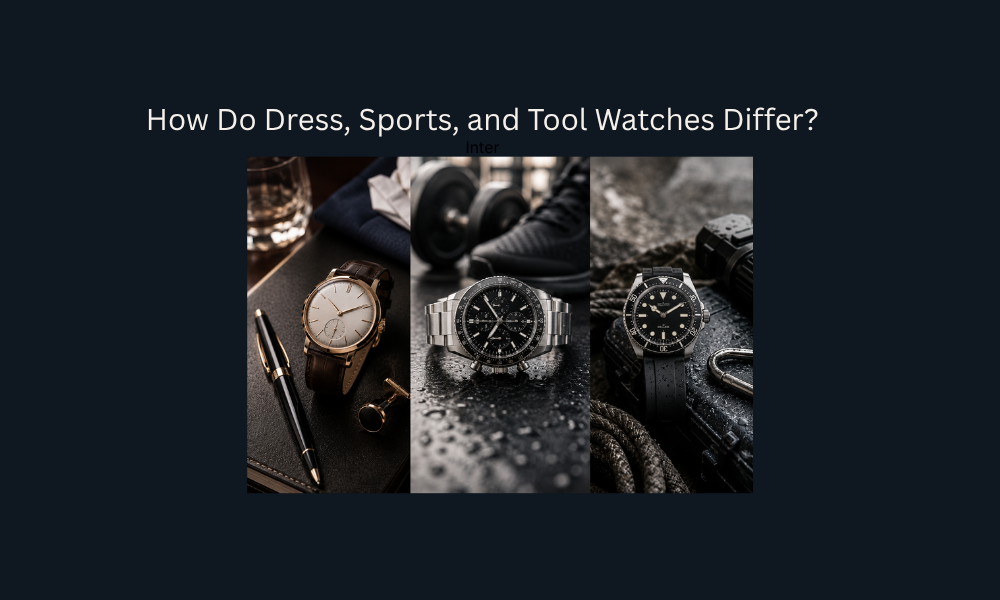
How Do Dress, Sports, and Tool Watches Differ?
Executing precise Watch Archetype Differentiation requires a structured evaluation framework that prioritizes physical case dimensions, environmental durability thresholds, and strict situational etiquette over impulsive aesthetic trends.
Forcing a timepiece into the wrong environment without understanding its categorical limitations leads to severe stylistic clashing, ergonomic discomfort, and catastrophic mechanical damage. This guide provides the framework for systematically defining environmental archetypes, evaluating hydrostatic survival metrics, and utilizing a quantitative scoring checklist to ensure flawless situational styling.
How to define the core framework of your watch archetype differentiation
Defining the core framework of your Watch Archetype Differentiation establishes the foundational environments (formal, active, professional utility) that force the separation of timepieces into three distinct design philosophies.
Rule: Form directly follows the intended environment.
Reason: You cannot wear a fragile watch while deep-sea diving, just as you cannot fit a bulky, neon dive watch under a fitted tuxedo cuff.
Example: Defining your goal as “situational mastery” immediately clarifies why specific physical dimensions and materials are locked to specific watch categories.
Why does case thickness anchor your watch archetype differentiation
Understanding why case thickness anchors your Watch Archetype Differentiation requires establishing how the vertical profile of the watch serves as the fastest, most reliable metric for separating formalwear from athletic utility and professional instruments. A thorough Timepiece profile comparison dictates the center of gravity on the wrist and the maximum allowable cuff clearance, enforcing a non-negotiable physical constraint. Through structured Watch dimension analysis, it becomes evident that a slender profile is mandatory for formal shirts, whereas extreme vertical depth is required to house the internal mechanisms necessary for survival instruments.
Timepiece Profile Comparison
What physical dimensions perfectly fit your watch archetype differentiation
Determining what physical dimensions perfectly fit your Watch Archetype Differentiation involves mapping the specific horizontal and vertical constraints that define the strict boundaries of each specific watch category.
Diameter Boundaries
-
•
Dress Watch: $34\text{mm}-38\text{mm}$ diameter, strictly under $10\text{mm}$ thick. → Result: Disappears under a fitted shirt cuff; prioritized entirely for formal, minimalist elegance.
-
•
Sports Watch: $39\text{mm}-42\text{mm}$ diameter, $10\text{mm}-13\text{mm}$ thick. → Result: The versatile middle ground; resilient enough for swimming and weekend activity but refined enough for casual office wear.
-
•
Tool Watch: $42\text{mm}+$ diameter, $13\text{mm}+$ thick. → Result: Bulky and highly legible; built specifically to house thick crystals, heavy gaskets, and shock absorbers for professional survival.
Are durability thresholds critical for your watch archetype differentiation
Evaluating if durability thresholds are critical for your Watch Archetype Differentiation demands determining how water resistance and shock protection dictate which watch can actually survive specific environmental routines. Applying these Timepiece survival metrics ensures you perform an accurate Category durability comparison before exposing the mechanism to hydrostatic pressure or kinetic impact.
Hydrostatic Survival Metrics
-
•
Dress Watch ($30\text{m}$ WR): Splash resistant only; highly vulnerable to blunt force. → Limitation: Strictly reserved for climate-controlled, low-impact environments (offices, galas).
-
•
Sports Watch ($100\text{m} – 200\text{m}$ WR): Safe for swimming and high-impact sports; features highly durable shock resistance. → Advantage: The ultimate “Go Anywhere, Do Anything” (GADA) standard for modern active lifestyles.
-
•
Tool Watch ($200\text{m}+$ WR / ISO Certified): Immune to extreme water pressure; features internal shock-absorbing cages or anti-magnetic shielding. → Advantage: Professional-grade survival instruments designed for saturation divers, pilots, or military operators.
Do aesthetic complications impact your watch archetype differentiation
Analyzing how aesthetic complications impact your Watch Archetype Differentiation injects commercial realism by evaluating how the presence (or lack) of external bezels and chronographs permanently changes the watch’s identity.
- If you are evaluating a watch with a rotating $60\text{-minute}$ dive bezel and heavily lumed, oversized hands
- → Do categorize it strictly as a sports or tool watch, regardless of its size
- → Result you recognize that utilitarian complications instantly remove a watch from the formal “dress” category, which demands pure, time-only minimalism.
Is assessing strap hardware essential to your watch archetype differentiation
Assessing if strap hardware is essential to your Watch Archetype Differentiation prevents categorization mistakes by understanding how the factory strap options lock a watch into a specific formality tier.
Rule: The strap often dictates the archetype.
Reason: A classic watch head becomes sporty when mounted on an FKM rubber strap, just as a sports watch becomes formal when mounted on fine alligator leather.
Example: Opting to evaluate the watch on a steel bracelet to confirm its identity as a versatile sports watch rather than a dedicated formal piece.
How to prevent situational styling faux pas in your watch archetype differentiation
Preventing situational styling faux pas in your Watch Archetype Differentiation involves matching the distinct watch archetype to your specific outfit to avoid looking socially awkward or physically uncomfortable.
-
The Risk: Wearing an ultra-thin, delicate gold dress watch on a glossy strap to the gym or the beach.
→ The Reality: The intense formality of the watch severely clashes with the active environment, and the sweat/water will rapidly destroy the leather strap and potentially flood the fragile movement. -
The Risk: Forcing a massive $45\text{mm}$ matte-titanium tool watch into a strict corporate boardroom presentation.
→ The Reality: The watch will refuse to fit under your cuff, draw inappropriate visual attention, and violate traditional business etiquette.
How to conclude your watch archetype differentiation with this final execution checklist
Concluding your Watch Archetype Differentiation with this final execution checklist provides a strong, execution-oriented closure that transforms the comparative theory into an actionable daily styling audit.
Rule: A scored checklist removes the guesswork from situational styling.
Reason: Quantifying the dimensions, durability, and aesthetics ensures you always wear the correct tool for the environment.
Example: Only finalizing your outfit choice if the watch archetype scores perfectly for the day’s planned activities.
Execution Checklist & Scoring Interpretation
Daily Styling Audit
Score $<3/5$: Change Watches. The watch archetype fundamentally clashes with your physical environment or social etiquette; swap it immediately.
Support Appendix: Advanced Watch Archetype FAQ
This appendix integrates troubleshooting seamlessly into the task flow to resolve advanced hybrid confusion and categorization debates regarding your Watch Archetype Differentiation.
Q: What is the difference between a “Sports Watch” and a “Tool Watch”?
A: While often used interchangeably, a sports watch is generally built for durable, everyday active wear (e.g., a stainless steel chronograph or standard $100\text{m}$ diver). A “Tool Watch” is an uncompromising, professional-grade instrument built for a specific, life-or-death job (e.g., an ISO-certified saturation diver with a helium escape valve or an anti-magnetic pilot’s watch).
Q: Can a sports watch be worn as a dress watch?
A: It depends entirely on the design. A massive $45\text{mm}$ neon orange dive watch cannot. However, a sleek, $39\text{mm}$ steel sports watch with a smooth bezel (like the Rolex Explorer or Omega Aqua Terra) frequently bridges the gap and passes elegantly in business-formal environments. For those who strictly prefer rotating aquatic pieces, evaluating your dive watch’s compatibility with formal dress codes is the next critical step to avoid clashing with traditional business etiquette.
Q: Why are dress watches usually less durable than sports watches?
A: To achieve the ultra-thin, minimalist profile required for a true dress watch (often under $8\text{mm}$ thick), manufacturers must physically remove the thick sapphire crystals, heavy rubber gaskets, and internal shock-absorbing cages that give sports watches their legendary durability.
Conclusion
By systematically evaluating the physical dimensions that dictate cuff clearance, the durability thresholds that separate fragile elegance from professional survival, and the aesthetic markers of dial minimalism versus functional complications, you elevate your horological understanding through precise Watch Archetype Differentiation. Mastering the distinct boundaries between dress, sports, and tool watches ensures that you always select the perfect timepiece for your environment, projecting intentionality and flawless situational style.