
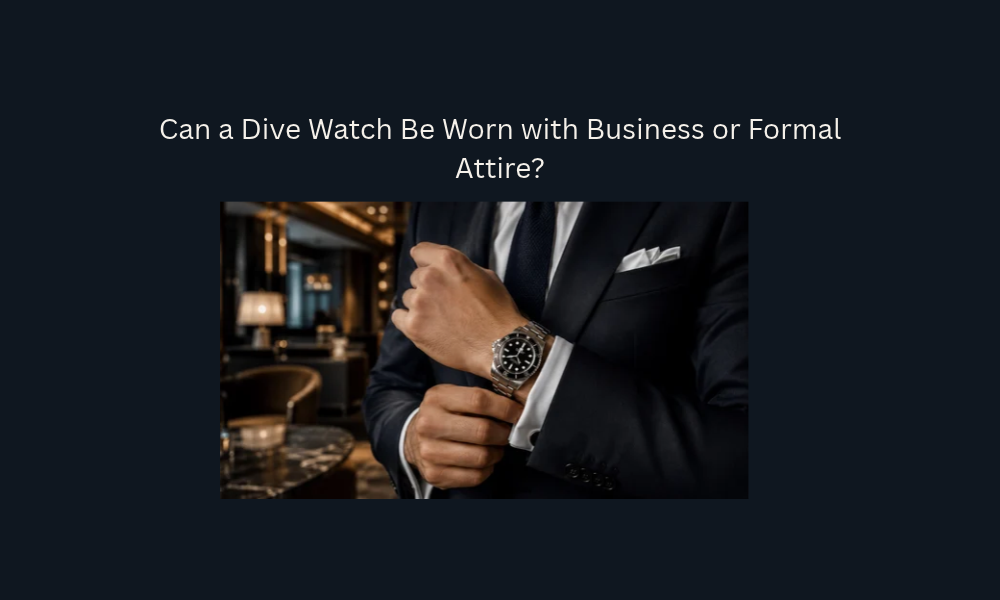
Can a Dive Watch Be Worn with Business or Formal Attire?
Yes—a dive watch can work well with a business suit, provided the watch is relatively slim, restrained in design, and paired with an appropriate bracelet or strap.
Strict formalwear is different.
Under traditional black-tie conventions, a thick sports watch with a rotating bezel, oversized luminous markers, and a utilitarian strap generally conflicts with the minimalism of a tuxedo. A slim, understated dress watch is the more appropriate choice for that setting.
The real question is therefore not simply whether a dive watch can be worn with tailoring.
It is which dive watch, with which clothes, and under which dress code.
Case thickness determines whether the watch fits beneath a shirt cuff. Diameter and lug length determine how bulky it appears. Dial, bezel, and strap choices decide whether the watch reads as refined sportswear or obvious diving equipment.
The following framework separates those variables so you can judge whether a specific dive watch belongs in the office, with a suit, or outside a strict formal event.
The Boundary Between Wearing a Dive Watch with a Suit and a Tuxedo
A business suit and a tuxedo may both involve tailoring, but they belong to different levels of formality.
That distinction determines how easily a dive watch fits into the outfit.
| Dress Code | Is a Dive Watch Acceptable? | Styling Requirements |
|---|---|---|
| Business Professional — Suit | Yes | Slim enough to clear the cuff; neutral dial; refined metal bracelet or dark leather |
| Smart Casual — Blazer / Chinos | Yes | Highly versatile; steel, titanium, or leather work well; moderate proportions preferred |
| Strict Black Tie — Tuxedo | Generally no | Traditional etiquette favors a slim, discreet, time-only dress watch |
How modern style rules accept a dive watch with business suits and smart-casual tailoring
Modern business clothing is significantly less rigid than traditional formal dress. This shift reflects broader changing watch etiquette , where the boundaries between sports watches and professional attire have become more flexible.
A standard two-piece navy, charcoal, or gray suit no longer requires a dedicated dress watch in every professional environment.
A refined dive watch can work because the contrast between tailoring and a well-made sports watch has become familiar.
The combination works particularly well when the watch avoids exaggerated tool-watch proportions.
A clean black or navy dial, moderate case size, controlled bezel design, and fitted metal bracelet can make a dive watch look deliberate rather than accidental.
Smart-casual clothing is even more flexible.
A blazer, open-collar shirt, chinos, knitwear, or tailored trousers can easily accommodate a sports watch because the outfit already mixes formal and casual elements.
In that environment, a dive watch often feels completely natural.
The key is visual balance.
The watch should complement the outfit rather than dominate it.
Why traditional black-tie dress codes still reject wearing a dive watch with a tuxedo
A tuxedo operates under a different visual logic.
Strict black-tie clothing is built around restraint, clean lines, dark evening fabrics, and minimal accessories.
A traditional dive watch was designed for almost the opposite purpose.
Its features may include:
- a rotating timing bezel,
- strong luminous markers,
- a thick pressure-resistant case,
- highly visible hands,
- a substantial bracelet,
- and an intentionally functional appearance.
Those features are useful underwater.
They are visually conspicuous with a dinner jacket.
Under strict traditional black-tie etiquette, the more coherent choice is therefore a thin, discreet, time-only dress watch—typically paired with black leather—or an equally restrained approach to wristwear.
That does not mean wearing a dive watch with a tuxedo is physically impossible or that nobody chooses to do it.
It means the combination intentionally breaks the conventional dress-code hierarchy.
How a dive watch acts as a versatile daily tool rather than a true formal dress watch
A dive watch and a dress watch solve different problems.
A dive watch is designed around versatility and durability.
It can move from:
- commuting,
- travel,
- office work,
- casual weekends,
- swimming,
- outdoor activities,
- and business-casual environments
without requiring the wearer to change watches.
A traditional dress watch is much more specialized.
Its strength comes from visual restraint rather than environmental capability.
A typical dress-watch formula emphasizes:
- a thin case,
- simple time display,
- minimal dial furniture,
- narrow bezel,
- restrained diameter,
- and dark leather strap.
That makes the dress watch more elegant with formal tailoring, but generally less versatile as an all-purpose sports watch.
A dive watch is therefore best viewed as a highly adaptable daily watch that can move upward into business attire when its proportions and styling permit.
It does not become a true dress watch simply because it is worn with a suit.
Why Case Thickness Determines if a Dive Watch Works with Tailoring
The most important suit-related dimension is often not diameter.
It is thickness.
A dive watch can look refined from above and still fail with tailoring if the case is too tall to move naturally beneath a buttoned shirt cuff.
How a thick dive watch catches on a tailored shirt cuff and ruins the line of a suit sleeve
A tailored shirt cuff is designed to fall cleanly around the wrist.
When the watch beneath it is too thick, the cuff cannot slide freely over the case.
Instead, the fabric can:
- catch on the bezel,
- bunch above the watch,
- remain trapped behind the case,
- or distort the line between shirt and jacket sleeve.
The result makes both the watch and the tailoring look less refined.
This is a physical problem rather than merely a styling opinion.
A watch that cannot clear the cuff changes how the sleeve sits.
Large dive watches can be particularly difficult because their height often comes from several stacked components:
- thick case construction,
- raised bezel,
- domed crystal,
- substantial caseback,
- and high-profile bracelet end links.
A suit-friendly dive watch needs to control that vertical bulk.
Why a case thickness under 12mm allows a dive watch to slide cleanly under a dress shirt
A practical target is approximately under 12mm in case thickness.
This is not an absolute law because shirt cuffs, wrist shapes, crystals, and case profiles vary.
It is a useful evaluation threshold.
Many heavy-duty tool watches exceed 13mm or 14mm.
At those dimensions, cuff interference becomes increasingly likely.
A dive watch around or below 12mm has a better chance of moving underneath a standard barrel cuff without requiring the wearer to force the sleeve over the watch.
The profile of the case also matters.
A watch with curved case flanks and a bezel that does not protrude dramatically may wear thinner than its specification suggests.
A flat-sided watch with a tall bezel may feel bulkier.
The simplest test is practical:
How case diameter and lug-to-lug length affect the perceived bulk of a dive watch in a business setting
Thickness controls cuff clearance.
Diameter and lug-to-lug length control visual scale.
A very large dive watch can fit under a cuff yet still overwhelm a tailored outfit when exposed.
For business clothing, approximately 36mm to 40mm is generally the safest range in the framework established by this brief.
That range tends to preserve the presence of a sports watch without turning it into the visual center of the outfit.
Lug-to-lug length matters just as much.
If the lugs extend beyond the edges of the wrist, the watch begins to look oversized regardless of its nominal diameter.
A 40mm watch with compact lugs can therefore appear more refined than another watch of the same diameter with a much longer case.
Extremely large cases—such as 44mm-plus tool watches—are more difficult to integrate into conservative tailoring because their scale reads as intentional sports equipment.
For a suit, restraint generally produces greater versatility.
How Dial and Bezel Design Affect the Formality of a Dive Watch
Two dive watches with similar dimensions can look completely different with tailoring.
The difference often comes from the dial and bezel.
Color, marker size, bezel thickness, typography, and surface finishing determine whether the watch visually recedes into the outfit or demands attention.
Why darker or neutral dial colors help a dive watch blend with conservative tailoring
Business suits commonly use restrained colors.
Navy, charcoal, gray, black, brown, and muted patterns dominate because they are easy to coordinate and visually controlled.
A dive watch using the same color logic integrates more naturally.
The safest dial choices include:
- black,
- navy,
- charcoal,
- silver,
- or other restrained neutral tones.
These colors function as visual anchors.
They allow the case, bracelet, shirt, and suit to form one coherent composition.
A black-dial dive watch on steel, for example, can sit comfortably beside a charcoal suit without introducing another strong color into the outfit.
The watch remains recognizable as a sports watch.
It simply avoids competing with the clothing.
How a clean, minimalist bezel makes a dive watch look more refined than heavy, geared edges
The rotating bezel is one of the defining visual features of a dive watch.
But bezel design varies significantly.
A slim bezel with restrained numerals and a polished ceramic or aluminum insert can look relatively elegant.
An oversized bezel with deep teeth, broad minute markings, exposed metal, and highly aggressive grip geometry looks much more utilitarian.
The functional reason for pronounced bezel grip is understandable.
A diver may need to manipulate the bezel while wearing gloves.
But that underwater advantage creates additional visual mass.
With business tailoring, a cleaner bezel usually works better because it allows the dial and case to appear less industrial.
The goal is not to disguise the watch as a dress watch.
It is to choose a dive watch whose functional components are visually restrained.
Why bright dial colors and oversized luminous markers push a dive watch firmly into casual territory
Underwater legibility often requires high contrast.
That can produce watches with:
- bright orange dials,
- vivid blue or yellow accents,
- enormous hands,
- oversized luminous plots,
- highly contrasting bezel numerals,
- and thick marker surrounds.
These are legitimate tool-watch features.
They simply communicate a more casual visual language.
In a boardroom or conservative business environment, a neon dial naturally attracts attention before the rest of the outfit.
Large luminous markers can have the same effect even when the dial itself is dark.
For a dive watch intended to work frequently with suits, restrained indices and conventional dial colors provide greater flexibility.
Choosing the Right Strap to Pair a Dive Watch with Business Attire
A strap can significantly change the perceived formality of the same dive watch.
The case and dial remain identical, but changing the material attached to them alters how strongly the watch communicates sports equipment.
How a refined stainless steel or titanium bracelet elevates a dive watch for office wear
A fitted metal bracelet is the natural baseline for wearing a modern dive watch with business clothing.
Steel and titanium work because they visually connect the watch head and bracelet into one finished object.
A well-executed bracelet feels intentional.
Useful characteristics include:
- fitted end links,
- restrained finishing,
- controlled taper,
- clean clasp design,
- and proportions that match the watch case.
The bracelet does not make the dive watch formal in the traditional sense.
It makes the watch look polished enough to coexist with structured clothing.
This is particularly effective with navy, gray, and charcoal tailoring.
Why a dark leather strap can make a vintage-style dive watch look closer to a traditional dress watch
Leather can shift the visual character even further.
A slim, vintage-inspired dive watch on black or dark brown leather can borrow some of the visual language of a traditional dress watch.
The effect works best when the watch itself is already restrained.
A compact 38mm dive watch with a simple black dial and narrow bezel can look dramatically more refined on smooth dark leather.
A 45mm professional tool watch with a massive bezel will not suddenly become a dress watch because the bracelet was removed.
Proportion still matters.
Leather works as a formality amplifier, not a disguise.
Why rubber and bright NATO straps make a dive watch too casual for a business suit
Rubber and nylon NATO straps emphasize the utilitarian origins of a dive watch.
Rubber communicates:
- water resistance,
- sport,
- diving,
- and functional durability.
NATO-style nylon communicates:
- military heritage,
- casual wear,
- field use,
- and utility.
Those associations work naturally with casual clothing.
They conflict more strongly with the smooth structure of worsted wool tailoring.
Bright colors increase the contrast further.
For business-suit use, a fitted metal bracelet or restrained dark leather is therefore the safer choice.
Rubber and bright nylon can remain excellent options for the same watch outside the office.
The James Bond Effect: Why Wearing a Dive Watch with a Suit Became Popular
The idea of combining a rugged sports watch with elegant tailoring did not develop only from changing office dress codes.
Popular culture played a major role.
James Bond became one of the most influential visual references for the combination.
How early James Bond films popularized pairing a rugged dive watch with elegant tailoring
In the 1960s, Sean Connery’s James Bond helped establish the image of a sports watch being worn in situations far removed from diving.
The character could move from action sequences and travel to dinner jackets and tailored clothing without changing the essential identity of the watch.
That contrast was memorable.
The watch suggested practicality, adventure, and readiness.
The tailoring communicated elegance.
Together, they created the image of someone who could operate comfortably in both worlds.
That cinematic combination helped normalize the idea that a rugged tool watch did not need to remain limited to purely sporting environments.
Why the cinematic rule-breaking with a tuxedo does not strictly apply to real-world black-tie events
James Bond is also the reason many people associate dive watches with tuxedos.
But the cinematic image should be separated from conventional dress-code etiquette.
Bond is a fictional operative.
The watch functions as part of the character’s identity and, conceptually, as equipment that remains useful regardless of clothing.
That narrative logic allows the films to break stylistic rules intentionally.
A real black-tie event operates differently.
If the dress code is genuinely strict, reproducing Bond’s sports-watch-and-tuxedo combination means choosing to break the traditional convention rather than follow it.
The cultural reference explains why the combination feels familiar.
It does not erase the distinction between a dive watch and a formal dress watch.
How this cultural shift turned the luxury dive watch into an accepted symbol of active professionalism
The broader influence extended beyond cinema.
Luxury dive watches gradually became associated with more than scuba diving.
They came to signal a combination of:
- technical capability,
- durability,
- travel,
- adventure,
- professional success,
- and luxury.
That made the category particularly compatible with modern business culture.
A dive watch can communicate that its wearer values a practical object rather than an accessory built only for formal appearance.
In contemporary office environments, that identity often works well.
The dive watch therefore moved from specialist equipment to one of the most versatile luxury-watch categories.
Its acceptance with suits is partly practical and partly cultural.
The Checklist for Selecting a Suit-Friendly Dive Watch
A suit-friendly dive watch does not need to imitate a traditional dress watch.
It needs to avoid the characteristics that physically or visually fight with tailoring.
Use the following criteria when evaluating a watch you already own or choosing a versatile model.
Verify the dive watch is slim enough to clear a tailored shirt cuff easily
Thickness should be one of the first filters.
A practical target is:
Under approximately 12mm.
The watch should slide underneath a normally buttoned shirt cuff without:
- catching,
- bunching the fabric,
- forcing the cuff upward,
- or distorting the jacket sleeve.
The number alone is not enough.
Test the watch with the type of shirt you actually wear.
Ensure the dial and bezel of the dive watch feature restrained colors and clean lines
Look for visual restraint.
The most versatile choices generally include:
- black, navy, charcoal, or silver dials,
- moderate luminous markers,
- simple typography,
- slim or clean bezel designs,
- controlled bezel numerals,
- and minimal bright accent colors.
Avoid highly aggressive tool-watch styling if business tailoring will be a major use case.
The watch can still look unmistakably like a dive watch.
It simply should not dominate the outfit.
Match the metal bracelet or strap of the dive watch to the formality of the business environment
For a conventional business suit, begin with:
- stainless steel,
- titanium,
- black leather,
- or dark brown leather where appropriate.
Reserve strongly utilitarian rubber and bright nylon straps for more casual settings.
The strap should support the visual level of the clothing rather than pull the watch toward beach, military, or outdoor styling.
Suit-Friendly Dimension Checklist
| Measurement | Target / Rule |
|---|---|
| Case Thickness | Under approximately 12mm for easier clearance beneath a buttoned cuff |
| Case Diameter | Approximately 36mm–40mm is generally the safest range for restrained tailoring |
| Lug-to-Lug Fit | Lugs should remain within the wrist rather than overhang |
| Cuff Clearance | Watch should slide smoothly beneath the cuff without snagging or bunching |
| Dial / Bezel | Neutral colors and relatively clean, restrained detailing |
| Bracelet / Strap | Refined steel, titanium, or dark leather for business use |
A refined dive watch can work very well with a business suit.
Prioritize a relatively thin case, moderate dimensions, neutral dial, clean bezel, and polished bracelet or dark leather strap.
Smart-casual tailoring gives you even more freedom.
Strict black tie remains the important boundary.
When the event genuinely calls for traditional tuxedo etiquette, a thin and discreet dress watch is the more coherent choice.
A dive watch earns its place with business clothing through versatility and restraint—not by pretending to be something it is not.