
Should You Choose a Seiko or an Orient as Your First Dress Watch?
Executing a precise Seiko vs Orient Selection requires a structured evaluation framework that prioritizes design philosophy, in-house movement reliability, and commercial budget realism over impulsive aesthetic trends. Forcing a choice between the two titans of entry-level Japanese watchmaking without understanding their distinct design philosophies leads to acquiring a piece that clashes with the wearer’s wardrobe and budget. This guide provides the framework for systematically evaluating dial artistry, assessing in-house mechanical calibers, and utilizing a quantitative scoring checklist to finalize your entry-level dress watch acquisition.
How to define the core framework of your Seiko vs Orient selection
Defining the core framework of your Seiko vs Orient Selection establishes the foundational battleground of entry-level Japanese horology and what a beginner actually needs in their first formal timepiece.
Why does design philosophy anchor your Seiko vs Orient selection
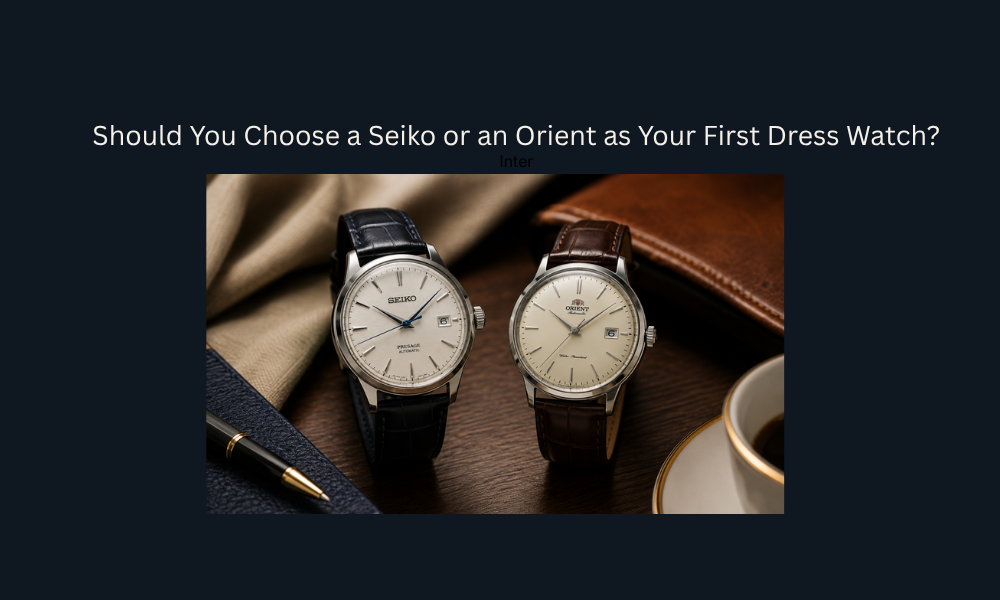
Understanding why design philosophy anchors your Seiko vs Orient Selection requires establishing how the stark contrast in dial execution and case geometry immediately separates the target audience for each brand. Analyzing entry-level Japanese aesthetics reveals two distinctly different approaches to watchmaking. Beginner formal watch design often forces a rigid path, but here, the split is clear. Seiko utilizes complex, modern textures that catch the light from every angle, acting as contemporary art for the wrist. Orient relies on classic, domed vintage simplicity, channeling pure mid-century restraint that flatters traditional suiting.
What in-house movements define your Seiko vs Orient selection
Determining what in-house movements define your Seiko vs Orient Selection involves weighing the performance, reliability, and finishing of the respective entry-level Japanese automatic calibers.
Seiko (e.g., Caliber 4R35)
Features hacking, hand-winding, and typically an exhibition case back with a decorated rotor.
Provides excellent visual appeal and interaction for beginners who want to see their mechanical engine at work.
Orient (e.g., Caliber F6724)
Upgraded to feature hacking and hand-winding, often housed behind a solid case back.
Incredibly highly durable and utilitarian workhorse that keeps costs exceptionally low without sacrificing core functionality.
Are dial aesthetics the deciding factor in your Seiko vs Orient selection
Evaluating if dial aesthetics are the deciding factor in your Seiko vs Orient Selection demands determining how complex dial textures versus domed vintage minimalism appeal to different formalwear tastes. Dress watch visual appeal hinges entirely on context. A direct formal dial comparison highlights the true differentiator between the brands:
Seiko (The Artistic Route)
Famous for intricate, light-catching textures (like the Cocktail Time series) and modern, sharp indices.
Acts as a flashy, conversation-starting statement piece that leans modern.
Orient (The Vintage Route)
Famous for pie-pan dials, Roman numerals, and aggressively domed mineral crystals (like the Bambino series).
Provides pure, historically accurate mid-century elegance that whispers rather than shouts.
Do price hierarchies impact your Seiko vs Orient selection
Analyzing how price hierarchies impact your Seiko vs Orient Selection injects commercial realism by comparing the ultra-budget Orient bracket against the slightly more premium Seiko bracket.
- If you have a strict, uncompromising budget of under $<\$200$ for your first mechanical watch
- Do immediately prioritize an Orient
- Result you secure a universally respected, in-house automatic dress watch without stretching into the $\$350-\$500$ territory currently demanded by entry-level Seikos.
Is assessing strap quality critical for your Seiko vs Orient selection
Assessing if strap quality is critical for your Seiko vs Orient Selection prevents immediate beginner disappointment by addressing the notorious shared weakness of sub-$<\$500$ Japanese watches.
How to prevent buyer’s remorse in your Seiko vs Orient selection
Preventing buyer’s remorse in your Seiko vs Orient Selection involves matching the specific brand’s “vibe” to your actual daily wardrobe to avoid buying a beautiful watch that sits unworn in a drawer.
Buying a vibrant, sunburst-textured Seiko for a highly conservative, somber corporate office.
The highly reflective dial draws massive attention, which can violate the core rule that formal watches should remain understated in traditional environments.
Buying a vintage-styled Orient with a domed crystal expecting it to survive as an “everyday beater.”
The domed mineral crystal is highly exposed to doorframes and desks; it will scratch easily if worn casually outside of formal or office settings.
If realizing the fragility of a domed crystal or the flashiness of a sunburst dial makes you hesitate, you may be reconsidering the need for a dedicated formal piece altogether. Rather than forcing a delicate dress watch into a demanding daily rotation, some collectors pivot to evaluating whether a traditional dive watch functions within formal dress codes, prioritizing a single, highly durable timepiece over specialized categories.
How to conclude your Seiko vs Orient selection with this final execution checklist
Concluding your Seiko vs Orient Selection with this final execution checklist provides a strong, execution-oriented closure that transforms the brand comparison into an actionable purchasing audit.
If you are currently deciding between two specific references from these brands, it is highly recommended to objectively compare their technical specifications side-by-side before executing this final purchasing audit.
Execution Checklist & Scoring Interpretation
- Score $5/5$: Immediate Buy. You have clearly identified the Japanese champion that perfectly fits your wrist and wallet.
- Score $3-4/5$: Pause. Identify the hesitation (e.g., you prefer the Seiko dial but only have the Orient budget) and wait before purchasing.
- Score $<3/5$: Hard Pass. Do not buy either; your budget or taste requires a Swiss watch or a sapphire crystal, meaning both Japanese entry-level options will disappoint you.
Support Appendix: Advanced Seiko vs Orient FAQ
This appendix integrates troubleshooting seamlessly into the task flow to resolve advanced beginner confusion and corporate lineage questions regarding your Seiko vs Orient Selection.
Sources & References
For further horological analysis and independent verification of the mechanical capabilities discussed in this guide, refer to the following authoritative materials:
Conclusion
By systematically evaluating the intricate dial artistry and premium positioning of Seiko against the unbeatable value and timeless vintage charm of Orient, you elevate your first major horological purchase through a precise Seiko vs Orient Selection. Both brands represent the absolute pinnacle of accessible, in-house mechanical watchmaking; your final decision simply dictates whether your wardrobe demands modern, eye-catching textures or pure, understated mid-century elegance.