
What Affects Wrist-Based Heart Rate Accuracy?
Executing a sound assessment of Wrist-Based Heart Rate Accuracy requires a structured diagnostic framework that prioritizes optical sensor physics, physiological realities, and kinetic interference over blind reliance on software algorithms. Relying on wearable biometric data without understanding the physical limitations of optical sensors leads to skewed training metrics, misdiagnosed performance issues, and severe user frustration. This guide provides the framework for systematically diagnosing optical interference, assessing physiological limitations, and utilizing a quantitative scoring checklist to ensure maximum biometric reliability.
How to define the core mechanics of your wrist-based heart rate accuracy
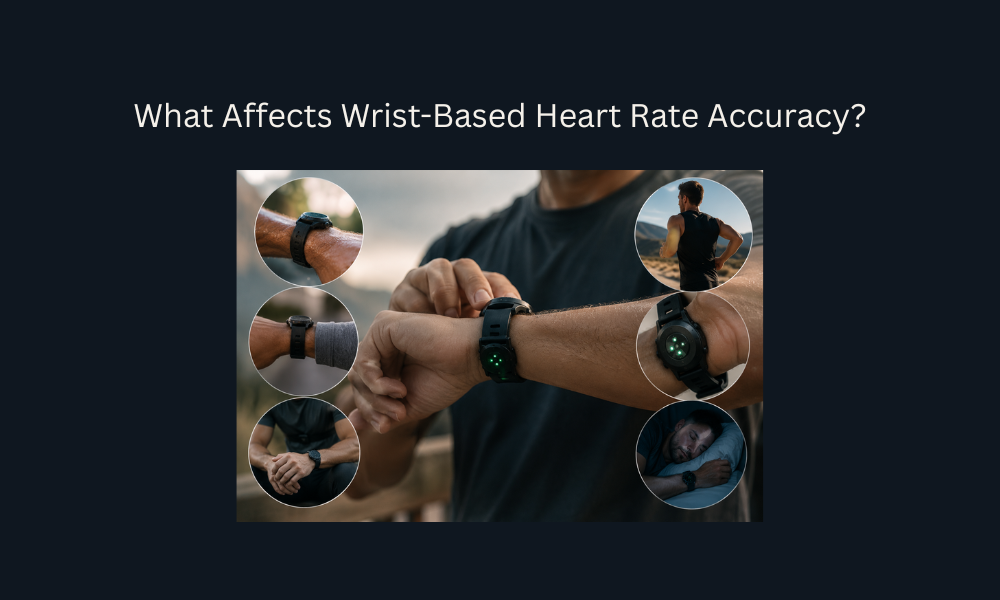
Defining the core mechanics of your Wrist-Based Heart Rate Accuracy requires establishing the foundational technology of Photoplethysmography (PPG) to explain how smartwatches use light reflection to estimate blood flow rather than directly measuring electrical heart signals.[2]
- Rule: Optical sensors measure volume, not electricity.
- Reason: The green LED lights on the back of your watch shine into the skin and measure the light bouncing back; more blood equals more absorbed light, indicating a heartbeat.
- Example: Defining your baseline as “light reflection tracking” immediately explains why anything that blocks or distorts that light will ruin your data.
Why does sensor fit anchor your wrist-based heart rate accuracy
Understanding why sensor fit anchors your Wrist-Based Heart Rate Accuracy requires establishing how the physical placement and tightness of the watch band act as the absolute foundation for reliable data collection. Optical sensor fitment dictates the validity of the entire metric system. If a strap is loose, it allows ambient sunlight to enter the sensor gap, which instantly washes out the delicate green LED signal and generates wildly inaccurate data spikes. Proper wearable monitor positioning dictates a firm seal against the skin to block out external interference.
What physiological traits limit your wrist-based heart rate accuracy
Determining what physiological traits limit your Wrist-Based Heart Rate Accuracy involves weighing the uncontrollable human elements—such as melanin levels, ink, and circulation—that inherently disrupt optical light sensors.
Skin Tone & Melanin
Darker skin tones contain more melanin, which absorbs green LED light.
→ Result: The sensor may struggle to penetrate the skin deeply enough to accurately read blood volume changes, potentially dropping beats.
Tattoos
Heavy, dark ink permanently blocks the light transmission.
→ Result: The watch will frequently fail to register a heart rate at all or produce wildly erratic spikes.
Cold Weather (Vasoconstriction)
Cold temperatures cause blood vessels near the skin’s surface to constrict.
→ Result: Reduced blood volume in the wrist makes it incredibly difficult for the sensor to detect a pulse without a proper \(10\text{-minute}\) warm-up.
Are motion artifacts critical to your wrist-based heart rate accuracy
Evaluating if motion artifacts are critical to your Wrist-Based Heart Rate Accuracy requires determining how intense, erratic movements introduce optical “noise” that the sensor cannot easily filter out. Kinetic tracking disruption is a physical reality of optical measurement. Anticipating exercise movement interference dictates how you interpret the incoming data.
Steady State Activity (Walking/Cycling)
Smooth, predictable movement.
→ Result: High accuracy; the software easily filters out the steady background noise.
High-Intensity Intervals (Sprints/CrossFit)
Violent, rapid arm swinging or heavy flexing of the wrist tendons.
→ Risk: The watch loses direct skin contact, allowing ambient light to enter the sensor and severely degrading the reading.
Do chest straps outperform your wrist-based heart rate accuracy
Analyzing if chest straps outperform your Wrist-Based Heart Rate Accuracy injects commercial and athletic realism by comparing the inherent limitations of optical wrist sensors against the medical-grade standard of electrical ECG straps.
- If you are doing heavy interval training, weightlifting, or demanding exact heart-rate-zone precision
- Do bypass the wrist sensor entirely and pair your watch with an ECG chest strap like the Polar H10
- Result you immediately capture the electrical impulses of your heart in real-time, completely eliminating the lag and motion errors of optical sensors.
The Electrical Measurement Advantage
While optical PPG sensors excel at general daily tracking by evaluating blood volume changes beneath the skin, they inherently suffer from processing lag during erratic kinetic movements. To fully diagnose performance limits, it is critical to understand the mechanical divergence between these two technologies. Chest-mounted monitors operate on an entirely different physiological diagnostic framework, detecting the immediate electrical signals generated by your myocardial contractions. This direct electrical pathway bypasses the optical noise introduced by rapid arm swings, heavy barbell grips, or extreme sprint intervals. Because electrical detection requires zero algorithmic smoothing or blood flow delay, the resulting data is virtually instantaneous. When evaluating performance metrics, this fundamental shift from estimating peripheral vascular volume to directly measuring electrical heart signals explains why chest-mounted hardware provides superior biometric precision during explosive, high-kinetic activities.
How to prevent cadence lock mistakes in your wrist-based heart rate accuracy
Preventing cadence lock mistakes in your Wrist-Based Heart Rate Accuracy involves diagnosing the most common software error in running watches, where the sensor confuses your physical footsteps with your biological heartbeat.[1]
Your heart rate suddenly spikes to \(170\text{+ BPM}\) during an easy jog, exactly matching your running cadence (steps per minute).
→ The Reality: Your watch is loose. The rhythmic bouncing of the heavy watch case on your wrist is tricking the sensor into registering the physical impacts as a heartbeat.
Move the watch a \(2\text{-finger}\) width above the wrist bone (away from the flexing joint) and tighten the strap securely so the skin moves with the watch.
How to conclude your wrist-based heart rate accuracy with this final execution checklist
Concluding your Wrist-Based Heart Rate Accuracy evaluation with this final execution checklist provides a strong, execution-oriented closure that transforms the technical variables into an actionable pre-workout audit.
Rule: A scored checklist separates reliable data from flawed optical noise.
Reason: Quantifying the watch’s fit, your environment, and your activity type guarantees you can trust your metrics.
Example: Only relying on the wrist sensor data if the fitment and activity type score perfectly for optical tracking.