
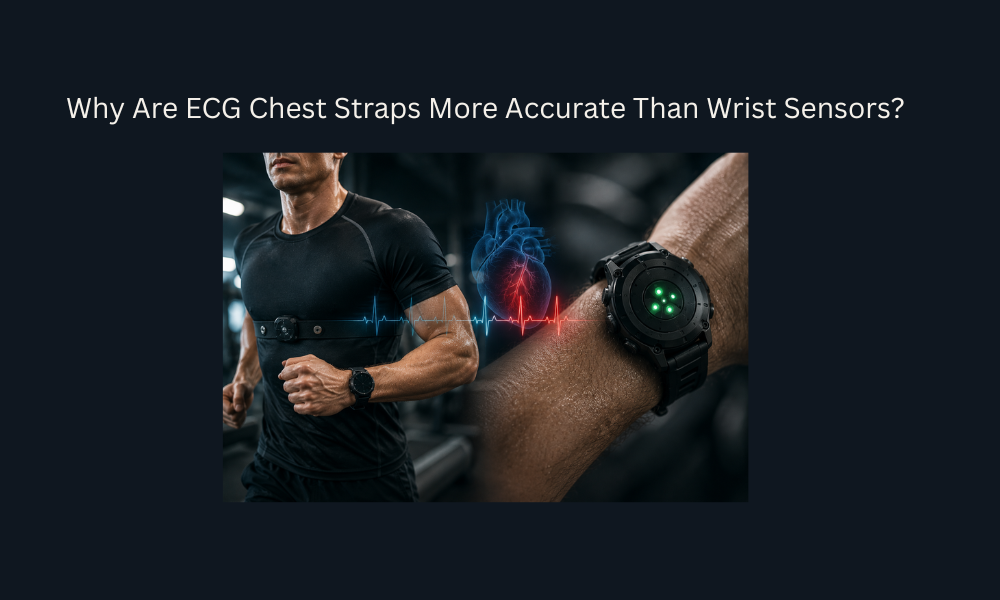
Why Are ECG Chest Straps More Accurate Than Wrist Sensors?
Executing a sound assessment of ECG Chest Strap Accuracy requires a structured diagnostic framework that prioritizes electrical signal proximity, zero-latency data collection, and physical conductivity over optical estimation. Relying on optical wrist estimation during intense training often leads to lagging metrics, missed data spikes, and skewed heart rate zone evaluations. This guide provides the framework for systematically diagnosing sensor technology differences, assessing electrical conductivity requirements, and utilizing a quantitative scoring checklist to ensure flawless biometric data collection.
How to define the core mechanics of your ECG chest strap accuracy
Defining the core mechanics of your ECG Chest Strap Accuracy establishes the foundational difference between directly measuring the electrical voltage of a heartbeat versus optically estimating blood volume.
- ▪ Rule: Direct measurement always beats estimation.
- ▪ Reason: While wrist-based heart rate accuracy relies on shining LED lights through the skin to guess blood flow changes, an electrocardiogram (ECG) chest strap acts as a clinical tool, directly reading the electrical signals that trigger the heart muscle to contract.
- ▪ Example: Defining your goal as “zero-latency data collection” perfectly frames why professional athletes rely on the electrical precision of a chest strap rather than optical wrist sensors.
Why does physical proximity anchor your ECG chest strap accuracy
Understanding why physical proximity anchors your ECG Chest Strap Accuracy establishes how placing the conductive pads directly over the sternum and heart muscle eliminates the physiological lag inherent to wrist sensors. By maintaining a Direct cardiac tracking baseline, you ensure Electrical signal proximity to the heart. This allows you to track the source of the electrical impulse rather than waiting for the physical blood volume to travel down an extremity.
What technological differences define your ECG chest strap accuracy
Determining what technological differences define your ECG Chest Strap Accuracy involves weighing the raw, unfiltered data collection of conductive polymer electrodes against the algorithm-smoothed data of optical sensors.
- › ECG Chest Strap (Electrodes): Detects the exact millivolt electrical impulse generated by the heart just milliseconds before a contraction. → Result: Captures every single heartbeat with zero delay, providing clinical-grade heart rate variability (HRV) and instantaneous data.
- › Optical Wrist Sensor (PPG): Measures the physical volume of blood pumping through the wrist capillaries. → Result: Fundamentally delayed, as it must wait for the blood to physically travel from the heart, down the arm, and into the wrist before a beat can be registered.
Are high-intensity intervals critical to your ECG chest strap accuracy
Evaluating if high-intensity intervals are critical to your ECG Chest Strap Accuracy determines how extreme, rapid spikes in heart rate expose the fatal flaws of optical wrist tracking while highlighting the absolute superiority of electrical straps. Focusing on Interval timing precision and Spike tracking reliability is essential for athletes.
- › Heavy Weightlifting / CrossFit: Involves massive wrist flexion and gripping, which pushes the watch away from the skin. → Result: Wrist sensors frequently “drop” the signal or freeze, while the chest strap remains securely locked to the torso, perfectly capturing the $160\text{+ BPM}$ spikes.
- › Sprint Intervals: Heart rate skyrockets from $100 \text{ to } 180\text{ BPM}$ in seconds. → Result: The chest strap records the spike instantly, whereas optical wrist sensors typically lag $10 \text{ to } 15\text{ seconds}$ behind the actual physical effort due to software smoothing and physiological delay.
Do smartwatch algorithms impact your ECG chest strap accuracy
Analyzing how smartwatch algorithms impact your ECG Chest Strap Accuracy injects commercial realism by explaining how connecting an external chest strap allows you to bypass the watch’s internal optical limitations.
- ▪ If you are frustrated by the lag and motion artifacts degrading your wrist-based heart rate accuracy during heavy workouts
- ▪ Do pair an external ANT+ or Bluetooth ECG chest strap directly to your smartwatch
- ▪ Result the watch automatically disables its green LEDs and algorithm, transforming its display into a pure, real-time monitor for the flawless electrical data coming from your chest.
While bypassing these internal optical algorithms is critical for high-intensity training, understanding the baseline reliability of wearable health sensors remains important for users balancing elite athletic tracking with continuous daily biometric monitoring.
Is managing moisture essential to your ECG chest strap accuracy
Assessing if managing moisture is essential to your ECG Chest Strap Accuracy prevents total sensor failure by addressing the ironic truth that while sweat ruins optical wrist sensors, ECG straps absolutely require moisture to function.
- ▪ Rule: Electricity requires a conductive medium.
- ▪ Reason: Conductive polymer pads cannot read electrical signals through dry skin and chest hair, resulting in erratic or dead readings at the beginning of a workout.
- ▪ Example: Opting to wet the electrode pads with saliva, water, or conductive electrode gel before putting the strap on to guarantee an instant, flawless electrical connection.
How to prevent connection mistakes in your ECG chest strap accuracy
Preventing connection mistakes in your ECG Chest Strap Accuracy involves matching the physical placement and maintenance of the strap to your body to avoid chafing, signal drops, and hardware corrosion.
- › The Risk: Putting the chest strap on upside down or too loosely. → The Reality: The transmitter will send inverted or dropped signals to your watch. The strap must be snug enough to prevent bouncing during running, positioned just below the pectoral muscles with the logo facing right-side up.
- › The Risk: Throwing the strap in your gym bag without detaching the transmitter “pod.” → The Reality: As long as the pod is snapped into the salty, sweaty strap, it remains active and will completely drain the coin-cell battery in a few days. Always unsnap the pod after every workout.
How to conclude your ECG chest strap accuracy with this final execution checklist
Concluding your ECG Chest Strap Accuracy with this final execution checklist provides a strong, execution-oriented closure that transforms the physiological and mechanical data into an actionable pre-workout audit.
- ▪ Rule: A scored checklist separates clinical precision from optical guesswork.
- ▪ Reason: Quantifying placement, moisture, and maintenance guarantees flawless data collection.
- ▪ Example: Only trusting your heart rate zones if the chest strap setup scores perfectly on the electrical conductivity audit.
Score $5/5$: Flawless Tracking. Your strap is perfectly primed to deliver zero-latency, clinical-grade electrical heart rate data.
Score $3-4/5$: Pause. Identify the vulnerability (e.g., you forgot to moisten the pads) and expect erratic data for the first $5\text{ minutes}$ of the workout until you start sweating.
Score $<3/5$: Signal Failure. Do not trust the data; the strap is dry, loose, or the pod battery is dead, meaning you are capturing zero electrical signals.
Support Appendix: Advanced ECG Chest Strap FAQ
This appendix integrates troubleshooting seamlessly into the task flow to resolve advanced connectivity confusion and maintenance friction regarding your ECG Chest Strap Accuracy.
Conclusion
By systematically evaluating the fundamental superiority of direct electrical tracking over optical estimation, mastering the necessity of conductive moisture, and eliminating the catastrophic motion artifacts of high-intensity intervals, you elevate your athletic data collection through uncompromising ECG Chest Strap Accuracy. Recognizing that true clinical-grade tracking requires locking a zero-latency sensor directly to your torso ensures you capture every single heartbeat perfectly, completely bypassing the frustrating physiological lag of standard wrist monitors.