
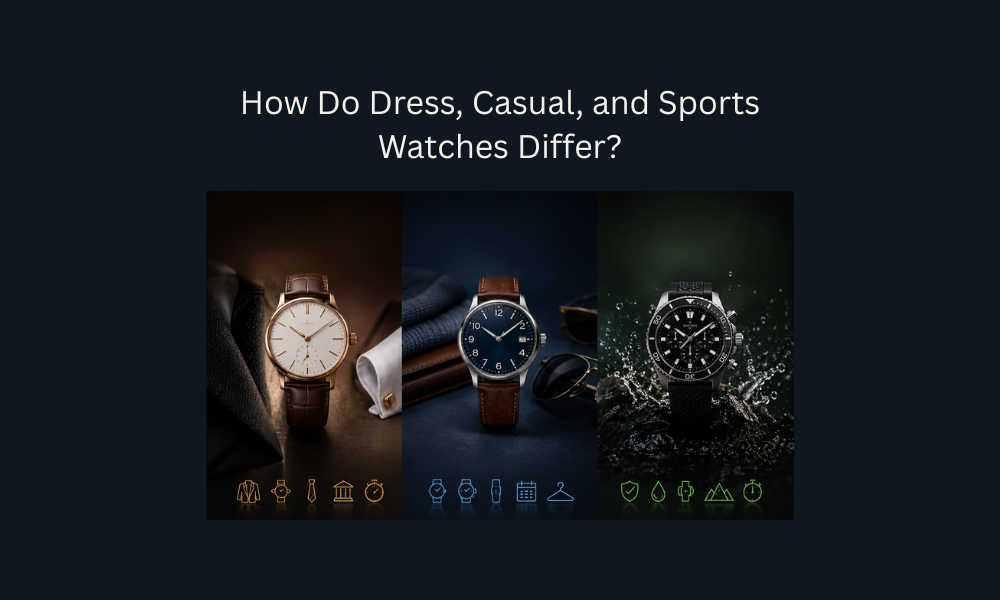
How Do Dress, Casual, and Sports Watches Differ?
Executing precise Watch Category Differentiation requires a structured evaluation framework that prioritizes physical case dimensions, environmental durability thresholds, and strict situational etiquette over impulsive aesthetic trends. Forcing a timepiece into the wrong environment without understanding its categorical limitations leads to severe stylistic clashing, ergonomic discomfort, and catastrophic mechanical damage. This guide provides the framework for systematically defining environmental archetypes, evaluating hydrostatic survival metrics, and utilizing a quantitative scoring checklist to ensure flawless situational styling.
How to define the core framework of your watch category differentiation
Defining the core framework of your Watch Category Differentiation establishes the foundational environments—formal, everyday, and extreme—that force the separation of timepieces into three distinct design philosophies.
- Rule: Form directly follows the intended environment.
- Reason: You cannot wear a fragile watch while rock climbing, just as you cannot fit a bulky dive watch under a fitted tuxedo cuff.
- Example: Defining your goal as “situational appropriateness” immediately clarifies why specific physical dimensions and materials are locked to specific watch categories.
Why does case thickness anchor your watch category differentiation
Understanding why case thickness anchors your Watch Category Differentiation requires establishing how the vertical profile of the watch serves as the fastest, most reliable metric for separating formalwear from athletic utility.
Executing a proper Timepiece profile comparison reveals that the vertical profile dictates the center of gravity on the wrist and available cuff clearance. Maintaining a strict $10\text{mm}$ thickness prevents the case from snagging on a fitted sleeve, making it a non-negotiable physical constraint during any Watch dimension analysis.
What physical dimensions perfectly fit your watch category differentiation
Determining what physical dimensions perfectly fit your Watch Category Differentiation involves mapping the specific horizontal and vertical constraints that define the strict boundaries of each watch archetype. Identifying a highly resilient GADA (Go Anywhere, Do Anything) model requires observing these strict parameters, just as evaluating a severe utility tool requires accounting for the space needed to house a heavy Sapphire crystal and a mechanical Shock absorber.
- Dress Watch: $34\text{mm}-38\text{mm}$ diameter, strictly under $10\text{mm}$ thick. → Result: Disappears under a fitted shirt cuff; prioritized for formal elegance.
- Casual/Everyday Watch: $38\text{mm}-41\text{mm}$ diameter, $10\text{mm}-12.5\text{mm}$ thick. → Result: The versatile “sweet spot” that clears casual jackets while maintaining moderate wrist presence.
- Sports/Tool Watch: $42\text{mm}+$ diameter, $13\text{mm}+$ thick. → Result: Bulky and highly legible; built specifically to house thick crystals, heavy gaskets, and shock absorbers.
Are durability thresholds critical for your watch category differentiation
Evaluating if durability thresholds are critical for your Watch Category Differentiation requires determining how water resistance and internal shock protection dictate which watch can actually survive your daily routine. Analyzing precise Timepiece survival metrics exposes the actual engineering limits of each model. Conducting an Archetype durability comparison proves that selecting a watch requires verifying hydrostatic limits, such as confirming a legitimate $200\text{m}$ water resistance rating for aquatic exposure.
- Dress Watch ($30\text{m}$ WR): Splash resistant only; highly vulnerable to blunt force. → Limitation: Strictly reserved for climate-controlled, low-impact environments (offices, galas).
- Casual Watch ($100\text{m}$ WR): Safe for swimming and rain; moderate shock resistance. → Limitation: Survives $95\%$ of daily life, but not built for extreme impact or deep-sea diving.
- Sports Watch ($200\text{m}+$ WR): Immune to water pressure; features internal shock-absorbing cages. → Advantage: The ultimate survival tool for intense physical activity and harsh elements.
While standard sports models handle surface-level athletic impact, analyzing the rigorous engineering required for professional aquatic exposure clarifies the strict boundary between a casual weekend tool and a certified submersible instrument.
Do strap materials impact your watch category differentiation
Analyzing how strap materials impact your Watch Category Differentiation injects commercial realism by evaluating how leather, steel, and rubber inherently lock a watch into a specific formality tier.
- If you are trying to determine if a watch is truly a sports watch or a casual hybrid → Do examine the factory strap options → Result a watch offered exclusively on a highly polished alligator strap is a dress watch, while one on an integrated FKM rubber strap is undeniably a sports watch.
Is assessing dial minimalism essential to your watch category differentiation
Assessing dial minimalism is essential to your Watch Category Differentiation to prevent categorization mistakes by understanding how the presence (or lack) of complications like rotating bezels and chronographs fundamentally changes the watch’s identity.
- Rule: Complexity equals casualness or sportiness.
- Reason: A traditional dress watch is “time-only” to project refined restraint, whereas a sports watch requires high-visibility scales, thick lume, and timing bezels for actual physical utility.
- Example: Recognizing that adding a dive bezel to a watch instantly permanently removes it from the “dress watch” category, regardless of its size.
How to prevent styling faux pas in your watch category differentiation
Preventing styling faux pas in your Watch Category Differentiation involves strictly matching the distinct watch archetype to your specific outfit to avoid looking socially awkward or feeling physically uncomfortable.
- The Risk: Wearing an ultra-thin, delicate gold dress watch with a t-shirt and gym shorts. → The Reality: The intense formality of the watch severely clashes with the athleisure, creating an awkward, unintentional “high-low” fashion mistake.
- The Risk: Forcing a massive $45\text{mm}$ matte-titanium sports watch into a strict corporate boardroom presentation. → The Reality: The watch will refuse to fit under your cuff, draw inappropriate visual attention, and violate traditional business etiquette.
How to conclude your watch category differentiation with this final execution checklist
Concluding your Watch Category Differentiation with this final execution checklist provides a strong, execution-oriented closure that transforms the comparative theory into an actionable daily styling audit.
- Rule: A scored checklist removes the guesswork from situational styling.
- Reason: Quantifying the dimensions, durability, and aesthetics ensures you always wear the correct tool for the environment.
- Example: Only finalizing your outfit choice if the watch category scores perfectly for the day’s planned activities.
Score $5/5$: Perfect Match. You have selected the exact watch category required for your environment and wardrobe.
Score $3-4/5$: Pause. Identify the mismatched variable (e.g., wearing a casual steel watch to a black-tie event) and consciously accept the style deviation.
Score $<3/5$: Change Watches. The watch category fundamentally clashes with your physical environment or social etiquette; swap it immediately.