
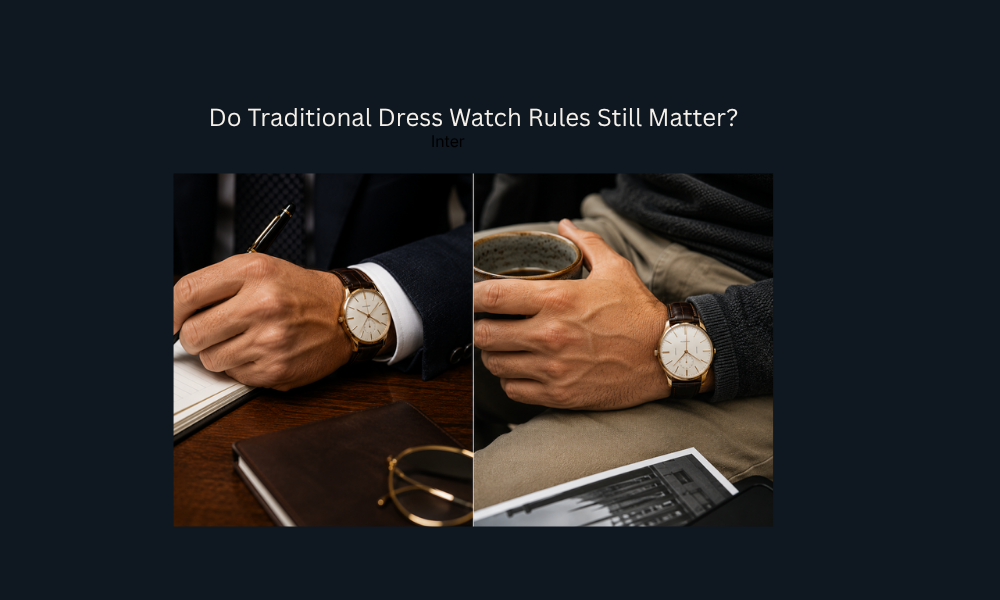
Do Traditional Dress Watch Rules Still Matter?
Executing a sound assessment of Traditional Dress Watch Rules requires a structured evaluation framework that prioritizes intentionality, historical context, and modern wardrobe integration over rigid historical dogma.
Applying outdated rules blindly or ignoring them entirely leads to awkward styling and social faux pas at formal events. This guide provides the framework for systematically evaluating historical etiquette, assessing modern wardrobe shifts, and utilizing a quantitative scoring checklist to ensure flawless formal styling.
How to define the core philosophy of your traditional dress watch rules
Defining the core philosophy of your Traditional Dress Watch Rules requires establishing the foundational mindset that understanding historical etiquette is required before you can successfully bend or break it.
Why does historical etiquette anchor your traditional dress watch rules
Understanding why historical etiquette anchors your Traditional Dress Watch Rules requires establishing the original $20\text{th}$-century baseline for formalwear (e.g., no watch at white-tie events, ultra-thin gold, black leather straps) to understand the context of modern changes.
Classic formal timepiece etiquette dictates that a watch should never pull focus from the garments. The strictest iterations of these codes, particularly at White Tie galas, mandated stark minimalism. Historic watch styling guidelines demanded small, precious metal cases without seconds hands, date windows, or glowing compounds like Super-LumiNova to ensure the dial remained purely functional yet virtually invisible. Establishing this highly restrictive historical baseline provides the contrast necessary to execute modern variations flawlessly.
What modern wardrobe shifts impact your traditional dress watch rules
Determining what modern wardrobe shifts impact your Traditional Dress Watch Rules involves weighing the strict historic rules of black-tie events against the reality of modern, relaxed business-formal and smart-casual environments.
Because these relaxed environments consistently blur the line between everyday wear and formal attire, collectors must carefully evaluate the modern relevance of a dedicated dress watch before committing to a hyper-minimalist piece.
Are strict material pairings mandatory for your traditional dress watch rules
Evaluating if strict material pairings are mandatory for your Traditional Dress Watch Rules requires determining if matching your watch strap to your shoes, and your watch case to your belt buckle/cufflinks, is still a non-negotiable styling law.
Formal accessory matching establishes cohesion within an outfit, acting as a visual anchor. Timepiece material coordination prevents jarring visual breaks across the wearer’s silhouette.
- Leather Matching (Black/Brown): Still highly relevant. → Result: Wearing a brown leather strap with black tuxedo shoes remains a glaring, visually jarring mistake that should always be avoided.
- Metal Matching (Gold/Silver): Increasingly flexible. → Result: While matching a gold watch to a gold belt buckle is ideal, mixing a steel watch with a gold wedding band is entirely acceptable in modern fashion.
Do metal bracelets violate your traditional dress watch rules
Analyzing if metal bracelets violate your Traditional Dress Watch Rules injects commercial realism by evaluating the modern acceptance of luxury integrated-bracelet sports watches in formal settings. The transition from pure leather straps to an elegant Milanese loop or a cohesive Integrated bracelet represents a shift in how society views status and dress codes.
- If you are attending a modern corporate event or standard wedding → Do feel confident wearing a slim, highly polished steel watch on a fine metal bracelet → Result you successfully bridge the gap between historic leather-strap rules and contemporary luxury trends.
Is maintaining a slim profile critical to your traditional dress watch rules
Assessing if maintaining a slim profile is critical to your Traditional Dress Watch Rules prevents physical wardrobe malfunctions by explaining why the rule regarding case thickness is the one rule that cannot be broken.
How to prevent stylistic faux pas when bending your traditional dress watch rules
Preventing stylistic faux pas when bending your Traditional Dress Watch Rules involves matching the watch’s formality level to the specific invitation to avoid looking disrespectful or out of touch.
- The Risk: Wearing an Apple Watch or smartwatch to a formal gala. → The Reality: A glowing screen breaks the aesthetic continuity of formalwear and implies you are easily distracted, which violates the core etiquette of being present.
- The Risk: Choosing an oversized ($44\text{mm}+$) watch to wear with a fitted suit. → The Reality: It draws the eye away from your face and the formalwear, dominating the outfit rather than complementing it.
How to conclude your traditional dress watch rules with this final execution checklist
Concluding your Traditional Dress Watch Rules with this final execution checklist provides a strong, execution-oriented closure that transforms the historical guidelines into an actionable, modern scoring system.
- Rule: A scored checklist ensures you bend the rules with purpose, not ignorance.
- Reason: Quantifying your outfit integration prevents embarrassing style clashes.
- Example: Only finalizing your outfit if the thickness, leather coordination, and event formality score perfectly.
Execution Checklist & Scoring Interpretation:
Support Appendix: Advanced Traditional Dress Watch Rules FAQ
Integrating troubleshooting seamlessly into the task flow resolves advanced etiquette confusion and styling friction regarding your Traditional Dress Watch Rules.
Q: Was it really a rule to never wear a watch to a formal event?
A: Yes. In traditional high-society etiquette (especially white-tie), checking the time was considered an insult to the host, implying you were bored. The “no watch” rule has largely faded, but it birthed the rule that formal watches must be hyper-minimalist to avoid drawing attention.
Q: Can a dive watch ever be worn with a tuxedo?
A: James Bond famously did it, but in the real world, it is highly discouraged. A dive watch is a thick, rugged tool that ruins the refined silhouette of a tuxedo and often fails to fit under the cuff.
Q: Do I have to wear a white dial watch for formal events?
A: Historically, white or silver dials were the strict standard for daytime and evening formal wear. Today, black, champagne, and even deep navy dials are perfectly acceptable, provided the dial itself is uncluttered.
Conclusion
By systematically evaluating the origins of formal etiquette, respecting the unbreakable physics of a fitted cuff, and understanding where modern fashion allows for flexibility, you elevate your styling from rigid conformity to mastering Traditional Dress Watch Rules. Prioritizing intentionality over strict historical dogma ensures that your timepiece serves as a sophisticated, complementary accessory that respects both the occasion and your personal style.