
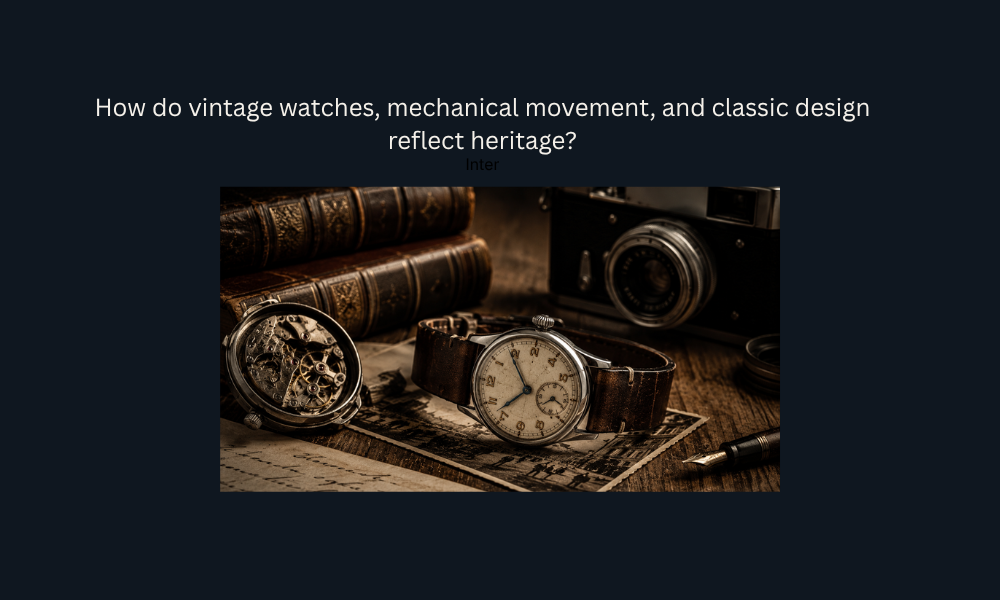
How Do Vintage Watches, Mechanical Movement, and Classic Design Reflect Heritage?
Executing a sound assessment of Vintage Watch Heritage requires a structured diagnostic framework that prioritizes unpolished originality, chronological accuracy, and matching mechanical provenance over pristine modern aesthetics. Purchasing older timepieces without evaluating serial chronologies or dial authenticity leads to acquiring worthless “franken-watches” assembled from mismatched parts. This guide provides the framework for systematically analyzing original patina, evaluating unpolished case geometry, and utilizing a quantitative scoring checklist to finalize your historical acquisition.
How to define the core appeal of your vintage watch heritage
Defining the core appeal of your Vintage Watch Heritage establishes the specific historical narrative that elevates an older timepiece from an outdated tool to a piece of wearable history.
Rule: Provenance dictates the premium.
Reason: A modern $\$500$ watch tells better time and is more waterproof than a $\$15,000$ vintage Rolex, meaning buyers are purchasing a story, not modern utility.
Example: Defining your goal as “wearing a piece of mid-century horology” immediately prioritizes original, untouched condition over perfect daily accuracy.
Why does classic design anchor your vintage watch heritage
Understanding why classic design anchors your Vintage Watch Heritage requires establishing how specific mid-century dimensions and materials capture the authentic aesthetic of a specific era. Antique timepiece history reflects a period constrained by distinct manufacturing limits, favoring understated proportions. Classic watch provenance is verified through these exact dimensions, specifically smaller case diameters ranging from $34\text{mm}$ to $38\text{mm}$. The physical footprint of mid-20th-century horology is further defined by high-domed acrylic crystals and the presence of naturally faded luminescent paint, capturing an aesthetic impossible to replicate in modern factories.
What makes a mechanical movement essential to your vintage watch heritage
Determining what makes a mechanical movement essential to your Vintage Watch Heritage involves weighing the historical significance of early horological engineering against modern technological convenience.
Vintage Movement Comparison Matrix:
- Manual-Wind Calibers: Requires daily interaction via the crown. → Result: The ultimate traditional horological connection, allowing for incredibly slim and elegant case designs.
- Early Automatic (Bumper/Rotor): The dawn of self-winding technology. → Result: Captures a specific transition in engineering history, complete with the charming, tactile “thump” of early bumper mechanisms.
Are original, unpolished parts viable for your vintage watch heritage
Evaluating if original, unpolished parts are viable for your Vintage Watch Heritage demands determining the immense financial and historical value of finding a watch exactly as it left the factory decades ago. Preserving historic timepiece originality ensures the physical record of the asset remains intact. Strict antique dial preservation isolates museum-grade specimens from ruined examples. Ensuring the long-term preservation of original specifications, including factory-correct hands and untouched bezels, directly protects the historical integrity of your investment.
Vintage Condition Evaluation Matrix:
- Original Patina (Tritium/Radium): Yellowed or darkened luminous material with natural aging. → Result: The highest tier of collector value; authenticates the watch’s survival through time.
- Polished/Service Replacement Parts: Bright white modern luminescent hands or overly rounded, shiny cases. → Risk: Destroys the “story” and slashes the secondary market value of the vintage piece by up to $50\%$.
Do period-correct straps impact your vintage watch heritage
Analyzing how period-correct straps impact your Vintage Watch Heritage injects commercial realism by evaluating how flimsy, original metal bracelets impact daily comfort versus historical accuracy.
If you want the absolute most authentic 1960s wearing experience → Do prioritize an original, period-correct folded-link or “rivet” steel bracelet → Result you accept a lighter, slightly “rattly” feel on the wrist in exchange for perfect historical cohesion.
Is assessing fragility and water resistance critical for your vintage watch heritage
Assessing fragility and water resistance is critical for your Vintage Watch Heritage to prevent catastrophic destruction by understanding that mid-century seals and alloys fail under modern pressures.
Rule: Assume a vintage watch has zero water resistance.
Reason: $50\text{-year-old}$ rubber gaskets have dried to dust, and microscopic pitting in the steel case prevents a true hermetic seal.
Example: Opting to take your vintage watch off before washing your hands, completely ignoring whatever depth rating is printed on the dial.
How to prevent “franken-watch” scams in your vintage watch heritage
Preventing “franken-watch” scams in your Vintage Watch Heritage involves strictly matching the watch’s serial numbers, dial codes, and movement stamps to verify factory originality. Because sophisticated forgeries often blend genuine and aftermarket parts, implementing a strict serial-number validation and provenance verification process is the only way to isolate authentic survivals from deceptive assemblies.
Vintage Risk Prevention Matrix:
- The Risk: Buying a vintage watch that has a flawless, brand-new looking dial but a heavily scratched case. → The Reality: The dial is likely a “redial” (repainted), completely destroying its authenticity and historical value.
- The Risk: Ignoring the movement serial number. → The Reality: If the case dates to 1965 but the movement serial dates to 1978, the watch is a “franken-watch” cobbled together from spare parts to deceive buyers.
How to conclude your vintage watch heritage with this final execution checklist
Concluding your Vintage Watch Heritage evaluation with this final execution checklist provides a strong, objective closure that transforms the historical evaluation into an actionable scoring system.
Rule: A scored checklist separates genuine historical artifacts from overpriced restoration nightmares.
Reason: Quantifying authenticity ensures you buy true heritage, not a deceptive scam.
Example: Only finalizing the purchase if the dial, case architecture, and movement serial numbers all align perfectly.
Execution Checklist & Scoring Interpretation:
- ☐ Provenance Match: The classic design and size reflect the authentic era you are targeting.
- ☐ Originality Audit: Verified the dial, hands, and bezel are original and not modern service replacements.
- ☐ Case Geometry Check: Confirmed the case has not been over-polished (factory chamfers and thick lugs remain).
- ☐ Movement Verification: The caliber and serial numbers correctly match the production year of the case.
- ☐ Fragility Acceptance: Accepted the lack of water resistance and modern shock protection.
Score $5/5$: Immediate Buy. The watch is an authentic, cohesive piece of horological history.
Score $3-4/5$: Pause. Identify the historical vulnerability (e.g., service replacement hands) and consciously accept the value tradeoff before buying.
Score $<3/5$: Hard Pass. Do not buy; the watch is a “franken-watch” or has been severely over-polished, destroying its heritage value.
Support Appendix: Advanced Vintage Watch Troubleshooting & FAQ
FAQ Mini-Matrix:
- Q: What is a “Tropical Dial”? * A: It is a collector term for a black dial that has faded over decades due to UV exposure and manufacturing chemical flaws into a rich, even brown color. True tropical dials are incredibly rare and command massive price premiums. This authentic surface evolution serves as a value-enhancing age indicator that cannot be replicated synthetically.
- Q: Why do collectors hate polished vintage watches? * A: Polishing removes microscopic layers of metal. Aggressive polishing rounds off the sharp, factory-cut edges (chamfers) of the case, permanently altering the original designer’s intended architecture and removing the watch’s authentic “scars” of history.
- Q: How accurate should I expect a $50\text{-year-old}$ mechanical watch to be? * A: Even after a full service by a master watchmaker, you should expect looser tolerances than modern watches. A variance of $\pm 15\text{ s/d}$ to $30\text{ s/d}$ is generally considered excellent for a vintage piece from the mid-century.
References & Citations
- Chronosphera: Types of Watches: Vintage Watches
- Millar Watches: Why Classic Designs Are Timeless in Modern Watches
Conclusion
By systematically evaluating original patina, unpolished case geometry, and matching period-correct movements, you elevate your purchase from a risky gamble to a masterclass in Vintage Watch Heritage. Prioritizing absolute authenticity over pristine perfection—while aggressively mitigating the risks of water damage and “franken-watch” scams—ensures your timepiece serves as a genuine, preserved artifact from horology’s golden era.