
What Do Watch Enthusiasts Consider a True Dress Watch?
Executing a sound assessment of a True Dress Watch Definition requires a structured evaluation framework that prioritizes elegant restraint, ultra-slim case profiles, and historical dial purity over utilitarian functionality. Confusing a versatile, metallic sports watch with a dedicated formal piece breaks strict styling rules and compromises formal attire. This guide provides the framework for systematically evaluating case thickness, dial purity, and material coordination, utilizing a quantitative scoring checklist to finalize your formal acquisition.
How to define the core horological philosophy of a true dress watch definition
Defining the core horological philosophy of a True Dress Watch Definition establishes the purist foundational mindset that a formal timepiece must prioritize elegant restraint over utilitarian functionality.
- Rule: Restraint is the ultimate sophistication.
- Reason: In purist horology, checking the time at a formal event is a faux pas; therefore, the watch must be so subtle it practically disappears until needed.
- Example: Defining your baseline as a “time-only, ultra-thin instrument” immediately separates a true dress watch from an everyday sports watch.
Why does absolute minimalism anchor a true dress watch definition
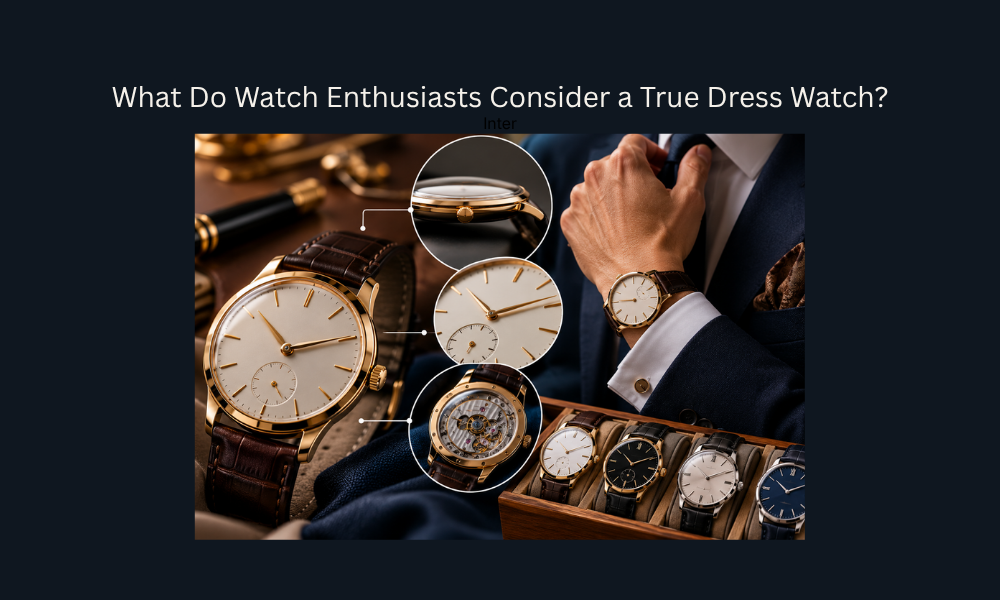
Understanding why absolute minimalism anchors a True Dress Watch Definition requires establishing how the strict elimination of complications creates the visual purity required by collectors. Meeting purist timepiece criteria demands an uncluttered aesthetic. Rejecting date windows, chronographs, and thick bezels ensures the dial remains an uninterrupted canvas of elegance. A time-only dial serves as the formal horology baseline, often utilizing slender baton markers or delicate Roman numerals rather than bulky Arabic digits. This strict adherence to minimalism guarantees the piece commands respect through subtlety rather than loud complexity.
What physical dimensions satisfy a true dress watch definition
Determining what physical dimensions satisfy a True Dress Watch Definition involves weighing the historical and ergonomic necessity of an ultra-slim case profile and a restrained diameter against modern oversized trends.
- Thickness (Under $8\text{mm}$): The non-negotiable physical requirement. → Result: The watch effortlessly slides completely under a tightly buttoned French cuff without snagging or ruining the drape of the suit.
- Diameter ($34\text{mm}$ to $38\text{mm}$): Historically accurate sizing. → Result: Ensures the watch remains subservient to the wrist, avoiding the vulgarity of a large “dinner plate” dial at a black-tie event.
Are specific dial layouts mandatory for a true dress watch definition
Evaluating if specific dial layouts are mandatory for a True Dress Watch Definition requires determining the enthusiast consensus regarding hour markers and the presence of a sweeping seconds hand. To meet strict formal aesthetic requirements, collectors execute a traditional dial layout selection that restricts motion.
- Two-Hand Layout (No Seconds): The absolute purist standard. → Result: Creates a completely “still” dial, reflecting the traditional etiquette that tracking exact seconds implies you are rushing or bored.
- Small Seconds (Sub-dial at $6\text{ o’clock}$): A historically accepted compromise. → Result: Adds subtle visual interest while maintaining the traditional aesthetic of early 20th-century watchmaking.
Do materials and strap choices impact a true dress watch definition
Analyzing how materials and strap choices impact a True Dress Watch Definition injects commercial realism by evaluating the strict traditional rules surrounding precious metals and leather bands.
If you are adhering strictly to the purist definition of formal horology → Do prioritize an $18\text{k}$ gold or platinum case mounted on an unpadded black alligator leather strap → Result you completely avoid the sporty, utilitarian associations of stainless steel and metal bracelets.
Is assessing durability irrelevance critical to a true dress watch definition
Assessing durability irrelevance is critical to a True Dress Watch Definition to prevent categorization mistakes by explaining why features like high water resistance actually disqualify a formal piece.
- Rule: Utilitarian durability compromises elegance.
- Reason: Adding $100\text{m}$ of water resistance requires thicker glass and bulky gaskets, destroying the ultra-thin profile.
- Example: Opting to accept a mere $30\text{m}$ of splash resistance, knowing the watch is built for ballrooms, not beaches.
How to prevent category blurring in a true dress watch definition
Preventing category blurring in a True Dress Watch Definition involves strictly mitigating the common error of confusing a versatile everyday watch with a dedicated formal piece.
- The Risk: Assuming a Rolex Datejust on a Jubilee bracelet is a “true” dress watch. → The Reality: While highly versatile and acceptable in business, a Datejust is fundamentally a sports watch (oyster case, luminous hands, metal bracelet) and fails the purist test for black-tie.
- The Risk: Buying a $42\text{mm}$ watch simply because it has Roman numerals and a leather strap. → The Reality: The massive diameter breaks the proportional rules of formal wear; a true dress watch must be understated in size.
How to conclude a true dress watch definition with this final execution checklist
Concluding a True Dress Watch Definition with this final execution checklist provides a strong, execution-oriented closure that transforms horological theory into an actionable collection audit.
- Rule: A scored checklist separates actual formal instruments from casual hybrids.
- Reason: Quantifying dimensions and minimalism ensures you acquire a historically accurate timepiece.
- Example: Only applying the “dress watch” label to your piece if the thickness, lack of lume, and dial purity score perfectly.
Horological Audit Checklist
- Score $5/5$: True Dress Watch. The piece perfectly embodies the purist definition of elegant horology.
- Score $3-4/5$: Versatile Hybrid. The piece has formal elements but includes sports features (e.g., steel case, date window); it is an “everyday” watch.
- Score $<3/5$: Sports Watch. Do not classify it as a dress watch; it is fundamentally a tool or sports watch.
Support Appendix: Advanced True Dress Watch Definition FAQ
This appendix integrates troubleshooting seamlessly into the task flow to resolve advanced collector confusion and modern styling friction regarding a True Dress Watch Definition.
- Q: Can a stainless steel watch ever be considered a true dress watch? A: Purists argue that only precious metals (gold, platinum) qualify. However, modern enthusiasts generally accept highly polished, ultra-thin stainless steel watches (like the Jaeger-LeCoultre Master Ultra Thin) as true dress watches, provided the dial and strap meet all other minimal criteria.
- Q: Why is luminous paint (lume) forbidden on a true dress watch? A: Lume is a functional tool designed for diving, aviation, or tactical environments. In traditional formal settings with adequate lighting, glowing hands are considered a distracting, utilitarian eyesore that ruins the refined polish of the hands.
- Q: Is it true you shouldn’t wear a watch at all with a tuxedo? A: Historically, yes. Traditional high-society etiquette dictates that wearing a watch to a strict “White Tie” event implies you are concerned about the time and, therefore, bored. If you must check the time, a hidden pocket watch is the traditional loophole. For modern “Black Tie,” a true, ultra-thin dress watch is now universally accepted. This transition from strict pocket-watch tradition to wrist-worn acceptance highlights how shifting style conventions continue to redefine formal etiquette.
Conclusion
By systematically evaluating the strict purist requirements of ultra-slim case profiles, absolute dial minimalism, and the intentional rejection of sporty utilitarian features, you elevate your understanding to master a True Dress Watch Definition. Recognizing that a genuine formal timepiece is designed to complement fitted formalwear through quiet, unobtrusive sophistication ensures that when the black-tie invitation arrives, your wrist projects authentic horological elegance.