
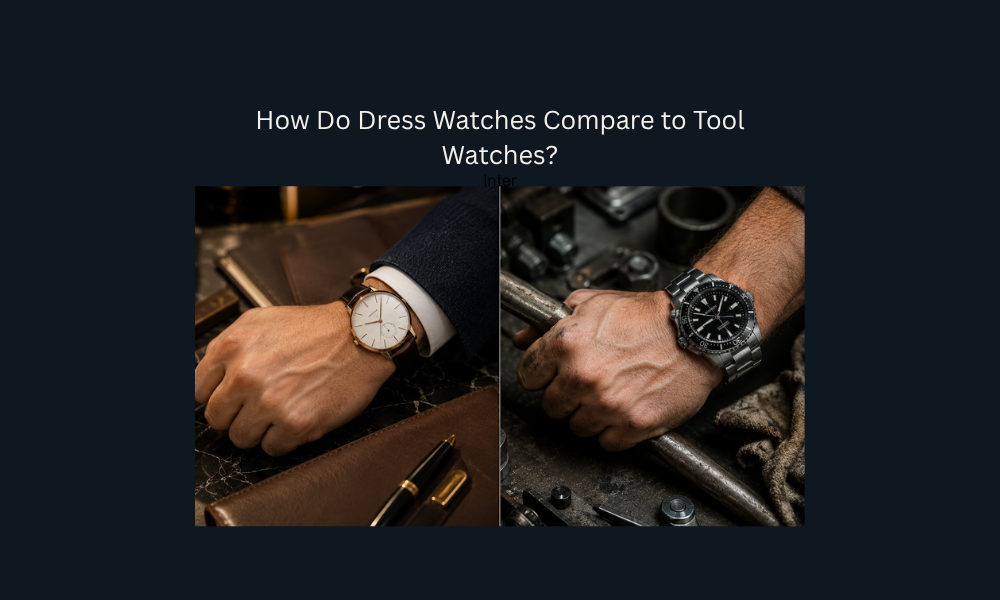
How Do Dress Watches Compare to Tool Watches?
Executing a sound Dress vs. Tool Watch Comparison requires a structured evaluation framework that prioritizes ergonomic proportions, durability thresholds, and wardrobe versatility over impulsive aesthetic trends.
Purchasing timepieces without understanding categorical limitations leads to severe buyer’s remorse and unworn watches that physically or socially clash with the wearer’s daily life. This guide provides the framework for systematically comparing core horological archetypes, assessing functional durability, and utilizing a quantitative scoring checklist to finalize your category selection.
How to define the core philosophy of your dress vs. tool watch comparison
Defining the core philosophy of your Dress vs. Tool Watch Comparison establishes the fundamental difference in purpose between refined formal understatement and raw, mission-driven utility.
Why historical purpose anchors your dress vs. tool watch comparison
Understanding why historical purpose anchors your Dress vs. Tool Watch Comparison requires establishing how historical contexts dictate the visual language of both watch categories. Executing a formal vs. utilitarian timepiece evaluation means acknowledging the distinct heritages that shaped these instruments.
Mid-century black-tie galas defined the slim, unadorned dress watch, requiring a piece that communicated elegance through minimalism. Conversely, an elegant vs. functional watch selection forces you to recognize that military aviation and deep-sea diving defined the highly legible, bezel-driven tool watch, creating an instrument where survival dictated the design.
What physical dimensions differentiate your dress vs. tool watch comparison
Determining what physical dimensions differentiate your Dress vs. Tool Watch Comparison involves weighing the ergonomic comfort of ultra-thin formal cases against the highly durable, highly legible presence of professional tool instruments.
Dress Watch ($34\text{mm} – 39\text{mm}$):
Typically under $10\text{mm}$ thick with a minimalist, unadorned dial and bezel.
Tool Watch ($40\text{mm} – 46\text{mm}+$):
Typically over $12\text{mm}$ thick to house shock absorbers, thick sapphire crystals, and functional rotating bezels.
Are durability thresholds critical for your dress vs. tool watch comparison
Evaluating if durability thresholds are critical for your Dress vs. Tool Watch Comparison requires determining your actual need for high-end water resistance, shock protection, and anti-magnetic shielding.
Executing a precise timepiece category comparison clarifies exactly what physical abuse your watch can withstand. This refined versus instrument watch evaluation hinges on the following engineering limits:
Tool Watch (High Durability):
$200\text{m}+$ water resistance, screw-down crowns, crown guards, anti-magnetic cages, and matte finishes.
Dress Watch (Low Durability):
$30\text{m}$ water resistance, push-pull crowns, highly polished soft metals (e.g., $18\text{k}$ gold).
Do wardrobe requirements impact your dress vs. tool watch comparison
Analyzing how wardrobe requirements impact your Dress vs. Tool Watch Comparison injects commercial realism by evaluating how leather straps versus steel bracelets or NATO straps alter the formality of the timepiece.
- If you wear a fitted suit or tuxedo to work or events
- Do prioritize a slim dress watch on a black or brown alligator leather strap
- Result you respect traditional formal etiquette and maintain the cohesive, elegant silhouette of your outfit.
How to prevent situational faux pas in your dress vs. tool watch comparison
Preventing situational faux pas in your Dress vs. Tool Watch Comparison involves matching the watch category’s specific limitations to your actual social and physical environments to avoid fashion mistakes or catastrophic damage.
Conclude your dress vs. tool watch comparison by verifying this final checklist
Concluding your Dress vs. Tool Watch Comparison requires verifying this final checklist to provide a strong, execution-oriented closure that transforms the comparative data into an actionable scoring system for your purchase.
Execution Checklist & Scoring Interpretation
Support Appendix: Advanced Dress vs. Tool Watch Troubleshooting & FAQ
This appendix integrates troubleshooting seamlessly into the task flow to resolve advanced category confusion and buying friction regarding your Dress vs. Tool Watch Comparison.
Q: Can a tool watch be worn as a dress watch?
A: It depends on the specific design. A massive, colorful saturation diver cannot. However, a refined, medium-sized tool watch with a smooth steel bezel (like a Rolex Explorer) often bridges the gap and passes in business-formal environments, functioning as a GADA (Go Anywhere, Do Anything) piece. For individuals hoping to avoid purchasing multiple specialized timepieces, finding a design that masterfully balances formal elegance with rugged durability can ultimately serve as a highly adaptable one-watch solution.
Q: Why are dress watches usually more expensive than entry-level tool watches despite doing less?
A: Dress watches frequently utilize precious metals (gold, platinum) and highly decorated, hand-finished mechanical movements. You are paying for haute horlogerie artistry and material rarity, not highly durable utilitarian functionality.
Q: What exactly defines a “Tool Watch”?
A: A tool watch is an instrument built for a specific job—such as diving, flying, or timing races. It prioritizes extreme legibility, durability, and specific complications (like rotating bezels or chronographs) over aesthetic decoration.
Conclusion
By systematically evaluating the vast differences in physical dimensions, durability thresholds, and aesthetic heritage, you elevate your purchase from guesswork to a strategic Dress vs. Tool Watch Comparison. Prioritizing the category that genuinely reflects your daily routine—while respecting the inherent limitations of both formal and highly durable tool timepieces—ensures you select an instrument that provides maximum daily utility and unwavering wearing satisfaction.