
Which Strap Materials Work Best for Everyday Wear?
Executing a precise Everyday Strap Material Selection requires a structured diagnostic framework that prioritizes climate adaptability, ergonomic comfort, and material science over impulsive aesthetic trends. Purchasing timepieces or straps without evaluating environmental exposure and sweat resilience leads to severe physical discomfort, foul odors, and unworn watches. This guide provides the framework for systematically evaluating composite strap materials, assessing climate risks, and utilizing a quantitative scoring checklist to finalize your daily wearability selection. Rigid criteria ensure the hardware serves the human.
How to define the core framework of your everyday strap material selection
Defining the core framework of your Everyday Strap Material Selection establishes the foundational truth that the strap dictates the comfort, utility, and visual versatility of a daily wearer far more than the watch head itself.
- Rule: Comfort dictates wrist time.
- Reason: A heavy steel watch head can feel weightless on a perfectly balanced strap, but a lightweight watch on a stiff, sweaty strap will be left in a drawer.
- Example: Defining your goal as “all-day ergonomic comfort” perfectly frames why selecting a material suited to your climate is critical.
Why does lifestyle environment anchor your everyday strap material selection
Understanding why lifestyle environment anchors your Everyday Strap Material Selection requires establishing how your daily climate, humidity levels, and physical activity dictate the baseline physical material required. Your daily watch band choice hinges entirely on accurate environmental diagnostics. Executing a versatile strap evaluation guarantees that an analytical assessment of heat and sweat exposure prevents the acquisition of porous materials for active environments.
What specific materials perfectly fit your everyday strap material selection
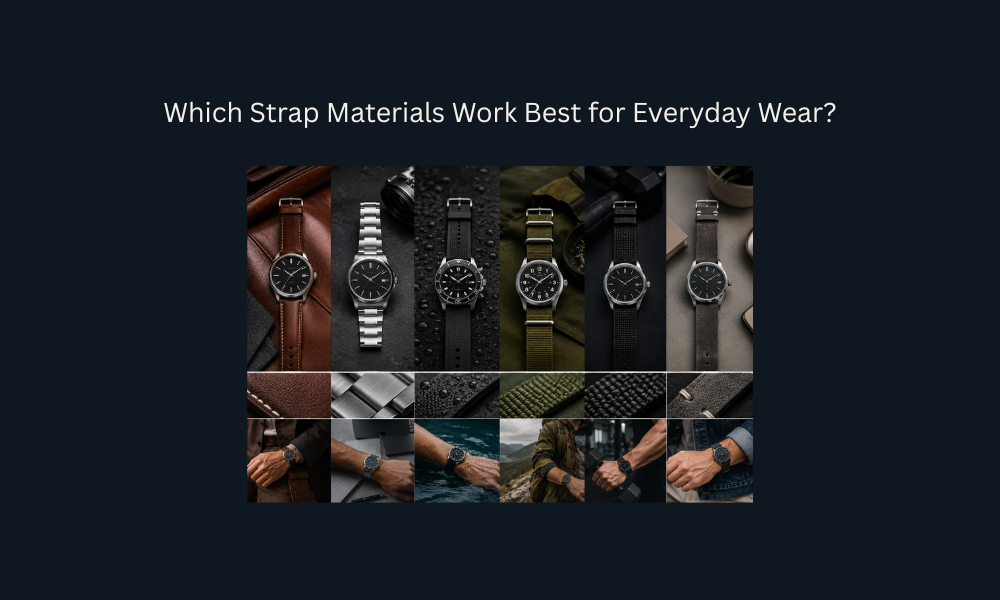
Determining what specific materials perfectly fit your Everyday Strap Material Selection involves weighing the breathability, durability, and weight of the three core casual strap materials against daily abuse.
- FKM (Fluoroelastomer) Rubber: Highly flexible, completely waterproof, and resistant to chemicals/UV rays. → Result: The ultimate active daily material; does not attract dust like cheap silicone and survives extreme humidity.
- Nylon (NATO / Marine Nationale): Woven fabric that is ultra-lightweight and breathable. → Result: Provides extreme security (NATO strap) or perfect dynamic tension (elastic Marine Nationale) for supreme ergonomic comfort.
- Stainless Steel Bracelet: Heavy, classic, and highly durable. → Result: The standard for Go Anywhere, Do Anything (GADA) versatility, though it requires a Micro-adjustment clasp to combat wrist swelling.
Material Performance Matrix
FKM Rubber
Nylon (NATO)
Steel Bracelet
Are leather options viable in your everyday strap material selection
Evaluating if leather options are viable in your Everyday Strap Material Selection requires determining the physical limitations of traditional leather when forced into daily, high-moisture wear, and evaluating modern hybrid solutions. Proper assessment of daily leather band viability shields the wearer from catastrophic everyday watch strap compromises.
- Standard Calfskin/Alligator: Dressy, elegant, and porous. → Risk: Rapidly degrades, stains, and absorbs foul odors if exposed to daily sweat, rain, or high humidity.
- Textured/Pebbled Leather: Hides physical wear and tear better than smooth leather. → Result: A decent smart-casual option strictly for climate-controlled office environments.
- Hybrid Sailcloth/Leather: A premium leather or Hybrid sailcloth top layer permanently bonded to a channeled FKM rubber inner lining. → Result: The ultimate everyday compromise, offering a refined aesthetic to the outside world with waterproof, sweat-wicking performance against the skin.
Hybrid Architecture Analysis
Do hardware components impact your everyday strap material selection
Analyzing how hardware components impact your Everyday Strap Material Selection injects commercial realism by evaluating how spring bars and buckles affect your ability to actually utilize different materials.
- If you frequently change your outfit and want to swap straps to match your environment → Do prioritize straps equipped with built-in Quick-release spring bars → Result you can seamlessly change from a steel bracelet for the office to a breathable rubber strap for the gym in $10\text{ seconds}$ without using tools or scratching your watch lugs.
Is assessing maintenance and hygiene critical for your everyday strap material selection
Assessing if maintenance and hygiene are critical for your Everyday Strap Material Selection prevents skin irritation and material degradation by outlining the cleaning requirements of daily-worn straps.
- Rule: Porous materials require strict hygiene routines.
- Reason: A daily-worn NATO or canvas strap acts like a sponge for dead skin and sweat, which will eventually smell and cause Contact dermatitis if ignored.
- Example: Opting to throw your nylon straps into a delicates laundry bag weekly, or strictly wearing FKM rubber if you prefer a zero-maintenance wipe-down.
How to prevent seasonal mismatch mistakes in your everyday strap material selection
Preventing seasonal mismatch mistakes in your Everyday Strap Material Selection involves matching the strap material to the time of year to avoid severe wrist fatigue, swelling, or aesthetic clashing.
- The Risk: Wearing a thick, unventilated leather strap in the peak of summer humidity. → The Reality: The leather will become a swampy, uncomfortable mess that rapidly deteriorates and smells. Always swap to rubber or mesh steel in the summer.
- The Risk: Wearing a heavy steel bracelet in freezing winter without an “on-the-fly” Micro-adjustment clasp. → The Reality: Your wrist naturally shrinks in the cold, causing the heavy steel watch head to slide uncomfortably down to your hand, creating severe friction.
Seasonal Risk Diagnostics
Summer Peak
High Humidity / Sweat
FKM Rubber / Nylon
Winter Freeze
Wrist Contraction (Cold)
Micro-adjust Clasp / Leather
How to conclude your everyday strap material selection with this final execution checklist
Concluding your Everyday Strap Material Selection with this final execution checklist provides a strong, execution-oriented closure that transforms the material evaluations into an actionable daily styling audit.
- Rule: A scored checklist separates aesthetic desire from physical comfort.
- Reason: Quantifying climate, formality, and maintenance ensures the watch actually stays on your wrist.
- Example: Only finalizing your strap choice for the day if the material scores perfectly against your planned activities.
Execution Checklist & Scoring Interpretation
Score $5/5$: Immediate Wear. The strap material flawlessly integrates into your daily environment, providing ultimate comfort.
Score $3-4/5$: Pause. Identify the mismatched variable (e.g., wearing leather on a highly active day) and consciously accept the risk of degrading the strap.
Score $<3/5$: Change the Strap. The material fundamentally clashes with your climate or activity level and will cause severe physical discomfort.
If your current band consistently yields a failing diagnostic score, the baseline material must be replaced. Rather than enduring ongoing physical friction, transitioning to a highly accurate personalized strap selection ensures your next acquisition is mathematically aligned with your specific climate exposure, physical activity level, and skin sensitivity requirements.
Support Appendix: Advanced Everyday Strap FAQ
This appendix integrates troubleshooting seamlessly into the task flow to resolve advanced material confusion and ergonomic friction regarding your Everyday Strap Material Selection.
Q: What is FKM rubber and why is it more expensive than silicone?
A: FKM (Fluoroelastomer) is a dense, premium, highly engineered synthetic rubber. Unlike cheap silicone, FKM is highly resistant to heat, UV rays, and chemicals. More importantly, it does not act like a magnet for lint and dust, keeping the strap looking pristine all day.
Q: How tight should my everyday watch strap be?
A: The general rule of thumb for ergonomic comfort is that you should be able to slide your pinky finger snugly between the strap and the underside of your wrist. If it leaves red marks, it is too tight and restricts blood flow; if the watch head flops over your wrist bone, it is too loose.
Q: Can I wear a NATO strap to the office?
A: It depends on your office dress code. For business professional environments, a fabric NATO strap is traditionally too casual and sporty. However, in modern business-casual settings, a high-quality “seatbelt” weave NATO in a subdued, solid color (like navy, black, or olive) is perfectly acceptable.