
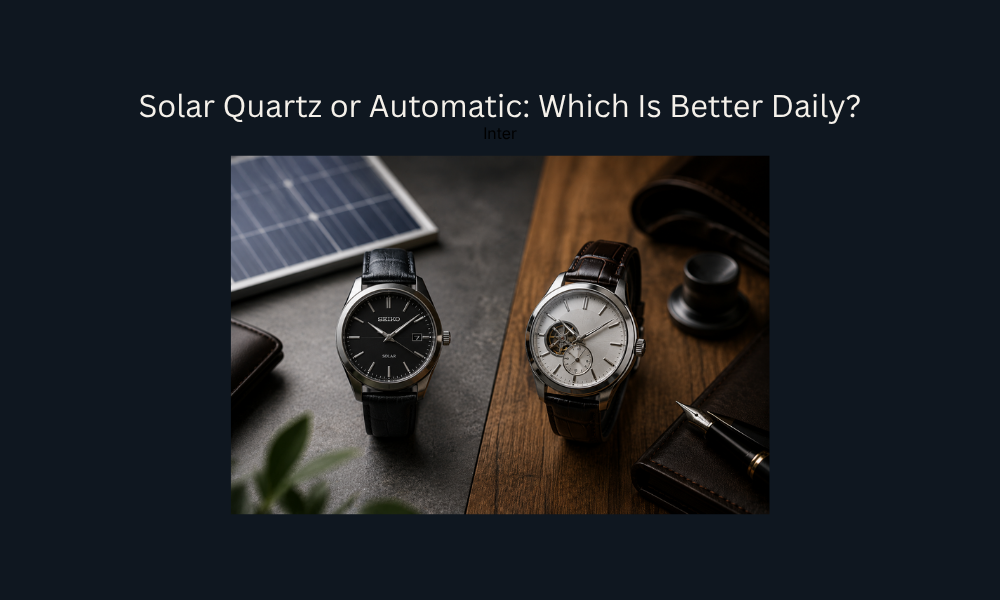
Solar Quartz or Automatic: Which Is Better Daily?
Executing a sound Daily Movement Selection requires a structured evaluation framework that prioritizes long-term maintenance tolerance, mechanical precision, and actual daily wearing habits over marketing hype. Purchasing timepieces without understanding the underlying engine technology leads to acquiring high-maintenance burdens or uninspiring tools that fail to match the user’s operational needs. This guide provides the framework for systematically comparing power reserves, assessing maintenance economics, and utilizing a quantitative scoring checklist to finalize your daily engine selection.
How to define the core framework of your daily movement selection
Defining the core framework of your Daily Movement Selection establishes the foundational difference in ownership philosophy between absolute convenience and traditional mechanical interaction.
The engine must match the operator.
A watch that requires constant winding and resetting will annoy a highly pragmatic user, while a “soulless” battery watch will bore a true enthusiast.
Defining your goal as “grab-and-go reliability” perfectly frames why a solar quartz movement defeats a mechanical caliber for a specific type of daily wearer.
Why does maintenance tolerance anchor your daily movement selection
Understanding why maintenance tolerance anchors your Daily Movement Selection requires establishing how your willingness to actively interact with the timepiece dictates the required underlying technology. As you establish an everyday caliber baseline, you must determine your threshold for mechanical engagement. A daily engine evaluation reveals that constant interaction—such as manually winding a mainspring, setting the exact time after a weekend of disuse, and advancing the date wheel after shorter months—heavily impacts the user experience. A purely mechanical engine demands this regular input. A solar-powered circuit bypasses these requirements entirely, providing uninterrupted timekeeping that directly accommodates a hands-off ownership philosophy.
What specific performance metrics define your daily movement selection
Determining what specific performance metrics define your Daily Movement Selection involves weighing the absolute accuracy and massive power reserves of light-powered electronics against spring-driven mechanical gears.
Solar Quartz
Powered by ambient light, highly accurate ($± 15\text{ seconds}$ per month).
→ Result: The ultimate zero-maintenance daily driver, boasting up to a $6\text{-month}$ power reserve in total darkness.
Automatic Mechanical
Powered by the physical kinetic motion of your wrist, acceptable accuracy ($± 10\text{ seconds}$ per day).
→ Result: Requires active daily wear (or a watch winder) to prevent the $40\text{-hour}$ power reserve from depleting over the weekend.
Are aesthetic priorities viable in your daily movement selection
Evaluating if aesthetic priorities are viable in your Daily Movement Selection demands determining how the visual experience impacts enthusiast satisfaction. A thorough caliber aesthetic selection defines the horological visual appeal you expect when checking the time.
Do long-term repair costs impact your daily movement selection
Analyzing how long-term repair costs impact your Daily Movement Selection injects commercial realism by comparing the financial realities of maintaining a mechanical gear train versus a solid-state capacitor.
you want a watch that will run perfectly for $15+\text{ years}$ with zero required financial investment
prioritize a solar quartz movement
you completely avoid the $\$200-\$500$ routine service fee required every $5\text{ to }7\text{ years}$ to disassemble, clean, and lubricate an automatic movement.
Resolving the engine maintenance budget dictates how remaining capital is allocated across the timepiece. Identifying which practical watch specifications extend the lifespan of the case and bracelet ensures the exterior chassis matches the mechanical resilience of your chosen movement.
Citations & References
Conclusion
By systematically evaluating the precision and indestructible convenience of solar technology against the sweeping aesthetic and heritage of mechanical gears, you elevate your purchase from guesswork to a masterclass in Daily Movement Selection. Recognizing that the “best” movement is entirely dictated by your willingness to interact with the timepiece ensures that your everyday watch serves as a reliable, satisfying companion rather than a high-maintenance burden.