

Who Created the First Pilot Watch and Why?
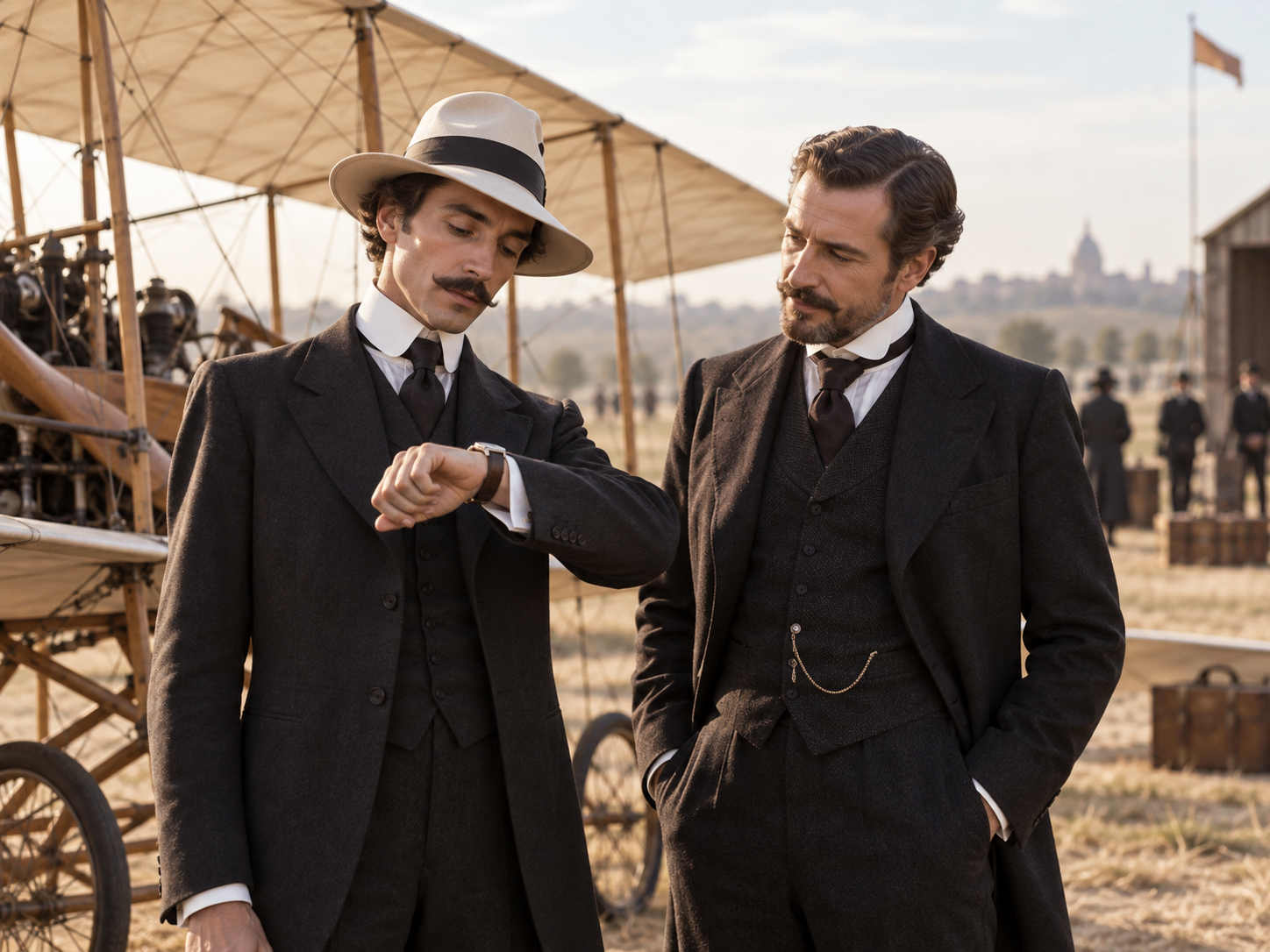
The widely cited first purpose-built pilot’s wristwatch was created in 1904 through a collaboration between Louis Cartier and pioneering Brazilian aviator Alberto Santos-Dumont.
The watch was born from an operational problem rather than a fashion experiment.
Santos-Dumont needed to check the time while flying without reaching into a pocket and taking attention away from unstable early aircraft controls. He discussed the problem with his friend Louis Cartier, who responded by creating a wrist-mounted timepiece that could remain visible during flight.
That bespoke watch later became known as the Cartier Santos.
Its historical importance is specific.
It was not the first wristwatch ever made. Wrist-worn timepieces existed earlier. Instead, the Santos is widely cited as the first wristwatch purpose-built around the practical requirements of an aviator.
Its significance came from solving four connected problems:
- keeping the timepiece continuously accessible,
- reducing the need to remove a hand from the controls,
- making the dial easy to read at a glance,
- and securely integrating the watch with a wrist strap.
The story of the first pilot watch is therefore the story of how a practical aviation problem helped accelerate the transition from pocket-carried timekeeping to wrist-mounted timekeeping.
Why Early Aviation Necessitated the First Pilot Watch
The first pilot watch emerged because early aviation placed demands on timekeeping that the traditional pocket watch did not handle efficiently.
Pilots did not simply need an accurate watch.
They needed a watch they could check without interrupting the physical task of controlling an aircraft.
Why early aviators needed to keep their hands continuously on the flight controls
Early flying machines were demanding to operate.
Aircraft and dirigibles from the first years of powered aviation lacked the stability, automation, and ergonomic control systems associated with later aircraft.
The pilot had to remain actively involved in maintaining direction and control.
Small corrections could matter.
Attention mattered as much as physical hand position.
That made any secondary task more disruptive.
Checking the time with a pocket watch could require the pilot to look away, move an arm, reach into clothing, and manipulate the watch before returning attention to the aircraft.
On the ground, those actions were trivial.
In an unstable early flying machine, they represented an unnecessary interruption.
The problem was therefore not simply that a pocket watch was inconvenient.
The deeper issue was that pocket-carried timekeeping conflicted with the continuous physical attention required by early aviation.
How retrieving traditional pocket watches interrupted crucial flight operations
The pocket watch was designed for a different environment.
It normally sat inside a vest, jacket, or coat pocket and was often connected to clothing by a chain.
To check it, the user had to:
- locate the watch,
- reach into the pocket,
- pull it free,
- position it for viewing,
- read the dial,
- and return it to the pocket.
That sequence worked perfectly well during ordinary daily life.
Inside an early aircraft, it became inefficient.
Heavy clothing could make access more difficult.
The pocket chain added another object to manipulate.
Most importantly, retrieving the watch could require the pilot to move at least one hand away from the immediate flying task.
The mechanical solution was straightforward once the problem was defined:
The wrist provided that location.
Why aviator Alberto Santos-Dumont prompted the need for a wrist-mounted horological solution
Alberto Santos-Dumont became the catalyst for the first pilot watch because he experienced the problem directly.
He was one of the most prominent aviation pioneers of the period and was deeply involved in experimental flight.
During his flying activities, checking a pocket watch was awkward.
Santos-Dumont reportedly discussed this difficulty with his friend Louis Cartier.
The complaint was practical:
he needed to know the time while flying, but retrieving a pocket watch interfered with the act of controlling the aircraft.
That observation transformed a general inconvenience into a clear design brief.
The new timepiece needed to remain attached to the body, visible without retrieval, and usable while the pilot remained engaged with the flight controls.
That requirement set the stage for Cartier’s 1904 solution.
How Louis Cartier and Alberto Santos-Dumont Collaborated on the First Pilot Watch
The first pilot watch did not emerge from an anonymous engineering department.
It developed through a personal relationship between an aviator facing a practical problem and a designer capable of turning that problem into a wearable object.
How the friendship between the Parisian designer and the celebrity aviator drove horological innovation
Louis Cartier and Alberto Santos-Dumont moved within the same Parisian social world.
But their importance to this story came from their different areas of expertise.
Santos-Dumont understood the operational problem.
Cartier understood jewelry, watch design, wearability, and form.
That combination mattered.
Santos-Dumont did not need to explain aviation as an abstract concept. He could describe a specific frustration he experienced in the air.
Cartier did not need to invent a completely new timekeeping mechanism. He needed to rethink how an existing timekeeping instrument was worn and accessed.
Their friendship created a direct design loop:
The result was an example of practical design driven by user experience long before that terminology became common.
Why Louis Cartier designed a bespoke wrist-worn timepiece to solve Santos-Dumont’s specific operational need
Cartier’s answer was to place the watch where Santos-Dumont could see it immediately.
Instead of carrying the timepiece in a pocket, the watch would be secured directly to the wrist.
That change may sound simple today because wristwatches are universal.
In 1904, it represented a meaningful shift in how a man might use a personal timepiece.
The watch no longer needed to be retrieved.
The pilot could glance toward his wrist and read the time while remaining physically engaged with the aircraft.
The solution addressed the central aviation problem directly.
It reduced unnecessary movement.
It improved access.
It kept the time display continuously available.
And it treated the wrist strap as a functional part of the watch rather than an improvised attachment.
The design was therefore not merely a smaller pocket watch worn differently.
It was conceived around the practical advantages of wrist-mounted use.
How the resulting Cartier Santos became widely cited as the blueprint for purpose-built aviation watches
The bespoke timepiece created for Santos-Dumont in 1904 later became associated with the Cartier Santos name.
Its historical position should be described carefully.
It was not the first wristwatch ever produced.
Earlier wrist-worn watches existed.
Its stronger and more precise claim is that it is widely cited as the first purpose-built pilot’s wristwatch.
That distinction matters because the watch was created in direct response to an aviation-specific usability problem.
The design linked wrist-mounted timekeeping with flight in a way earlier wristwatches had not.
Later aviation watches would become much larger, more instrument-like, and mechanically specialized.
Military Flieger watches and aviation chronographs belong to later stages in that development. Later military aviation requirements pushed pilot watches toward larger, standardized cockpit instruments, including the B-Uhr pilot-watch format, where extreme legibility and operational function became dominant design priorities.
The 1904 Santos represents an earlier milestone:
the moment wrist-mounted timekeeping was deliberately applied to the operational needs of a pilot.
The Physical Design Elements That Characterized the First Pilot Watch
The historical importance of the first pilot watch was not limited to who wore it.
Its physical design helped make wrist-mounted timekeeping practical.
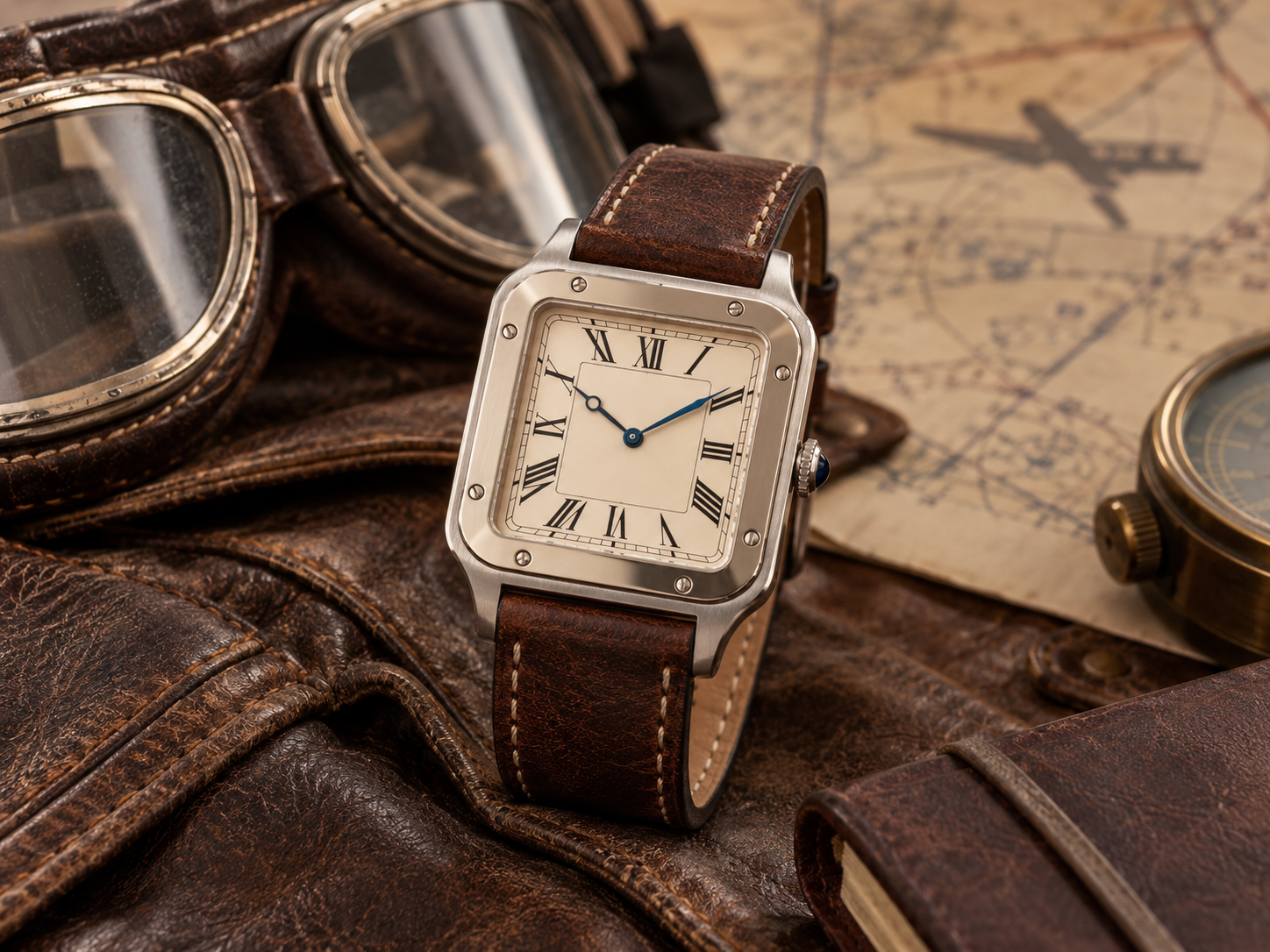
Historical Design Feature Checklist
- Attachment: Integrated wrist-strap attachment for a leather strap.
- Legibility: High-contrast dial with prominent Roman numerals.
- Shape: Distinctive square case and exposed bezel screws.
- Profile: Flat architecture designed to sit comfortably on the wrist.
How integrated wrist-strap attachments provided a functional mounting solution for the leather strap
Moving a watch from the pocket to the wrist created a structural problem.
The case needed a reliable way to connect with the strap.
A crude solution could simply adapt a pocket-watch case by attaching wire loops or similar fittings.
The Santos approached the wrist as part of the design itself.
The strap connection was integrated into the geometry of the case.
That made the watch appear intentionally wrist-mounted rather than converted from another format.
Functionally, the attachment allowed the leather strap to hold the case securely against the pilot’s wrist.
The timepiece remained available without needing to be held in the hand.
This was one of the most important changes introduced by the shift from pocket watch to wristwatch:
the human body effectively became the mounting platform for the instrument.
How the square bezel and highly legible Roman numerals made the dial readable at a glance
The Santos used a distinctive square geometry that made it visually different from the round pocket watches familiar at the time.
Its dial also featured prominent Roman numerals.
Those elements contributed to clear visual organization.
The contrast between the dial background, hands, and numerals supported rapid reading.
The historical claim should remain narrow, however.
The Roman numerals should not automatically be described as an aviation-specific engineering feature chosen because testing proved them superior in flight.
The stronger conclusion is that the bold dial architecture supported legibility.
That mattered because the operational advantage of wrist-mounted timekeeping depended on the pilot being able to glance at the watch rather than study it.
The wrist solved the access problem.
A clear dial helped complete the solution.
Why the flat case profile allowed the timepiece to sit securely against the aviator’s wrist
Wrist-mounted equipment also needs to remain wearable.
A case that projects too far from the wrist can move excessively, catch on clothing, or become uncomfortable.
The Santos used a comparatively flat geometric form that sat close to the wrist.
That profile supported everyday wearability and helped the watch remain stable on the leather strap.
Again, the design should not be overstated as if every dimension had been optimized through modern aviation ergonomics.
Its significance is more direct.
The case was shaped as a wrist-worn object.
It was meant to sit naturally against the body rather than hang from a chain inside a pocket.
That shift in physical relationship between wearer and watch was one of the defining innovations of the design.
Why the First Pilot Watch Was More Practical Than a Pocket Watch in Flight
The simplest way to understand the first pilot watch is to compare its operating workflow with the pocket watch it replaced.
| Functional Metric | Traditional Pocket Watch | First Pilot Watch — Cartier Santos |
|---|---|---|
| Access Location | Inside a vest or coat pocket | Strapped directly to the wrist |
| Retrieval Required | High — requires reaching and pulling the watch free | None — remains exposed on the wrist |
| Visibility | Obscured until retrieved | Available for at-a-glance reading |
| Control Interruption | Requires retrieval while managing flight controls | Minimal retrieval-related interruption |
How the continuous visibility of the wrist-mounted watch eliminated the need for retrieval
The wrist-mounted design removed an entire sequence of actions.
The pilot no longer needed to search for the watch.
There was nothing to pull from a pocket.
There was no separate object to hold while reading the time.
The dial remained attached to the body.
That meant checking the time could become a glance rather than a retrieval process.
This is the central functional advantage of the first pilot watch.
The innovation was not primarily about increasing mechanical complexity.
It was about reducing user interaction.
By changing where the watch was worn, Cartier reduced the number of actions required to access time information.
Why eliminating the pocket chain removed the need to interrupt flight controls to check the time
The pocket chain represented another layer of interaction.
It secured the watch when carried conventionally, but it also reinforced the fact that the watch was a separate object that had to be retrieved and handled.
The wrist strap changed that relationship.
The timepiece stayed attached to the pilot in the position where it would be read.
There was no need to pull a chain, free the watch from clothing, or hold it during the reading process.
For an aviator, the value was immediate.
The pilot could reduce retrieval-related distraction and keep greater attention on controlling the aircraft.
This was the key operational improvement that justified creating a dedicated wrist-mounted solution.
How Santos-Dumont’s public use of this practical tool helped demonstrate the practicality of men’s wristwatches
The Santos also had cultural importance.
At the beginning of the twentieth century, wrist-worn timepieces were still strongly associated with jewelry and were more commonly linked with women’s fashion than men’s everyday timekeeping.
Men generally relied on pocket watches.
Santos-Dumont challenged that convention through use rather than argument.
He was a celebrated aviator publicly wearing a wrist-mounted watch because it solved a practical problem.
That context changed how the object could be perceived.
The wristwatch was not simply decorative jewelry.
It could be functional equipment.
Santos-Dumont’s prominence helped demonstrate that wrist-worn timekeeping made sense for men whose activities required faster access than a pocket watch could provide.
Aviation offered one of the clearest examples.
The Timeline of How the First Pilot Watch Reached the Public
The original 1904 watch was a bespoke solution.
The next important step was transforming that individual design into a commercial product.
Why Santos-Dumont’s status as a pioneering celebrity helped generate public interest in his wrist-worn tool
Santos-Dumont was not an obscure experimental pilot.
He was a highly visible public figure associated with the excitement surrounding early aviation.
His flights attracted attention.
So did the equipment connected with them.
The unusual watch worn directly on his wrist therefore became visible in a context associated with modern technology, speed, and innovation.
The object carried a story.
It was not simply a new Cartier watch.
It was the kind of watch worn by a famous aviator because an ordinary pocket watch was inconvenient in the air.
That narrative made the wrist-mounted design easier for the public to understand.
Its practicality had already been demonstrated by a recognizable user.
How Cartier partnered with specialist Swiss movement makers to produce the watch for the public in 1911
The bespoke aviation watch eventually became a commercial product.
According to the timeline established by the brief, Cartier worked with Edmond Jaeger, who collaborated with specialist Swiss movement makers, to support production.
In 1911, the Santos reached the public as a commercially available wristwatch.
That date should remain separate from the original creation date.
1904 marks the bespoke watch created for Santos-Dumont.
1911 marks its commercial transition into a product available to customers.
The distinction mirrors a pattern seen throughout watch history:
invention and commercialization are separate milestones.
Why the commercial release successfully turned a bespoke aviation solution into a commercial wristwatch
The 1911 release changed the status of the design.
What had begun as a personalized response to one aviator’s problem became a reproducible wristwatch.
Consumers did not need to fly aircraft to appreciate its advantages.
Continuous wrist visibility was useful in ordinary life as well.
The design therefore moved beyond the environment that inspired it.
Its aviation origin remained historically important, but the underlying solution—keeping time immediately accessible on the wrist—had much broader value.
Commercialization transformed the Santos from a custom aviation instrument into a luxury wristwatch that could participate in the wider adoption of wrist-worn timekeeping.
The Enduring Historical Legacy of the First Pilot Watch
The historical importance of the first pilot watch comes from the problem it solved more than from later aviation-watch conventions.
The 1904 Cartier Santos did not look like a twentieth-century military Flieger watch.
It was not an aviation chronograph.
It did not establish every technical feature later associated with pilot watches.
Its contribution came earlier.
It demonstrated why a pilot might need time on the wrist in the first place.
Why horological historians widely cite the 1904 Cartier Santos as the first purpose-built pilot’s watch
The strongest historical formulation is precise:
That does not mean it was the first wristwatch.
It means its creation was directly linked to the requirements of an aviator.
That purpose-built relationship gives it its place in aviation-watch history.
Santos-Dumont identified a problem experienced in flight.
Cartier responded with a wrist-mounted timekeeping solution.
The watch therefore connects an identifiable user, an identifiable aviation problem, and an identifiable design response.
That is what makes the 1904 milestone so significant.
How the foundational design logic of wrist-mounted, at-a-glance time reading remains relevant
Modern pilot watches may contain very different features.
Some emphasize oversized luminous dials.
Others include chronographs, multiple time zones, slide-rule bezels, or additional aviation-oriented functions.
But the foundational usability principle remains recognizable.
The pilot should be able to access time information quickly without searching for a separate object.
Cartier and Santos-Dumont addressed that problem by moving the watch onto the wrist.
That seems ordinary today precisely because the solution became so successful.
The original innovation was not simply the physical strap.
It was the idea that timekeeping could be positioned for immediate, hands-free access during an activity that demanded concentration.
That logic remains central to tool-watch design.
Summarizing how Cartier the designer and Santos-Dumont the aviator solved early flight’s timing problem
The first pilot watch was created through the interaction of two people with different expertise.
Alberto Santos-Dumont identified the operational problem.
A pocket watch was awkward to retrieve while controlling an early aircraft.
Louis Cartier created the design solution.
He placed the timepiece directly on the wrist, integrated it with a leather strap, and produced a wearable watch that could be read without the traditional pocket-watch retrieval process.
The resulting 1904 watch became the foundation of what would later be known as the Cartier Santos.
Its significance was not that it invented wrist-worn timekeeping from nothing.
Its significance was that it applied wrist-mounted timekeeping to aviation as a deliberate functional solution.
The watch was therefore born from necessity.
A pioneering aviator needed to know the time without interrupting the act of flying.
A Parisian designer turned that need into a practical wrist-worn instrument.
That combination is why the Cartier Santos remains widely cited as the first purpose-built pilot’s wristwatch—and why its origin story remains one of the clearest examples of functional necessity shaping watch design.