
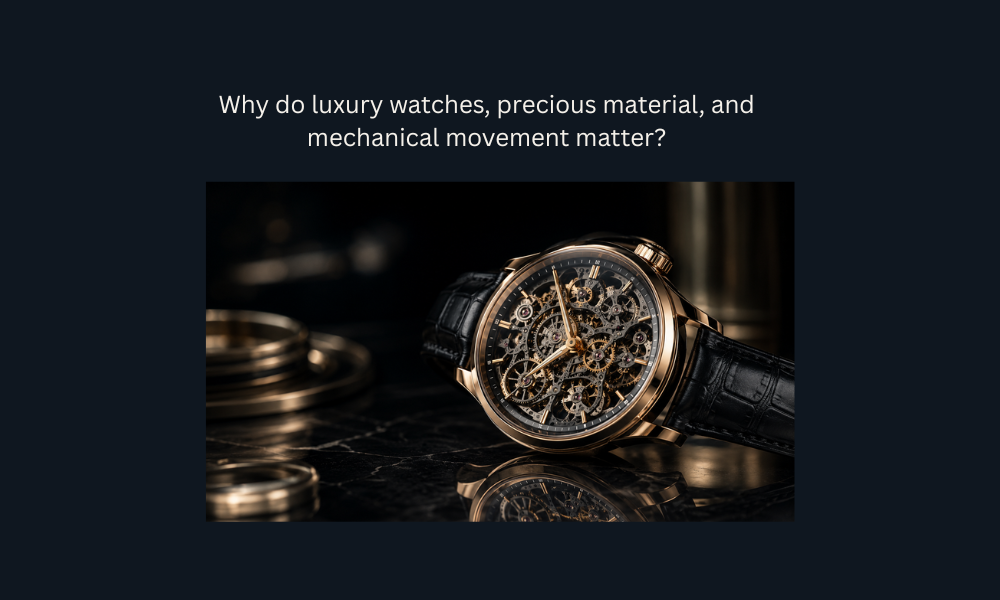
Why Do Luxury Watches, Precious Material, and Mechanical Movement Matter?
Executing a precise assessment of Luxury Watch Value requires a structured diagnostic framework that prioritizes mechanical architecture, high-end material finishing, and historical provenance over artificial scarcity and emotional hype. Purchasing high-end timepieces without evaluating the underlying technical and material specifications results in severe buyer’s remorse and trapped capital in depreciating, hype-driven assets. This guide provides the framework for systematically analyzing haute horlogerie finishing, evaluating the true cost of in-house movements, and utilizing a quantitative scoring checklist to finalize your high-end acquisition.
How to define the core prestige of your luxury watch value
Defining the core prestige of your Luxury Watch Value establishes the historical and emotional environment that elevates a timepiece from a simple utilitarian tool to a generational status symbol and heirloom.
- Rule: Prestige dictates the premium.
- Reason: A \(\$10\) quartz watch tells objectively better time than a \(\$50,000\) Patek Philippe; therefore, luxury buyers are fundamentally purchasing artisanal craftsmanship and micro-engineering, not utility.
- Example: Defining your goal as acquiring a “generational heirloom” immediately justifies the massive price premium of haute horlogerie over mass-produced fashion watches.
Why does horological heritage anchor your luxury watch value
Understanding why horological heritage anchors your Luxury Watch Value requires establishing how centuries of continuous watchmaking, iconic designs, and brand provenance justify high retail and secondary market prices.
Evaluating high-end timepiece worth means looking directly at the manufacturer’s historical record. Brand equity acts as a protective moat for value retention, separating established Swiss houses like Vacheron Constantin from unproven modern startups offering similar physical specifications. A premium watch investment relies heavily on this provenance. Long-standing manufacturers have spent decades proving their mechanical reliability and design permanence, ensuring their assets remain desirable across multiple generations of collectors. However, acquiring these legacy assets outside of authorized boutiques requires implementing rigorous provenance verification to ensure the physical piece matches its historical claims and to protect your capital against secondary-market risks.
What makes a mechanical movement essential to your luxury watch value
Determining what makes a mechanical movement essential to your Luxury Watch Value involves weighing the intricate hand-finishing and micro-engineering of an automatic or manual-wind caliber against the sterile efficiency of quartz. The internal engine dictates the true functional artistry of the piece.
- In-House Mechanical Caliber: Designed, manufactured, and assembled entirely by the brand. → Result: Ultimate horological prestige, exclusivity, and hand-finished artistry (e.g., anglage, Geneva stripes).
- Chronometer Certified (COSC): A mechanical movement rigorously tested for extreme accuracy. → Result: Merges mechanical romanticism with verifiable, high-end performance standards.
Proprietary vs. Standard Engine Matrix
In-House Caliber
100% Brand Assembled
Outsourced Ébauche
Mass-Produced Base
Are precious materials viable for your luxury watch value
Evaluating if precious materials are viable for your Luxury Watch Value requires determining the financial and aesthetic impact of choosing \(18\text{k}\) gold or platinum over standard stainless steel. A systematic approach to high-end metal selection clarifies both the physical density and the public perception of the asset. Knowing the premium material worth ensures your choice aligns with your lifestyle parameters.
- \(18\text{k}\) Yellow/Rose Gold: Warm, highly visible, traditional luxury standard. → Risk: Very soft metal that dents easily; draws significant public attention.
- Platinum/White Gold: Extremely heavy, dense, “stealth wealth” aesthetic. → Result: The ultimate pinnacle of luxury material, often mistaken for steel by untrained eyes but prized by collectors.
Precious Metal Physicality & Visibility Index
Do finishing techniques impact your luxury watch value
Analyzing how finishing techniques impact your Luxury Watch Value injects commercial realism by evaluating how microscopic details like dial texturing and hand-beveled edges dictate the difference between a \(\$5,000\) watch and a \(\$50,000\) watch.
- If you are evaluating a watch in the “Holy Trinity” tier like Audemars Piguet
- → Do inspect the movement and dial under a \(10\text{x}\) loupe
- → Result you visually confirm the hundreds of hours of hand-polishing and guilloché work that justify the astronomical price tag.
Is assessing depreciation and market demand critical for your luxury watch value
Assessing depreciation and market demand is critical for your Luxury Watch Value to prevent massive financial loss by understanding the difference between retained equity and immediate retail depreciation. To actively mitigate this risk, buyers must evaluate the long-term ownership economics of different manufacturers before finalizing a transaction.
- Rule: Most luxury watches lose value immediately upon retail purchase.
- Reason: Outside of a few artificially scarce steel models, a high-end precious metal watch will lose \(20\%\) to \(40\%\) of its value the second you leave the boutique.
- Example: Opting to buy a luxury watch pre-owned on the secondary market so the original buyer absorbs the massive initial depreciation hit. This strategy of avoiding the retail drop aligns with broader collector purchasing trends, highlighting how adapting your pre-owned acquisition strategies is now central to intelligent asset curation.
Retail Purchase vs. Secondary Market Equity Retention
How to prevent hype buying and status mistakes in your luxury watch value
Preventing hype buying and status mistakes in your Luxury Watch Value requires matching the watch’s actual craftsmanship to your budget, actively avoiding purchases driven purely by Instagram trends or artificial waitlists. You must recognize Veblen good dynamics, where a product’s demand increases simply because its price is artificially inflated, stripping away objective financial reasoning.
→ The Reality: You are paying for artificial scarcity, not horological quality. When the hype dies, your “investment” will crash.
→ The Reality: The fragile mechanical movement and soft gold case will be destroyed by daily desk-diving and casual bumps.
How to conclude your luxury watch value with this final execution checklist
Concluding your Luxury Watch Value evaluation requires utilizing this final execution checklist to transform the emotional allure of luxury into a rational, actionable scoring system.
- Rule: A scored checklist separates true horological art from empty marketing hype.
- Reason: Quantifying the movement, material, and depreciation prevents a devastating financial regret.
- Example: Only finalizing a \(\$10,000+\) purchase if the craftsmanship and heritage score perfectly against your collection goals.
Execution Checklist
- Heritage Audit: Verified the brand possesses genuine horological history and continuous manufacturing expertise.
- Movement Match: Confirmed the mechanical caliber is hand-finished or features an in-house architecture justifying the premium.
- Material Acceptance: Selected a precious metal (or high-grade steel) and accepted its specific scratch vulnerabilities.
- Market Realism: Acknowledged the immediate depreciation value of the reference on the secondary market.
- Maintenance Budget: Factored the high cost of specialized luxury mechanical servicing into the \(10\text{-year}\) ownership budget.
Score \(5/5\): Immediate Buy. The watch perfectly balances horological artistry with your financial and aesthetic goals.
Score \(3-4/5\): Pause. Identify the vulnerability (e.g., massive immediate depreciation) and consciously accept the financial hit before buying.
Score \(<3/5\): Hard Pass. Do not buy; you are paying entirely for marketing hype or status, and the watch lacks true mechanical substance.
Support Appendix: Advanced Luxury Watch Troubleshooting & FAQ
This appendix integrates troubleshooting seamlessly into the task flow to resolve advanced high-end buying friction and clarify luxury market confusion.
Q: Why do some stainless steel luxury watches cost more than solid gold watches?
A: Market demand and artificial scarcity. Brands often restrict the production of their steel sports models, driving secondary market prices wildly above retail, while their gold models sit readily available in the boutique.
Q: What does “Haute Horlogerie” actually mean?
A: “High watchmaking.” It refers to the absolute pinnacle of the craft, characterized by extreme mechanical complications (tourbillons, minute repeaters) and hundreds of hours of microscopic, hand-applied aesthetic finishing on the movement parts.
Q: Is a luxury watch a good financial investment?
A: Generally, no. Watches should be viewed as functional art and emotional purchases. While a tiny percentage of specific models appreciate, the vast majority of luxury watches are depreciating assets that also require expensive routine maintenance.