
Why Does Lug-to-Lug Matter More Than Case Diameter?
Executing a sound Lug-to-Lug Sizing Utility requires a structured diagnostic framework that prioritizes wrist anatomy, vertical span, and end-link articulation over arbitrary horizontal diameter trends.
Purchasing timepieces based solely on case diameter without evaluating bone structure leads to severe physical fatigue, top-heavy imbalance, and expensive buyer’s remorse.
This guide provides the framework for systematically evaluating case architecture—from total vertical span to visual dial expansion—and utilizing a quantitative scoring checklist to ensure maximum wrist-time utility.
How to define the core framework of your lug-to-lug sizing utility
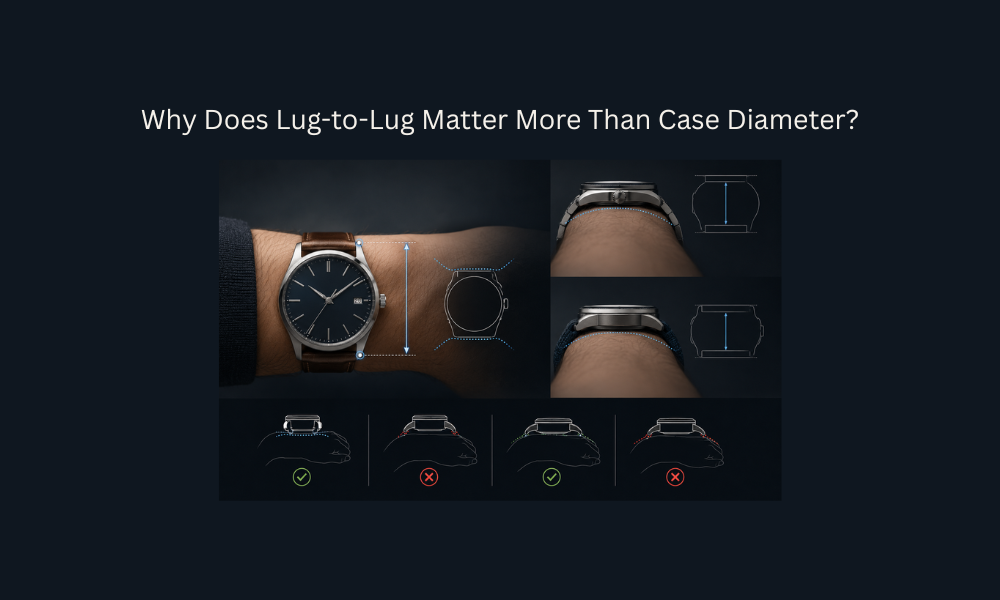
Defining the core framework of your Lug-to-Lug Sizing Utility requires establishing the foundational truth that watches sit vertically across the wrist, not horizontally, making vertical distance the ultimate arbiter of fit.
The wrist is a flat surface, not a perfect circle.
If a watch is wider than the flat top of your wrist, the lugs will overhang into the air, creating a sloppy fit and causing the watch to slide uncomfortably.
Defining your goal as “zero overhang” perfectly explains why a $39\text{mm}$ watch with a $50\text{mm}$ lug-to-lug will wear far worse than a $42\text{mm}$ watch with a $46\text{mm}$ lug-to-lug.
Why does the horizontal illusion anchor your lug-to-lug sizing utility
Understanding why the horizontal illusion anchors your Lug-to-Lug Sizing Utility requires establishing how relying solely on the widely marketed case diameter creates a false sense of how a watch actually occupies physical space.
The standard diameter specification merely calculates how wide the watch is from $9\text{ o’clock}$ to $3\text{ o’clock}$, completely ignoring the rigid metal structures holding the strap. Relying on this lateral dimension establishes a deeply flawed Watch proportion baseline.
Evaluating actual wearability demands examining the Vertical timepiece measurement to understand the true structural footprint spanning across the bone.
What makes vertical containment essential to your lug-to-lug sizing utility
Determining what makes vertical containment essential to your Lug-to-Lug Sizing Utility involves weighing the aesthetic and ergonomic disaster of “lug overhang” against the locked-in comfort of proper vertical containment.
Contained ($75\%$ to $95\%$ of wrist width)
The lugs rest entirely on the flat plane of the wrist.
Overhang ($100\%+$ of wrist width)
The lugs protrude past the edges of the wrist into empty space.
Are case curvature and geometry viable in your lug-to-lug sizing utility
Evaluating if case curvature and geometry are viable in your Lug-to-Lug Sizing Utility requires determining how aggressively curved lugs can “cheat” the vertical measurement, making a mathematically large watch wear significantly smaller.
Flat measurements alone remain insufficient without integrating Case profile ergonomics. A proper Watch lug curvature analysis reveals the physical differences in case architecture:
Project straight out from the case horizontally.
→ Risk: A flat $48\text{mm}$ lug-to-lug will wear massive, feeling like a stiff board resting on the wrist.
Hug the natural contour of the arm downward.
→ Result: A curved $48\text{mm}$ lug-to-lug wraps the wrist, hiding the vertical mass and wearing significantly smaller than its numbers suggest.
Do bracelet end-links impact your lug-to-lug sizing utility
Analyzing how bracelet end-links impact your Lug-to-Lug Sizing Utility injects commercial realism by evaluating the hidden danger of solid metal end-links that artificially extend the watch’s vertical footprint.
- If you are evaluating a watch with a stated $46\text{mm}$ lug-to-lug measurement on a metal bracelet
- → Do check if the bracelet uses protruding “male” center links or articulating “female” links
- → Result you avoid the trap of a male end-link artificially pushing the effective lug-to-lug out to $51\text{mm}$, completely ruining your expected fit.
Is assessing dial proportion critical for your lug-to-lug sizing utility
Assessing dial proportion is critical for your Lug-to-Lug Sizing Utility to prevent visual dissatisfaction by understanding how bezel thickness and dial color manipulate the perceived size of the watch, regardless of the physical measurements.
Dial surface area dictates perceived size.
A $40\text{mm}$ dive watch with a thick bezel has a tiny dial and looks compact; a $40\text{mm}$ dress watch with no bezel is entirely dial and looks like a dinner plate.
Opting to downsize your required lug-to-lug if buying an “all-dial” dress watch to prevent it from visually overpowering your wrist.
How to prevent sizing mistakes in your lug-to-lug sizing utility
Preventing sizing mistakes in your Lug-to-Lug Sizing Utility involves matching the mathematical vertical footprint to your actual anatomy, stopping the habit of buying watches based solely on diameter specifications.
The Risk:
Filtering e-commerce sites strictly for “$38\text{mm}$ watches” while ignoring the vertical measurements.
→ The Reality:
You might accidentally buy a $38\text{mm}$ vintage-inspired watch with massive $50\text{mm}$ lugs, resulting in severe overhang on a smaller wrist.
The Risk:
Assuming your wrist circumference (e.g., $7\text{ inches}$) is the only metric that matters.
→ The Reality:
Two $7\text{-inch}$ wrists can have entirely different shapes (one perfectly round, one flat and wide). A flat wrist can handle a much longer lug-to-lug than a round wrist of the exact same circumference.
Rather than guessing how these variables interact on your specific bone structure, running a targeted wearability assessment maps the exact relationship between the watch’s vertical mass and your wrist’s flat surface area.
How to conclude your lug-to-lug sizing utility with this final execution checklist
Concluding your Lug-to-Lug Sizing Utility with this final execution checklist provides a strong, execution-oriented closure that transforms the dimensional data into an actionable scoring system for your next purchase.
- Rule: A scored checklist separates visual illusion from physical reality.
- Reason: Quantifying the vertical span and end-link structure ensures a comfortable, proportional fit.
- Example: Only finalizing the purchase if the vertical footprint and case geometry score perfectly for your specific wrist shape.
Execution Checklist & Scoring Interpretation
Score $5/5$: Immediate Buy. The vertical dimensions are perfectly optimized for your anatomy.
Score $3-4/5$: Pause. Identify the dimensional risk (e.g., straight lugs approaching maximum wrist width) and try the watch on physically before buying.
Score $<3/5$: Hard Pass. Do not buy; the lug-to-lug guarantees overhang, ensuring the watch will be uncomfortable and look disproportionate.
Support Appendix: Advanced Lug-to-Lug Troubleshooting & FAQ
This appendix integrates troubleshooting seamlessly into the task flow to resolve advanced sizing confusion and structural friction.
Q: What is the difference between “male” and “female” end-links?
A male end-link features a protruding center metal piece that extends stiffly past the watch lugs before the bracelet bends. This effectively adds $2\text{mm}-5\text{mm}$ to the total length of the watch. A female end-link is recessed, allowing the bracelet to articulate and drop straight down immediately from the lug tips, maintaining the true case measurement.
Q: How do I measure the “flat” width of my wrist?
Do not use a flexible tape measure around your wrist. Instead, place a standard ruler flat across the top of your wrist and look straight down. The distance where your wrist drops off on either side is your maximum allowable lug-to-lug limit.
Q: Why do brands rarely advertise the lug-to-lug measurement?
Historically, case diameter was the easiest marketing metric for the general public to understand. However, as the collector community has grown more educated on wearability, modern enthusiast brands and microbrands are increasingly placing lug-to-lug measurements front and center in their specifications.
Conclusion
By systematically prioritizing vertical containment over horizontal width, evaluating the geometric forgiveness of downward-curving lugs, and identifying the hidden size increases caused by solid end-links, you elevate your purchase from guesswork to masterful Lug-to-Lug Sizing Utility. Breaking the habit of relying strictly on case diameter ensures you never again suffer the ergonomic disaster of lug overhang, allowing you to select timepieces that sit with perfect balance and comfort on your wrist.