
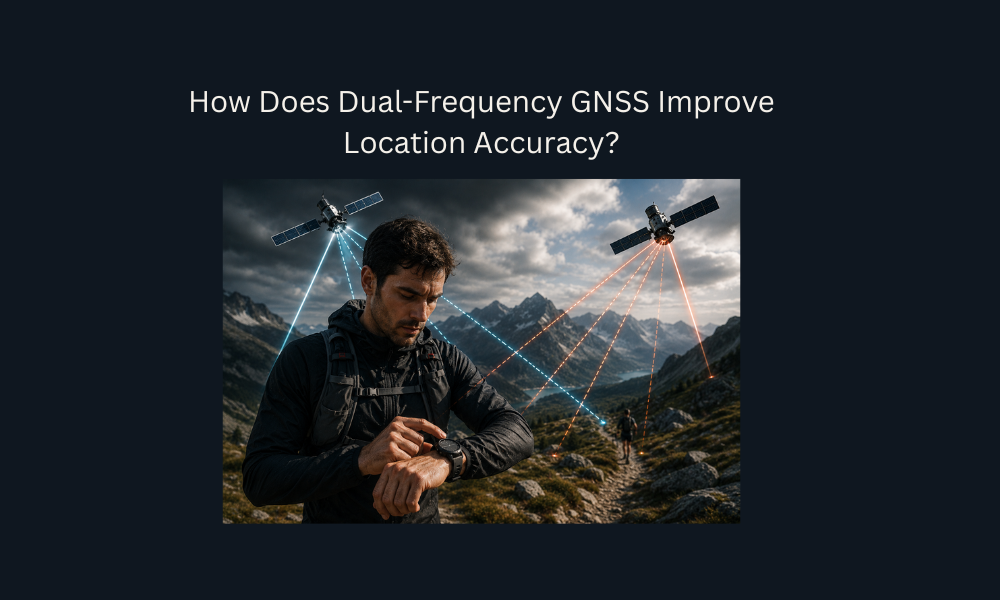
How Does Dual-Frequency GNSS Improve Location Accuracy?
Executing a sound assessment of Dual-Frequency GNSS Accuracy requires a structured diagnostic framework that prioritizes ionospheric correction, multipath rejection, and multi-constellation redundancy over legacy single-band limitations. Relying on legacy single-band receivers leads to massive positioning errors in urban canyons and completely compromises the safety and efficiency of autonomous operations or precision mapping. This guide provides the framework for systematically evaluating $L1/L5$ capabilities, assessing multipath mitigation, and utilizing a quantitative scoring checklist to finalize your high-precision location tracking deployment.
How to define the core technical advantage of your dual-frequency GNSS accuracy
Defining the core technical advantage of your Dual-Frequency GNSS Accuracy establishes the foundational difference between legacy single-band receivers estimating errors and modern dual-band receivers actively measuring and correcting them.
- Rule: Two signals eliminate guesswork.
- Reason: Because different frequencies travel through the atmosphere at slightly different speeds, a receiver listening to both can calculate the exact atmospheric distortion and subtract it.
- Example: Defining your goal as “decimeter-level precision” immediately frames why dual-frequency tracking is replacing single-band GPS in autonomous vehicles and smartphones.[1]
Why does ionospheric correction anchor your dual-frequency GNSS accuracy
Understanding why ionospheric correction anchors your Dual-Frequency GNSS Accuracy requires establishing how the ionosphere (a layer of charged particles in the atmosphere) acts as the single largest source of error for satellite navigation, and how two bands neutralize it.[2] As solar radiation heavily ionizes the upper atmosphere, these charged particles delay satellite radio signals transmitting down to Earth.
Establishing a two-frequency location baseline provides the mathematical data needed to counteract this delay. By continuously cross-referencing the slightly distinct arrival times of the $L1$ and $L5$ signals, the receiver calculates a precise correction model. This dynamic calculation removes the specific atmospheric delay entirely, ensuring your multi-band positioning precision remains highly reliable regardless of solar weather conditions.
What makes multipath mitigation essential to your dual-frequency GNSS accuracy
Determining what makes multipath mitigation essential to your Dual-Frequency GNSS Accuracy involves weighing the performance of $L1/L5$ dual-band receivers against single-band receivers when navigating through “urban canyons” full of skyscrapers.
Multipath Error Prevention Matrix
- Single-Frequency ($L1$ only): Susceptible to “multipath” (signals bouncing off glass buildings before hitting the receiver). → Result: The receiver is tricked into thinking it is further away from the satellite, causing location jumps of $10 \text{ to } 50\text{ meters}$.
- Dual-Frequency ($L1 + L5$): Utilizes the advanced modulation and wider bandwidth of the $L5$ signal. → Result: The chip can easily distinguish the true, direct signal from the delayed, bounced reflections, maintaining pinpoint accuracy in dense cities.
Are multi-constellation networks required to maximize your dual-frequency GNSS accuracy
Evaluating if multi-constellation networks are required to maximize your Dual-Frequency GNSS Accuracy determines the necessity of connecting to GPS (USA), Galileo (Europe), and BeiDou (China) simultaneously to ensure enough $L5$ signals are visible in the sky. Securing global positioning network selection ensures hardware limits do not throttle your tracking capabilities.
Constellation Tracking Matrix
- GPS-Only Tracking: Limits the total number of visible satellites. → Risk: If buildings block several GPS satellites, the receiver loses its dual-frequency lock and accuracy drops.
- Multi-Constellation Tracking: Accesses dozens of $L1/L5$ satellites across Galileo, GPS, and BeiDou simultaneously. → Result: Guarantees a continuous, highly reliable dual-frequency lock even under heavy tree canopy or between high-rises.
Activating satellite constellation redundancy prevents signal starvation and ensures continuous baseline geometry.
Do battery consumption realities impact your dual-frequency GNSS accuracy
Analyzing how battery consumption realities impact your Dual-Frequency GNSS Accuracy injects commercial realism by evaluating the power draw required to process two simultaneous radio frequencies on mobile devices or drones.
- If you are deploying a fleet of battery-powered IoT trackers or consumer smartwatches,
- Do acknowledge that dual-frequency processing requires more power than legacy single-band chips.
- Result: You must balance the absolute need for pinpoint accuracy against the device’s battery lifecycle, potentially utilizing smart-switching firmware.
Is assessing RTK and PPP integration critical for your dual-frequency GNSS accuracy
Assessing if RTK and PPP integration is critical for your Dual-Frequency GNSS Accuracy prevents unrealistic expectations by explaining that dual-frequency hardware is just the first step to true centimeter-level precision.
- Rule: Hardware requires corrective software for absolute perfection.
- Reason: While dual-frequency gets you from $5\text{ meters}$ down to $1\text{ meter}$ of accuracy, achieving centimeter-level precision requires external correction data.
- Example: Opting to pair your dual-frequency receiver with an RTK (Real-Time Kinematic) base station network for autonomous drone delivery or precision agriculture.
How to prevent spoofing and jamming mistakes in your dual-frequency GNSS accuracy
Preventing spoofing and jamming mistakes in your Dual-Frequency GNSS Accuracy involves matching the advanced $L5$ signal structure to your security requirements to avoid malicious interference in commercial or autonomous operations.
Signal Security Risk Prevention Matrix
- The Risk: Relying on legacy $L1/L2$ combinations in areas with heavy radio interference. → The Reality: The $L2$ band operates in an unprotected spectrum and is highly vulnerable to jamming from military or civilian radio noise.
- The Risk: Using a single-band receiver for autonomous vehicle routing. → The Reality: Single-band signals are relatively easy to “spoof” (fake), potentially diverting an autonomous drone or car. Dual-frequency requires attackers to spoof two complex bands simultaneously, drastically increasing security.
How to conclude your dual-frequency GNSS accuracy with this final execution checklist
Concluding your Dual-Frequency GNSS Accuracy evaluation with this final execution checklist provides a strong, execution-oriented closure that transforms the technical specifications into an actionable hardware audit.
- Rule: A scored checklist separates legacy location tracking from next-generation precision.
- Reason: Quantifying signal bands and multipath rejection ensures your hardware supports autonomous or high-precision needs.
- Example: Only finalizing your hardware purchase if the $L1/L5$ capabilities and constellation support score perfectly.
Execution Checklist & Scoring Interpretation
- Band Audit: Verified the receiver processes both $L1$ and $L5$ (or $E1/E5a$) frequency bands simultaneously.
- Constellation Check: Confirmed support for multi-constellation tracking (GPS, Galileo, BeiDou) to ensure maximum satellite visibility.
- Environment Match: Acknowledged the system will be used in “urban canyons” or dense forests where multipath rejection is critical.
- Correction Acceptance: Budgeted for RTK or PPP correction services if centimeter-level precision is required.
- Power Validation: Ensured the device’s battery capacity can support continuous dual-band processing.
Score $5/5$: Immediate Deployment. The hardware is perfectly optimized for next-generation, high-precision location tracking.
Score $3-4/5$: Pause. Identify the vulnerability (e.g., lack of RTK support) and determine if $1\text{-meter}$ accuracy is sufficient for your specific use case.
Score $<3/5$: Hard Pass. Do not deploy; you are relying on legacy single-band technology that will fail in urban environments.
Support Appendix: Advanced Dual-Frequency GNSS FAQ
Integrating troubleshooting seamlessly into the task flow resolves advanced technical confusion and hardware friction regarding your Dual-Frequency GNSS Accuracy.
FAQ Mini-Matrix
Q: What is the difference between $L1/L2$ and $L1/L5$ dual-frequency receivers?
A: $L1/L2$ was the older standard, relying heavily on Russian GLONASS satellites, and the $L2$ band is unprotected from radio interference. $L1/L5$ is the modern standard, utilizing newer GPS and Galileo satellites with advanced $BPSK(10)$ modulation that is heavily protected against jamming and multipath errors.
Q: Does my smartphone have dual-frequency GNSS?
A: It depends on the model. The Xiaomi Mi 8 was the first in $2018$. Today, most premium flagship smartphones (like recent Apple iPhone Pro models and Samsung Galaxy Ultras) feature dual-frequency chips, while budget phones still rely on single-band $L1$.
Q: Can dual-frequency GNSS track me indoors?
A: No. While the $L5$ signal penetrates tree canopy and rain better than $L1$, GNSS technology still requires a line-of-sight to the satellites in space. It cannot penetrate deep into parking garages or concrete buildings. Once that line-of-sight is broken, wearables are forced to switch to internal accelerometers for motion-based distance estimation, which fundamentally alters tracking reliability during indoor workouts.
References & Citations
- [1] UniqueNav. "What Are The Benefits Of Using A Multi-Frequency GNSS Receiver?" https://www.uniquenav.com/blog/what-are-the-benefits-of-using-a-multi-frequency-gnss-receiver
- [2] Lerus. "Ionospheric Delay: A Key Factor in GPS Signal Accuracy." https://www.lerus.com/articles/ionospheric-delay-a-key-factor-in-gps-signal-accuracy.html