
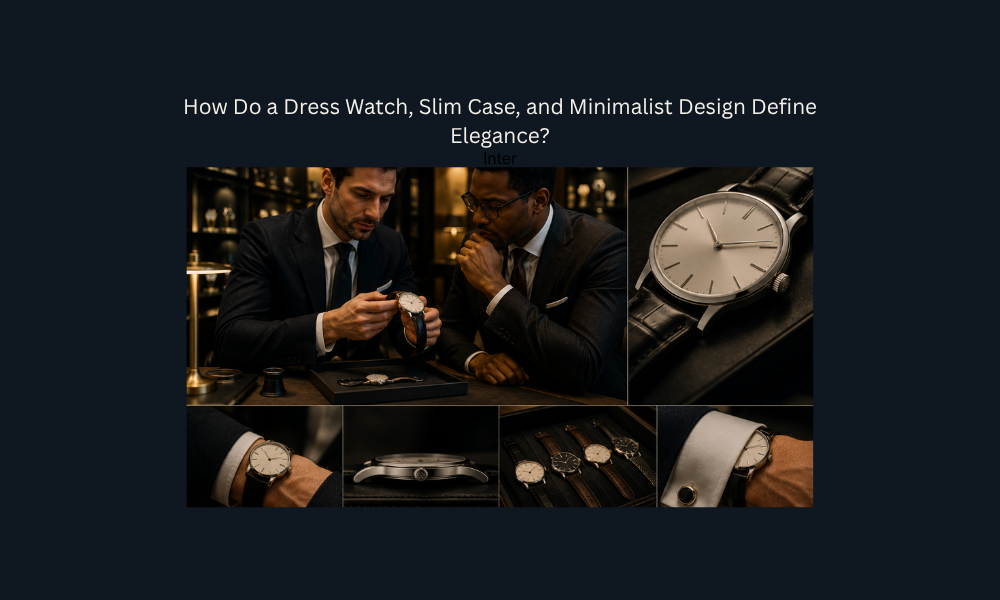
How Do a Dress Watch, Slim Case, and Minimalist Design Define Elegance?
Executing a true standard of Dress Watch Elegance requires a structured aesthetic framework that prioritizes slim case profiles, absolute dial minimalism, and strict sartorial coordination over impulsive, status-driven flashiness.
Wearing oversized, highly complicated sports watches with tailored formalwear breaks fundamental styling rules and visually ruins the line of a suit. A formal environment demands precision not just in timekeeping, but in presentation.
This guide provides the framework for systematically evaluating case thickness, dial purity, and material coordination, utilizing a quantitative scoring checklist to finalize your formal acquisition. We will analyze the strict horological rules that separate a true dress piece from an everyday utility watch.
How to define the core principles of your dress watch elegance
Defining the core principles of your Dress Watch Elegance establishes the foundational philosophy that in high-level formal horology, less is always more.
- Rule: True elegance relies on restraint, not mechanical complication.
- Reason: A formal timepiece is designed to quietly complement a well-cut suit, not aggressively compete with it for attention.
- Example: Defining your goal as “unobtrusive sophistication” immediately eliminates busy chronograph dials, thick rotating bezels, and oversized $42\text{mm}+$ cases from your selection parameters.
Why does a slim case profile anchor your dress watch elegance
Understanding why a slim case profile anchors your Dress Watch Elegance requires establishing how physical case thickness dictates the watch’s ability to integrate cleanly with formal attire.
Achieving true formal timepiece sophistication relies entirely on this physical metric. The watch must effortlessly glide beneath a tightly buttoned French cuff without snagging the fabric. A slim case profile, typically measuring under $10\text{mm}$, guarantees this frictionless interaction, cementing your dress watch refinement by keeping the wrist profile flat and unobtrusive.
What makes minimalist design essential for your dress watch elegance
Determining what makes minimalist design essential for your Dress Watch Elegance involves weighing the visual impact of stripped-down, time-only dials against the distracting clutter of unnecessary complications.
Time-Only Dial
Absolute Purity
Chronograph
Sporty Clutter
- Time-Only (Two Hands): No seconds hand, no date window, simple baton markers. → Result: The absolute pinnacle of traditional formal elegance and visual purity.
- Three-Hand with Date: Adds a sweeping seconds hand and a subtle date complication. → Result: Excellent for business-formal office wear, but slightly less traditional for a strict black-tie event.
- Chronographs/Busy Dials: Multiple sub-dials and thick applied indices. → Result: Inherently sporty; completely breaks the clean visual flow required for formal elegance.
While dial minimalism and a slim case profile are the foundational pillars of formal horology, you might be curious about the granular details—like crystal shape, hand styling, and crown design—that complete the aesthetic. If you want to understand the exact anatomy of these timepieces beyond a simple time-only dial, exploring specific traditional dress watch elements will help you identify the subtle nuances that separate a true formal piece from a standard everyday wearer.
Do case dimensions and proportions impact your dress watch elegance
Analyzing how case dimensions and proportions impact your Dress Watch Elegance injects commercial realism by evaluating how historically smaller diameters dictate modern formalwear standards.
Understanding that smaller diameters dictate formalwear standards is only the first step; applying these historical proportions to your specific wrist size requires a bit more technical calculation. To ensure your timepiece remains perfectly subservient to the wrist and avoids overhanging the edges, evaluating balanced wrist proportions is necessary before finalizing any formal acquisition.
Are precious metals required to achieve your dress watch elegance
Evaluating if precious metals are required to achieve your Dress Watch Elegance involves determining your actual need for $18\text{k}$ gold versus the highly polished, budget-friendly versatility of stainless steel. Formal watch aesthetics demand perfection in finishing, regardless of the core material.
- Yellow/Rose Gold: Warm, highly traditional, instantly recognizable as a luxury material. → Risk: Can look overly flashy if the case is too thick or the dial is too busy.
- White Gold/Platinum: Heavy, understated, “stealth wealth” appeal. → Risk: Carries a massive price premium but is often visually mistaken for standard steel.
- Polished Stainless Steel: Highly durable, versatile, cost-effective. → Risk: Lacks the traditional historical prestige of a gold formal watch, though perfectly acceptable in modern settings.
Mastering timepiece elegance criteria dictates that a polished steel watch of correct proportions will always outclass an oversized gold watch.
Is assessing strap pairing critical for your dress watch elegance
Assessing strap pairing is critical for your Dress Watch Elegance to prevent severe aesthetic mismatch by understanding why leather straps are mandatory for strict formal wear.
- Rule: Metal bracelets are inherently sporty.
- Reason: The metal links, bulky deployment clasps, and sheer volume of a bracelet clash with the refined, soft fabrics of a tailored suit.
- Example: Opting for a black or dark brown alligator leather strap with a simple, flat pin buckle to maintain the ultimate sleek, elegant profile.
How to prevent stylistic clashing in your dress watch elegance
Preventing stylistic clashing in your Dress Watch Elegance involves precisely matching the watch’s visual traits to your formal wardrobe to avoid blatant fashion errors.
- The Risk: Wearing a thick $14\text{mm}$ dive watch with a tailored tuxedo. → The Reality: The watch will not slide under the shirt cuff, causing the sleeve to bunch up and ruining the clean lines of the suit.
- The Risk: Matching a brown leather watch strap with black leather formal shoes and a black belt. → The Reality: Mismatched leathers break the cohesive elegance of a formal outfit; your leathers must always coordinate.
Avoiding blatant fashion errors like wearing a thick dive watch with a tuxedo is crucial, but mastering sartorial coordination goes beyond just the strict black-tie level. As you navigate different social and professional environments, from conservative boardrooms to semi-formal galas, coordinating a watch with formalwear ensures your timepiece always perfectly mirrors your wardrobe’s exact dress code.
How to conclude your dress watch elegance with this final execution checklist
Concluding your Dress Watch Elegance with this final execution checklist provides a strong, objective closure that transforms the aesthetic rules into an actionable scoring system.
- Rule: A scored checklist ensures strict adherence to formal tradition.
- Reason: Quantifying minimalism prevents the accidental purchase of a sporty, hybrid piece.
- Example: Only finalizing the purchase if the thickness, dial layout, and strap score perfectly for your specific formal needs.
- Score $5/5$: Immediate Buy. The watch perfectly embodies minimalist elegance and will elevate any formal attire.
- Score $3-4/5$: Pause. Identify the compromised factor (e.g., it has a metal bracelet instead of leather) and decide if you can easily fix it before wearing.
- Score $<3/5$: Hard Pass. Do not buy; the watch is too thick, too busy, or too sporty to ever function as a true elegant dress piece.
Support Appendix: Advanced Dress Watch Troubleshooting & FAQ
This appendix integrates troubleshooting seamlessly into your task flow to resolve advanced styling confusion and clarify historical formal etiquette.
- Q: Why do traditional dress watches lack a seconds hand?
- A: In classic high-society etiquette, checking the precise seconds at a formal event or gala was considered rude and indicated you were bored or rushing. Time-only watches emphasize being “in the moment.”
- Q: Can I wear a dress watch with casual clothing like jeans and a t-shirt?
- A: It is difficult to pull off. A highly polished, ultra-thin gold watch on a shiny alligator strap will severely clash with casual wear. If you want a watch that does both, look for a steel “everyday” watch, not a strict dress watch.
- Q: Are Roman numerals or Arabic numerals more elegant?
- A: Generally, Roman numerals or simple applied baton markers are considered the most formal and elegant. Large Arabic numerals (1-12) are historically associated with military or field watches and tend to look much sportier.
References & Further Reading
- Minimalist Design Principles: Simple Watch Co. – Minimalist Watch Design Principles Explained
- Case Proportions & Sizing: Zeno-Watch Basel – How to Choose Watch Size
- Strap Pairing & Coordination: Molequin – How to Match Watch Straps to Your Personal Style