
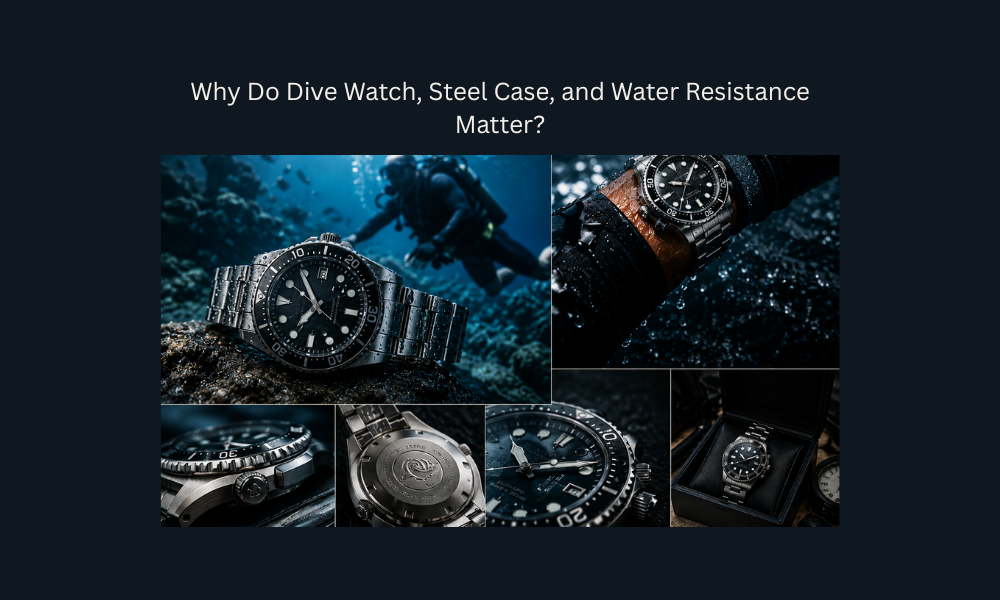
Why Do Dive Watch, Steel Case, and Water Resistance Matter?
Executing an assessment of submersible equipment requires a structured diagnostic framework that prioritizes metallurgical integrity, hydrostatic scaling, and mechanical security over impulsive aesthetic trends. Purchasing aquatic timepieces without a structured protocol leads to acquiring inadequate hardware, resulting in catastrophic movement flooding or severe ergonomic fatigue. This guide provides the framework for systematically evaluating metallurgical properties, assessing depth certification standards, and utilizing a quantitative scoring checklist to ensure maximum aquatic utility.
How to define the core purpose of your dive watch reliability
Defining the core purpose of your Dive Watch Reliability requires establishing the primary aquatic environment and physical abuse threshold the timepiece must survive before evaluating specific models.
- Rule: Survival dictates structural design.
- Reason: The extreme atmospheric pressure, saltwater corrosion, and blunt force of the ocean will instantly destroy a standard dress watch.
- Example: Defining your goal as “active scuba and water sports” immediately prioritizes a sealed steel case and $200\text{m}$ depth rating over slim aesthetics.
Submersible Hardware Anatomy
Why does a steel case anchor your dive watch reliability
Understanding why a steel case anchors your Dive Watch Reliability involves identifying the specific metallurgical properties required to combat saltwater corrosion and extreme atmospheric pressure. Submersible timepiece endurance depends on the selection of high-grade materials. Marine-grade stainless steel, specifically $316\text{L}$ or $904\text{L}$, provides the necessary resistance to oxidation. This material is highly durable and withstands crushing underwater forces that would deform softer metals, establishing an Aquatic watch baseline for any serious equipment.
What makes water resistance essential to your dive watch reliability
Determining what makes water resistance essential to your Dive Watch Reliability requires weighing the necessity of screw-down crowns, thick case backs, and heavy rubber gaskets required to seal the movement.
| Rating | Technical Specification | Result |
|---|---|---|
| $100\text{m}$ Rating | Push-pull or screw-down crown, standard gaskets. | Excellent for surface swimming and daily wear, but vulnerable to dynamic pressure spikes. |
| $200\text{m}+$ ISO 6425 Certified | Rigorously lab-tested for overpressure, condensation, and shock. | The ultimate professional standard for active scuba submersions and absolute peace of mind. To fully comprehend how manufacturers guarantee this level of survivability, you must examine the strict certification testing requirements that separate certified tools from commercial replicas. |
Hydrostatic Pressure Scale
Are rotating bezels and luminous dials viable for your dive watch reliability
Evaluating if rotating bezels and luminous dials are viable for your Dive Watch Reliability demands determining your actual operational need for unidirectional timing and extreme low-light legibility. These represent critical Submersible hardware selection choices and Alternative physical protections for the operator.
| Hardware Component | Function | Risk |
|---|---|---|
| Unidirectional Bezel | Only rotates counter-clockwise to track elapsed time. | Adds significant thickness to the case, but acts as a fail-safe so timing can only ever be “shortened” accidentally underwater. This physical barrier against time-extension serves as a critical fail-safe timing system, ensuring your oxygen reserves are never overestimated. |
| Oversized Lumed Hands | Heavily painted with Super-LumiNova. | Can look overly bulky or cartoonish in formal settings, but ensures instant readability in murky water or total darkness. |
Unidirectional Fail-Safe Mechanism
Do case dimensions impact your dive watch reliability
Analyzing how case dimensions impact your Dive Watch Reliability injects commercial realism by evaluating how thick sapphire crystals and deep depth ratings cause unavoidable bulk and wrist fatigue.
If you demand a watch with a $500\text{m}+$ depth rating and extreme pressure resistance, you must acknowledge that the case must be $14\text{mm}+$ thick to house the necessary protective crystal and gaskets. Consequently, you accept the top-heavy, chunky wearing experience in exchange for absolute structural integrity.
Is assessing strap hardware critical for your dive watch reliability
Assessing whether strap hardware is critical for your Dive Watch Reliability prevents catastrophic loss by evaluating the failure points of standard metal bracelets versus specialized aquatic straps.
- Rule: If a spring bar breaks, the watch sinks.
- Reason: Heavy steel bracelets rely on tiny metal pins; if one snaps during a scuba descent or extreme water sport, the heavy watch head is lost permanently.
- Example: Opting for a one-piece NATO strap or a vented FKM rubber dive strap that keeps the watch secured to your wrist even if a single pin fails.
Strap Hardware Redundancy: Standard vs. NATO
How to prevent flooding mistakes in your dive watch reliability
Preventing flooding mistakes in your Dive Watch Reliability involves strictly matching the watch’s physical vulnerabilities to your specific aquatic behavior to avoid catastrophic movement failure. Mastering the mechanics of your crown sealing system is your primary defense against moisture intrusion, as the slightest oversight in thread engagement immediately compromises the internal gaskets.
Crown Seal Mechanism Comparison
| The Risk | The Reality |
|---|---|
| Jumping into a pool with the screw-down crown accidentally left unscrewed. | Water will instantly bypass the main stem gasket, flooding the dial and rusting the mechanical gears. |
| Pressing chronograph buttons while submerged. | Engaging a pusher underwater temporarily opens a gap in the seal; water will enter the case immediately unless the watch features specialized magnetic pushers. |
How to conclude your dive watch reliability with this final execution checklist
Concluding your Dive Watch Reliability with this final execution checklist provides a strong, objective closure that transforms physical specifications into an actionable scoring system.
- Rule: A scored checklist separates actual submersible tools from “diver-styled” fashion watches.
- Reason: Quantifying durability ensures the watch will actually survive aquatic abuse.
- Example: Only finalizing the purchase if the steel case, crown, and water resistance score perfectly for your specific hydrostatic needs.
Score $5/5$: Immediate Buy. The watch is a true submersible tool perfectly optimized for water environments.
Score $3-4/5$: Pause. Identify the vulnerability (e.g., push-pull crown instead of screw-down) and consciously accept the aquatic tradeoff before buying.
Score $<3/5$: Hard Pass. Do not buy; the watch is a “dive watch” in name only and will flood under actual physical pressure.
Support Appendix: Advanced Dive Watch Troubleshooting & FAQ
This appendix resolves advanced technical confusion and buying friction to ensure you confidently finalize your Dive Watch Reliability assessment.
Q: Do I really need a Helium Escape Valve (HEV) on my dive watch?
A: Absolutely not, unless you are a commercial saturation professional living in a pressurized bell for days at a time. For $99.9\%$ of recreational swimmers and submersions, an HEV is useless marketing bulk.
Q: Can I wear my $200\text{m}$ steel dive watch in a hot shower or sauna?
A: It is highly discouraged. While the watch resists pressure, extreme heat causes the steel case to expand and the rubber gaskets to temporarily deform, allowing steam (which is highly penetrative) to bypass the seals and cause condensation inside the dial.
Q: Why do steel dive watches feel so heavy for daily wear?
A: The weight comes from the solid block of $316\text{L}$ steel required to withstand crushing atmospheres, combined with thick sapphire glass. If the weight causes fatigue at the office, swap the steel bracelet for a lighter rubber strap to dramatically improve ergonomics.
References & Citations
- The Ultimate Guide to Watch Water Resistance: Dive Deep into Ratings, Myths, and Custom Mastery – Romlicen
- Why Dive Watches Are More Than Tools – Noah’s Fine Jewelry