
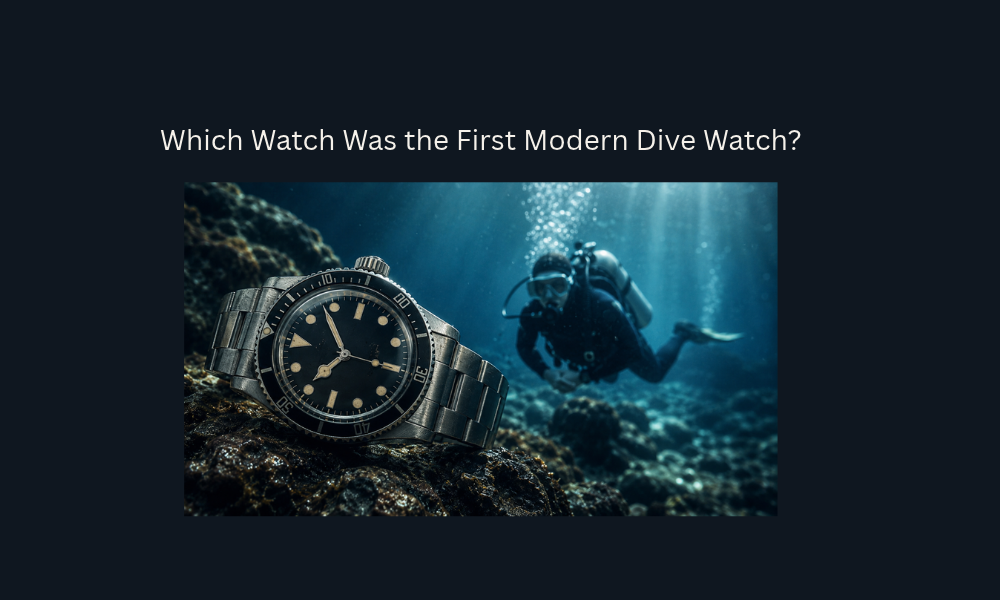
Which Watch Was the First Modern Dive Watch?
Few questions in watch history generate as much debate as the identity of the first modern dive watch.
Rolex enthusiasts often point to the Submariner because it became the most recognizable dive-watch design in the world. Blancpain supporters point to the Fifty Fathoms because it reached military divers earlier and introduced several features that later defined the category.
The answer depends on what “modern dive watch” actually means.
A waterproof case alone is not enough.
To qualify under the framework used here, a watch must combine meaningful underwater water resistance with high-contrast legibility and, most importantly, a rotating elapsed-time bezel that allows a diver to measure time underwater.
That definition immediately separates the modern dive watch from earlier waterproof watches and underwater timepieces.
Using those criteria and the release timeline established in this brief, the Blancpain Fifty Fathoms takes the historical edge as the first modern dive watch, while the Rolex Submariner became the model that most successfully popularized and standardized the category.
Defining the Required Features of the First Modern Dive Watch
Before comparing Blancpain and Rolex, the category needs a mechanical definition.
Early twentieth-century watchmakers had already developed cases capable of resisting water.
Military divers also used highly luminous watches before 1953.
What changed with the modern dive watch was the combination of these capabilities with a dedicated external system for measuring elapsed underwater time.
| Modern Dive Watch Criteria | Historical Requirement / Function |
|---|---|
| Rotating Bezel | External timing ring used to track elapsed underwater time and distinguish modern dive watches from earlier waterproof watches |
| High Water Resistance | Sufficient depth capability for sustained underwater use rather than basic splash protection |
| High-Contrast Luminescence | Large luminous hands and markers designed for visibility in dark or low-visibility water |
| Secured Crown System | Crown sealing architecture intended to protect one of the most vulnerable openings in the case |
How the rotating elapsed-time bezel separated modern diving tools from traditional waterproof watches
Water resistance protects the movement.
A timing bezel gives the diver information.
That difference is fundamental.
Before the modern dive-watch format emerged, a waterproof watch could accompany someone into the water, but the case itself did not necessarily provide a dedicated method for tracking underwater elapsed time.
The external rotating bezel changed the function of the watch.
A diver could align the bezel marker with the minute hand at the beginning of a dive and then read elapsed time directly from the dial.
The watch therefore became more than a sealed timekeeper.
It became an active underwater timing instrument.
Within this historical framework, that feature creates the clearest dividing line between an early waterproof watch and a modern dive watch.
Why high-contrast luminescent dials became a mandatory requirement for deep-sea legibility
A dive watch must remain readable in conditions where normal watch dials can become difficult to see.
Water absorbs light as depth increases.
Visibility may also be reduced by darkness, sediment, weather, or enclosed underwater environments.
Military frogmen therefore needed large hands and hour markers that could be identified quickly.
Early professional diving watches used highly luminous materials on dark dials to create maximum contrast.
The goal was not decorative brightness.
It was functional recognition.
A diver had to determine the position of the minute hand and compare it with the bezel without prolonged inspection.
That made strong underwater legibility another defining feature of the emerging modern dive-watch format.
How a minimum 100-meter depth rating established the functional baseline for true scuba diving
Basic water resistance and diving capability are not equivalent.
A watch intended for underwater work must tolerate sustained external pressure rather than occasional contact with water.
The rise of self-contained underwater breathing equipment expanded how long and how deeply divers could operate.
That changed the engineering requirements placed on their watches.
Under the criteria used in this brief, approximately 100 meters of rated water resistance establishes a practical historical baseline for distinguishing a true diving instrument from a watch built mainly to survive rain, splashes, or brief immersion.
The important distinction is functional.
A modern dive watch was expected to operate as underwater equipment, not merely as a water-resistant everyday watch.
Why Early Waterproof Timepieces Failed to Qualify as the First Modern Dive Watch
The modern dive watch did not appear without predecessors.
Several earlier watches solved important parts of the underwater-timekeeping problem.
They deserve historical credit.
But solving one part of the problem is different from establishing the complete modern dive-watch architecture.
How the 1926 Rolex Oyster achieved water resistance but lacked dive-specific timing tools
The Rolex Oyster was a major milestone in waterproof watch-case development.
Its case architecture helped establish the idea that a wristwatch could be securely protected against external moisture.
That contribution is fundamental to dive-watch history.
But the Oyster was not yet a modern dive watch under the criteria used here.
It lacked the external rotating elapsed-time bezel that would later allow divers to measure underwater duration directly from the watch.
Its achievement was primarily case sealing.
It demonstrated that a wristwatch could be made substantially more resistant to water ingress.
That made it an essential precursor to the modern dive watch rather than the complete modern diving instrument itself.
Why the 1932 Omega Marine functioned as an early underwater tool without a modern case architecture
The Omega Marine moved the concept further toward genuine underwater use.
Its distinctive rectangular construction used a double-case arrangement designed to protect the watch during immersion.
It also demonstrated that wristwatches could survive serious underwater testing.
Historically, that makes the Marine one of the most important pre-war underwater watches.
But its architecture remained different from the later dive-watch blueprint.
It did not combine the now-familiar round tool-watch format with an external rotating elapsed-time bezel and the complete visual and mechanical system that would define professional dive watches in the 1950s.
The Omega Marine therefore represents an important underwater engineering step without qualifying as the first modern dive watch under this definition.
How World War II frogmen watches achieved legibility but missed the crucial rotating bezel requirement
Military diving during World War II accelerated the development of underwater wristwatches.
Watches associated with combat swimmers, including large luminous military pieces such as the Panerai Radiomir family, demonstrated the importance of visibility and robust water-resistant construction.
Their oversized hands and markers addressed a real operational need.
A diver needed to read the watch quickly in low light.
But these watches still lacked one feature that later became central to the modern format:
the rotating elapsed-time bezel.
They therefore supplied important elements of the blueprint without completing it.
By the early 1950s, the remaining step was to combine water resistance, underwater visibility, and an external timing mechanism into one purpose-built diving watch.
How the Blancpain Fifty Fathoms Established the Blueprint for the First Modern Dive Watch
The strongest historical case for the first modern dive watch begins with Blancpain.
The Fifty Fathoms was not simply a waterproof wristwatch later adopted by divers.
It was developed around the operational requirements of professional underwater users.
That distinction matters.
How Jean-Jacques Fiechter and French combat divers collaborated to create the Fifty Fathoms in 1953
Jean-Jacques Fiechter, then leading Blancpain, was himself an experienced diver.
That gave him direct familiarity with the practical limitations of existing wristwatches underwater.
At the same time, French military combat divers needed a watch specifically suited to their operational requirements.
Captain Bob Maloubier and the French Nageurs de Combat were central to that military demand.
The resulting Fifty Fathoms brought together features that addressed the actual diving environment rather than simply adapting a conventional watch for water exposure.
Its 1953 military delivery is especially important to the historical debate.
The watch existed as a completed, functional diving instrument before the Rolex Submariner’s widely recognized 1954 public debut.
That timeline gives Blancpain a crucial chronological advantage.
Why Blancpain patented the push-to-turn locking bezel to prevent accidental timing errors underwater
The bezel was one of the Fifty Fathoms’ most important mechanical innovations.
A conventional freely rotating timing ring could move unintentionally if it struck equipment, rocks, or another object underwater.
That creates an obvious timing problem.
If the bezel shifts, the diver may read a different elapsed duration from the one originally set.
Blancpain addressed this with a locking approach that required downward pressure before the bezel could be rotated.
The mechanism reduced the likelihood of accidental movement.
This transformed the bezel from a convenient timing accessory into a deliberately secured underwater timing system.
That safety-oriented thinking became a defining characteristic of later professional dive-watch design, eventually evolving into the modern one-way bezel safety system , which limits accidental movement from making elapsed dive time appear shorter than it actually is.
How the Fifty Fathoms achieved exceptional water resistance using a double O-ring crown system
The crown is one of the most vulnerable openings in any watch case.
The setting stem must pass through the case wall, creating a penetration that needs reliable sealing.
Blancpain’s solution used a double O-ring crown system.
Rather than depending only on a single sealing point, the architecture incorporated redundant elastomeric barriers around the crown interface.
This was particularly significant because Blancpain could not simply duplicate every crown solution already protected by competing intellectual property.
The double-seal approach gave the Fifty Fathoms a strong water-resistant crown system suited to professional diving requirements.
Combined with the locking bezel, luminous display, and robust case architecture, it helped complete the modern dive-watch blueprint.
How the Rolex Submariner Competed for the Title of the First Modern Dive Watch
The Rolex Submariner remains the other major contender.
Its historical importance is impossible to separate from the development of the dive-watch category.
But invention and category dominance are not necessarily the same achievement.
How Rolex developed the Submariner concurrently and debuted it to the public at the 1954 Basel Fair
Rolex was working on its own professional diving-watch concept during the same general period.
The company already possessed extensive experience with water-resistant Oyster cases, giving it a strong engineering foundation.
Development and testing took place around 1953.
The Submariner then reached broad public attention with its presentation at the Swiss watch fair in Basel in 1954.
That timing is central to the debate.
Rolex was clearly not entering the field decades later.
The two projects developed very close together.
But under the release chronology used in this brief, Blancpain’s completed military delivery in 1953 precedes the Submariner’s 1954 public introduction.
Why the early Rolex Submariner utilized a friction-fit bidirectional bezel instead of a patented locking mechanism
Early Submariners did not yet use the later unidirectional dive-bezel format now associated with professional diving watches.
Instead, the bezel operated through a simpler friction-fit arrangement.
It could rotate in both directions.
That made it useful for elapsed-time measurement, but less protected against accidental movement than Blancpain’s secured system.
Patent limitations form part of the historical explanation presented in this brief.
Blancpain’s protected bezel design prevented competitors from simply adopting the same locking mechanism.
The result was an unusual reversal of later public perception:
the Submariner eventually became the visual archetype of the dive watch, but the earliest versions did not yet contain every bezel-safety refinement that would later become standard.
How Rolex’s aggressive marketing and production scale solidified the Submariner as the archetypal diving tool
Where Rolex achieved extraordinary success was commercialization.
The Submariner moved beyond a specialist professional-diving audience and became a globally recognized civilian watch.
Rolex had several advantages.
Its Oyster case already carried strong associations with water resistance.
The company possessed substantial production capability.
Its international distribution and marketing were also capable of placing the Submariner in front of a much wider audience.
Over time, the Submariner became more than another professional diving watch.
It became the visual shorthand for the entire category.
Its round steel case, black rotating bezel, luminous markers, and bracelet configuration were copied or reinterpreted throughout the watch industry.
Blancpain may have established the earlier blueprint under the criteria used here.
Rolex made that blueprint globally familiar.
Comparing Timelines and Patents in the First Modern Dive Watch Debate
The Blancpain-versus-Rolex argument becomes clearer when invention, release, mechanical design, and commercialization are separated.
| Historical Metric | Blancpain Fifty Fathoms | Rolex Submariner |
|---|---|---|
| Year Conceived / Tested | 1953 | 1953 |
| First Public / Military Release | 1953 — French military delivery | 1954 — public debut at Basel |
| Bezel Mechanism | Patented secured push-to-turn system | Bidirectional friction-fit bezel |
| Crown System | Double O-ring sealing system | Screw-down Oyster crown |
| Historical Strength | Earlier completed professional-diving implementation | Faster global commercial recognition |
Why Blancpain’s earlier military delivery gives the Fifty Fathoms the definitive historical edge
The strongest argument for Blancpain is chronological.
A concept under development is not the same as a completed watch placed into operational use.
The Fifty Fathoms was delivered as a functional military diving watch in 1953.
Under the timeline established by this brief, that predates the Submariner’s public unveiling in 1954.
The distinction between military delivery and commercial exhibition matters.
The Fifty Fathoms did not need to be the first watch advertised to the general public to qualify as the earlier completed product.
For the question “Which watch was first?”, the earlier operational release carries greater historical weight than later mass-market visibility.
How Rolex’s faster path to mass commercial availability complicates the historical perception
Chronology explains invention.
Visibility explains memory.
Blancpain’s early Fifty Fathoms was closely associated with military and professional diving channels.
That gave it credibility among specialists but limited its initial civilian visibility.
Rolex took the dive-watch concept to a much broader commercial audience.
The Submariner became easier for ordinary watch buyers to encounter, recognize, and purchase.
That difference helps explain why many people instinctively assume the Submariner must have been first.
The watch that becomes the most culturally dominant is often remembered as the originator.
Historically, those are separate questions.
The Fifty Fathoms can hold the earlier-release advantage while the Submariner holds the stronger claim to commercial popularization.
Why the Blancpain locking bezel patent forced Rolex to use a less secure early bezel design
Patent protection affected how quickly competing manufacturers could adopt similar timing mechanisms.
Blancpain’s locking bezel architecture gave the Fifty Fathoms a distinctive early safety feature.
Competitors could not simply reproduce the same protected solution.
That helps explain why early Submariners relied on a simpler bidirectional bezel.
The distinction matters because modern divers now associate bezel security with the category itself.
Later dive watches would increasingly adopt mechanisms intended to prevent accidental timing errors.
The early patent environment therefore influenced not only the rivalry between Blancpain and Rolex but the pace at which the broader industry converged on the modern dive-watch bezel format.
The Final Historical Consensus on the First Modern Dive Watch
The debate becomes much easier to resolve once three different achievements are separated:
Rolex had already made foundational advances in waterproof wristwatch construction before the 1950s.
Omega and military watchmakers had also produced important underwater predecessors.
But under the criteria and timeline used in this brief, Blancpain was the first to combine the essential features into a completed modern diving instrument.
Rolex then transformed that type of watch into one of the most recognizable product categories in horology.
Why the Blancpain Fifty Fathoms receives the historical credit under the modern-dive-watch criteria
The Fifty Fathoms has the stronger claim when the question is narrowly defined as:
Which completed watch first established the modern professional dive-watch format?
Its case rests on several connected facts within this brief’s historical framework:
- a 1953 military delivery,
- purpose-built development for combat divers,
- an external elapsed-time bezel,
- a secured bezel mechanism,
- strong underwater legibility,
- substantial water resistance,
- and a dedicated crown-sealing system.
Earlier watches contributed individual elements.
The Fifty Fathoms assembled those elements into the complete functional package.
That is why it receives the historical edge here.
How the Rolex Submariner became the most recognized standard for the category moving forward
Winning the invention timeline did not guarantee permanent market dominance.
Rolex achieved something different.
The Submariner became the world’s most recognizable interpretation of the dive-watch concept.
Its design was commercially durable, highly legible, easy to identify, and supported by Rolex’s global reach.
As the decades passed, countless dive watches adopted proportions and visual cues that resembled the Submariner more closely than the earliest Fifty Fathoms.
That gave Rolex enormous influence over how the public imagines a dive watch.
The final historical distinction is therefore straightforward:
The two achievements are related, but they are not the same.
If the question is which watch was the first modern dive watch, the Fifty Fathoms has the earlier historical claim in this framework.
If the question is which watch most successfully defined the category in popular culture and the commercial market, the Submariner has the stronger case.