
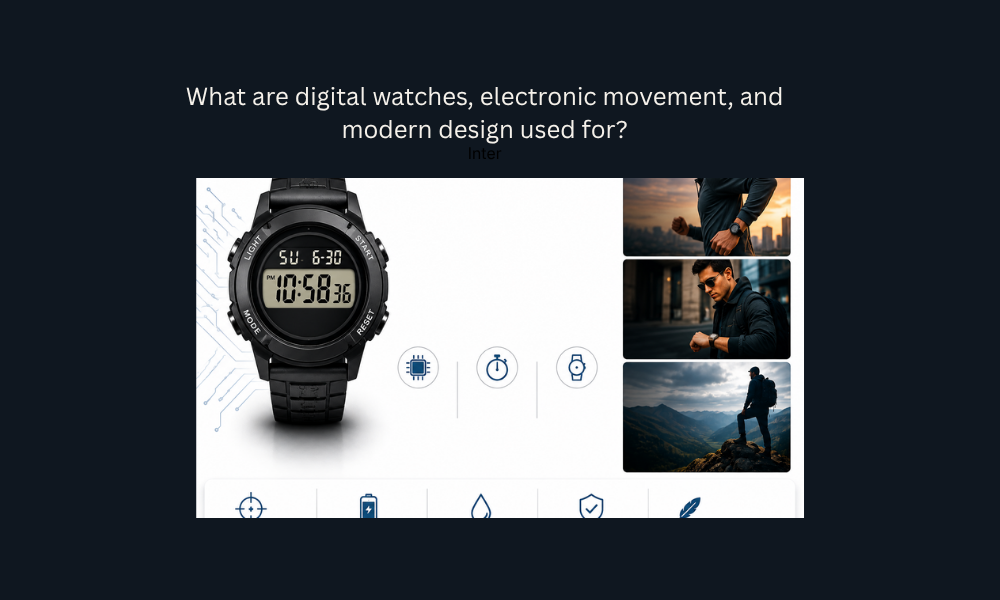
What Are Digital Watches, Electronic Movement, and Modern Design Used For?
Executing a sound assessment of Digital Watch Utility requires a structured diagnostic framework that prioritizes solid-state precision, high-contrast data processing, and ergonomic modern composites over traditional analog aesthetics. Purchasing electronic timepieces without evaluating screen technology and battery dependency leads to acquiring unreadable, dead devices that fail their primary measurement purpose. This guide provides the framework for systematically evaluating solid-state electronic modules, assessing display visibility, and utilizing a quantitative scoring checklist to finalize your functional selection.
How to define the core purpose of your digital watch utility
Defining the core purpose of your Digital Watch Utility establishes the primary modern environments that demand an electronic interface over analog hands.
- Rule: Information processing dictates the display.
- Reason: A runner tracking split times or heart rates needs immediate, exact numerical feedback, not an angle on a dial.
- Example: Defining your goal as “fitness data tracking” immediately prioritizes a digital smart-display over a mechanical sports watch.
Why does an electronic movement anchor your digital watch utility
Understanding why an electronic movement anchors your Digital Watch Utility requires establishing how solid-state modules eliminate the fragility of physical gears, offering supreme shock resistance and absolute precision.
Establishing the solid-state watch baseline means analyzing internal architecture. Electronic timepiece functionality relies entirely on solid-state electronics. The absence of balance wheels, mainsprings, and delicate escapements renders the module functionally immune to the blunt force impacts that destroy mechanical watches.
FIG 1.0: Solid-State Isolation vs. Mechanical Vulnerability
What makes a modern design essential to your digital watch utility
Determining what makes a modern design essential to your Digital Watch Utility involves weighing the lightweight composites and integrated straps of modern digital cases against traditional, heavier metal architectures. Utilizing modern Polycarbonate resin replaces the density of steel with highly protective, shock-absorbing armor.
Polycarbonate/Resin Case:
Ultra-lightweight, high impact absorption.
Integrated Silicone Straps:
Seamlessly molded into the case structure.
Are multi-functional displays viable for your digital watch utility
Evaluating if multi-functional displays are viable for your Digital Watch Utility demands determining your actual need for massive data points versus simple timekeeping on the screen. Making your electronic readout selection requires a strict assessment of alternative screen capabilities.
Basic LCD/LED Display: Shows time, day, and date.
Result: Perfect for simple, highly legible, battery-efficient daily wear.
Smart/Connected Display: Tracks heart rate, GPS, and smartphone notifications.
Result: Essential for fitness and connectivity, but requires constant battery recharging.
Do specialized backlights impact your digital watch utility
Analyzing how specialized backlights impact your Digital Watch Utility evaluates the critical necessity of active illumination features for nighttime operability.
Is assessing battery dependency critical for your digital watch utility
Assessing if battery dependency is critical for your Digital Watch Utility prevents unexpected device failure by establishing the charging or replacement lifecycle of complex digital modules. Understanding these feature-to-battery tradeoffs is essential for prioritizing long-term autonomous operation over unnecessary smartwatch bloat.
- Rule: More features equal less battery life.
- Reason: A basic digital watch runs for $10\text{ years}$ on a single battery; a GPS smartwatch dies in $2\text{ days}$.
- Example: Opting for a “Tough Solar” digital watch if you refuse to deal with charging cables or battery replacements, shifting entirely to maintenance-free energy.
FIG 2.0: Feature Density vs. Autonomous Battery Lifespan
How to prevent screen glare and viewing angle mistakes in your digital watch utility
Preventing screen glare and viewing angle mistakes in your Digital Watch Utility involves strictly matching the watch’s screen technology to your outdoor environment to avoid a blank or unreadable display.
The Risk: Buying a “Negative display” (black background, light digits) for low-light indoor use.
The Reality: Negative displays are notoriously difficult to read from off-angles or in dim lighting; standard “Positive display” screens are far superior for quick legibility. Proper display readability optimization requires matching the background contrast directly to your primary lighting environment.
The Risk: Using a standard TFT smartwatch screen in direct, bright sunlight.
The Reality: The sun washes out the backlight, making the screen completely black. Choose a reflective LCD (MIP) display for outdoor sports.
FIG 3.0: Memory-in-Pixel (MIP) Ambient Light Reflection Architecture
How to conclude your digital watch utility with this final execution checklist
Concluding your Digital Watch Utility with this final execution checklist provides a strong, execution-oriented closure that transforms the electronic features into an actionable scoring system.
- Rule: A scored checklist separates actual tech tools from bulky plastic fashion watches.
- Reason: Quantifying features and battery life ensures the device will actually serve your daily routine without constant failure.
- Example: Only finalizing the purchase if the battery, screen, and functions score perfectly for your specific needs.