
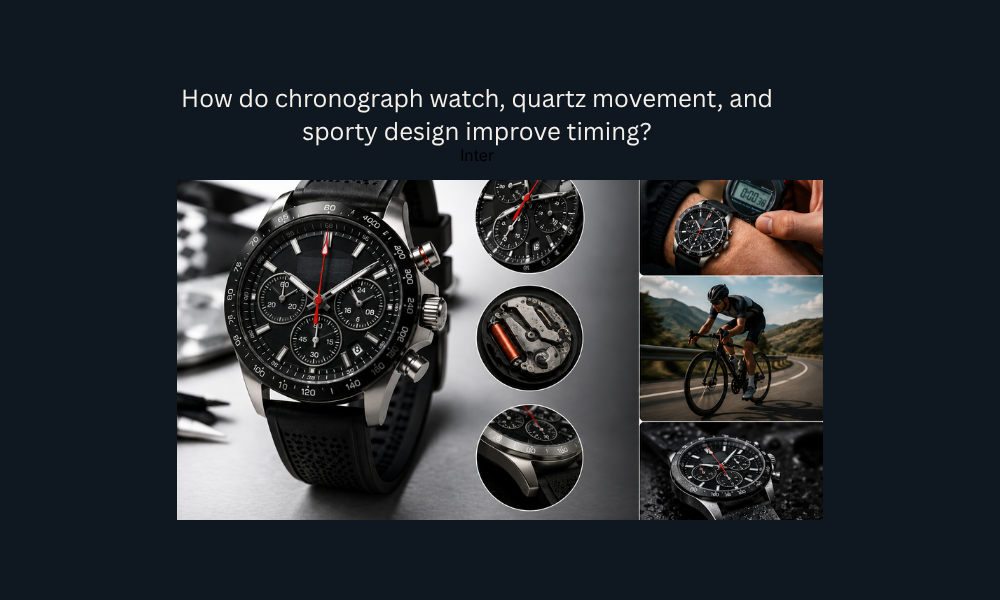
How Do Chronograph Watch, Quartz Movement, and Sporty Design Improve Timing?
Executing a sound assessment of Chronograph Watch Timing requires a structured diagnostic framework that prioritizes quartz precision, high-contrast legibility, and ergonomic pusher design over impulsive aesthetic trends.
Purchasing timepieces with complex sub-dials without evaluating their functional usability leads to acquiring cluttered, unreadable watches that fail their primary measurement purpose.
This guide provides the framework for systematically evaluating quartz movement precision, assessing the necessity of specific timing scales, and utilizing a quantitative scoring checklist to finalize your functional selection. We will strip away the marketing jargon and focus entirely on the horological utility of these complex instruments.
How to define the core purpose of your Chronograph Watch Timing
Defining the core purpose of your Chronograph Watch Timing establishes the primary tracking environment before evaluating specific sub-dials or movements. The specific context where you need to track elapsed time dictates the physical requirements of the watch.
-
Rule: Measurement dictates mechanism.
-
Reason: A standard three-hand watch cannot track split-second intervals accurately.
-
Example: Defining your goal as “tracking sprint intervals” immediately prioritizes a dedicated stopwatch complication over a simple dive bezel.
Understanding this primary tracking environment prevents you from overpaying for capabilities you will never utilize.
Why does a quartz movement anchor your Chronograph Watch Timing
Understanding why a quartz movement anchors your Chronograph Watch Timing requires establishing how electronic technology provides superior fractional-second precision and eliminates the fragility of complex mechanical gear trains. A stopwatch precision baseline requires consistency that traditional mainsprings struggle to match under physical duress.
An electronic timing mechanism utilizes a battery-powered oscillator to achieve extraordinary accuracy, often breaking down time into $1/10\text{th}$ or even $1/100\text{th}$ of a second intervals. Standard mechanical beats, typically sweeping at 4Hz, cannot offer this level of granular measurement reliably. Opting for quartz establishes a baseline standard for precision that ensures your elapsed time recordings are absolute, not approximate. For those who demand this battery-powered reliability but still desire the tactile, instant reset of a traditional gear train, exploring hybrid chronograph technology bridges the gap between raw electronic precision and mechanical feel.
What makes a sporty design essential to your Chronograph Watch Timing
Determining what makes a sporty design essential to your Chronograph Watch Timing involves weighing the high-contrast legibility and ergonomic grip of sport-focused designs against dressy, delicate alternatives. The physical interface of the watch determines your speed of operation. A heavily lumed application like Super-LumiNova is often integrated into these designs to maintain that legibility in low-light environments.
- Sporty Design: Matte dials, high-contrast sub-dials, oversized pushers. → Result: Ultimate instant readability and grip under physical stress or heavy sweating.
- Dressy Design: High-polish cases, minimal indices, delicate flush pushers. → Result: Visually elegant, but hard to operate quickly or read at a split-second glance.
Oversized pushers, high-contrast sub-dials, matte dial with thick luminescent markers.
Flush minimal pushers, low-contrast dial mapping, highly polished reflective case.
Are tachymeter bezels and sub-dials viable for your Chronograph Watch Timing
Evaluating if tachymeter bezels and sub-dials are viable for your Chronograph Watch Timing requires determining your actual need for speed-tracking scales and $12\text{-hour}$ totalizers on the dial. Selecting the correct alternative timing scales prevents the dial from becoming a chaotic mess of unreadable numbers. This stopwatch capability selection directly impacts how quickly your eye can process the information. However, if your daily routine involves regular distance-based timing calculations, mastering how these scales convert elapsed time into a precise rate becomes an essential skill.
- Tachymeter Bezel: Measures speed based on travel time over a fixed $1\text{-mile}$ or $1\text{-km}$ distance. → Risk: Rarely used in modern daily life, adding severe visual clutter if you only need to time a $5\text{-minute}$ egg.
- $60\text{-Minute}$ Sub-dial: Tracks elapsed minutes up to an hour. → Result: The most practical daily tool for parking meters, cooking, and workout intervals.
Tracks speed over fixed distance. Often introduces unnecessary visual noise.
Highly isolated, practical display for standard interval measurement.
Do specialized pushers impact your Chronograph Watch Timing
Analyzing how specialized pushers impact your Chronograph Watch Timing injects commercial realism by evaluating how pump pushers versus screw-down pushers affect immediate operability. The hardware extending from the case wall dictates how quickly you can initiate the timer. Furthermore, understanding how external pushers trigger the internal timing mechanism efficiency determines whether your central seconds hand starts with a seamless glide or an erratic jump.
→ Do prioritize standard pump pushers over screw-down pushers
→ Result you eliminate the $5\text{-second}$ delay of having to unscrew the hardware before pressing start.
Is assessing battery and mechanical limits critical for your Chronograph Watch Timing
Assessing battery and mechanical limits is critical for your Chronograph Watch Timing to prevent catastrophic power drain or movement wear by understanding the cost of leaving the complication running constantly. An electronic timing mechanism requires careful power management.
-
Rule: The stopwatch is a situational tool, not the main timekeeper.
-
Reason: Running a quartz chronograph $24/7$ will drain the battery in months rather than years.
-
Example: Opting to reset and stop the central seconds hand exactly at $12\text{ o’clock}$ when not actively timing an event.
How to prevent operational mistakes in your Chronograph Watch Timing
Preventing operational mistakes in your Chronograph Watch Timing involves strictly matching the watch’s physical vulnerabilities to your specific behavior to avoid breaking the resetting hammer or flooding the case. Complex movements require disciplined operation to survive daily wear.
- The Risk: Pressing the chronograph reset button while the timer is still actively running. → The Reality: On many chronographs, this forces gears to clash and can instantly snap the internal resetting mechanism.
- The Risk: Engaging the pushers while submerged underwater. → The Reality: Pressing a button opens the gasket seal; water will flood the case immediately and destroy the movement.
Gear Clash
Resetting without stopping forces the hammer onto spinning cams, shearing delicate metal components instantly.
Gasket Breach
Pusher depression compromises the O-ring seal, creating a direct vacuum path for liquid ingress to flood the case.
How to conclude your Chronograph Watch Timing with this final execution checklist
Concluding your Chronograph Watch Timing with this final execution checklist provides a strong, execution-oriented closure that transforms the physical features into an actionable scoring system. You must quantify your assessment before committing capital.
-
Rule: A scored checklist separates actual timing tools from purely fashionable “busy dials.”
-
Reason: Quantifying legibility and operability ensures the watch serves its primary function flawlessly.
-
Example: Only finalizing the purchase if the quartz accuracy and pusher ergonomics score perfectly.
Diagnostic Scoring Checklist
Resolving advanced troubleshooting and FAQ for your Chronograph Watch Timing
Resolving advanced troubleshooting and FAQ for your Chronograph Watch Timing integrates seamlessly into the task flow to eliminate operational confusion and buying friction.
Q: Why is the large central seconds hand not moving?
A: On a traditional chronograph, the large central hand is the stopwatch tracker, not the running seconds. The actual running seconds are usually displayed on a small continuous sub-dial to keep the main dial clear for timing events.
Q: What is a “flyback” chronograph?
A: A flyback allows you to reset and restart the timer with a single push, bypassing the “stop-reset-start” sequence. It is highly valuable for timing consecutive fast-paced intervals.
Q: Does the chronograph second hand misaligning mean the watch is broken?
A: On mechanical watches, yes, it requires a watchmaker. But on quartz chronographs, a misaligned seconds hand (e.g., stopping at $12:02$ instead of $12:00$) can usually be manually recalibrated by pulling the crown out and using the pushers to advance the hand back to zero.
Finalizing your Chronograph Watch Timing for maximum daily utility
Finalizing your Chronograph Watch Timing ensures that your acquisition serves as a highly functional instrument rather than a purely aesthetic impulse.
By systematically evaluating the extreme accuracy of a quartz movement, the high-contrast legibility of a sporty design, and the ergonomic safety of dedicated pushers, you elevate your purchase into a masterclass in functional selection.
Prioritizing intuitive sub-dial layouts—while mitigating the risks of battery drain and water damage—guarantees your timepiece tracks every split-second flawlessly.