
How Does Watch Size Affect Comfort When Choosing a Watch?
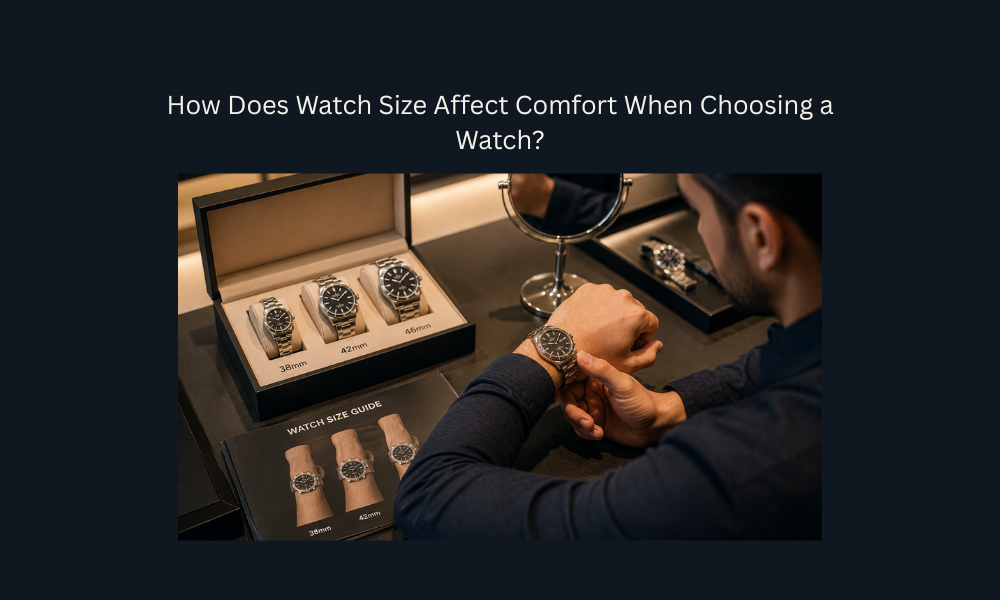
Executing a sound Watch Size Comfort Decision requires a structured diagnostic framework that prioritizes wrist anatomy, lug-to-lug span, and end-link articulation over arbitrary horizontal diameter trends. Purchasing timepieces based solely on case diameter without evaluating bone structure leads to severe physical fatigue, top-heavy imbalance, and expensive buyer’s remorse. This guide provides the framework for systematically evaluating case architecture—from total vertical span to visual dial expansion—and utilizing a quantitative scoring checklist to ensure maximum wrist-time utility. While many buyers focus on the width of a case, true wearability is found in the holistic interaction between the metal and the wrist.
How to define the core baseline for your watch size comfort decision
Defining the core baseline for your Watch Size Comfort Decision requires establishing your exact wrist circumference and flat-surface width before evaluating specific case diameters.
- Rule: Measure the wrist, not just the trend.
- Reason: A $42\text{mm}$ watch sits perfectly on a round $7.5\text{-inch}$ wrist but will painfully overhang on a flat $6.2\text{-inch}$ wrist. The flat-surface measurement dictates the maximum permissible length of the watch case.
- Example: Defining your baseline as “under $40\text{mm}$” immediately narrows your search, preventing you from buying oversized watches that cause daily discomfort.
Why lug-to-lug distance anchors your watch size comfort decision
Understanding why lug-to-lug distance anchors your Watch Size Comfort Decision requires establishing how the vertical length of the watch dictates wearability far more than the horizontal case diameter. Establishing a strict timepiece dimension baseline using the lug-to-lug span is the most critical step in a watch fit evaluation.
The physical span from the top lug to the bottom lug interacts directly with the bone structure of the wrist. The total length of the watch must not exceed the flat surface width of the wrist bones. If the lugs extend past the curvature of the wrist, the strap will not drop down naturally, causing the watch head to lift away from the skin. This gap destabilizes the center of gravity, causing the watch to pull sideways during daily activities.
What makes case thickness essential in your watch size comfort decision
Determining what makes case thickness essential in your Watch Size Comfort Decision involves weighing the daily comfort of ultra-thin profiles against the bulk and instability of thick, high-complication tool watches.
Are oversized and vintage dimensions viable for your watch size comfort decision
Evaluating if oversized and vintage dimensions are viable for your Watch Size Comfort Decision requires determining your actual tolerance for heavy, modern case architectures versus the lightweight, diminutive feel of vintage styling. When exploring alternative case dimensions, your timepiece sizing selection must account for the shift in total mass.
Do bezel and dial proportions impact your watch size comfort decision
Analyzing how bezel and dial proportions impact your Watch Size Comfort Decision injects commercial realism by evaluating how the physical size of a watch can feel vastly different based on its visual dial-to-bezel ratio.
Is assessing strap integration critical for your watch size comfort decision
Assessing strap integration is critical for your Watch Size Comfort Decision to prevent long-term ownership frustration by understanding how rigid end-links artificially extend the vertical size of the watch case.
- Rule: Male end-links increase the lug-to-lug wingspan.
- Reason: A bracelet with protruding “male” end-links forces the metal outward before draping down, effectively adding $2-4\text{mm}$ to the watch’s total vertical length. This alters the center of gravity and increases the risk of overhang.
- Example: Opting for a watch with “female” end-links or using a leather strap to ensure the watch drops sharply around your wrist for maximum ergonomic comfort.
How to prevent overhang and fatigue mistakes in your watch size comfort decision
Preventing overhang and fatigue mistakes in your Watch Size Comfort Decision involves strictly matching the physical footprint of the watch to your bone structure to avoid painful sliding and top-heavy imbalance.
How to conclude your watch size comfort decision with this final execution checklist
Concluding your Watch Size Comfort Decision with this final execution checklist provides a strong, execution-oriented closure that transforms the sizing options into an actionable scoring system.
Support Appendix: Advanced Watch Sizing Troubleshooting & FAQ
This appendix integrates troubleshooting seamlessly into the task flow to resolve advanced ergonomic confusion and buying friction.
- Q: What is the “golden ratio” for watch sizing? * A: While highly subjective, traditional horological guidance suggests the watch case should cover approximately $60\%$ to $70\%$ of the flat surface of your wrist. Anything over $85\%$ risks lug overhang.
- Q: Why do square or rectangular watches wear larger than round watches? * A: A $36\text{mm}$ square watch has significantly more surface area and volume than a $36\text{mm}$ round watch. Always test square watches in person, as they typically wear like a round watch that is $3-4\text{mm}$ larger.
- Q: Does a NATO strap make a watch more comfortable? * A: It depends on the size. NATO straps are incredibly comfortable but run under the case back, adding $1-2\text{mm}$ of total thickness. If the watch is already too thick, a NATO will make it dangerously top-heavy.