
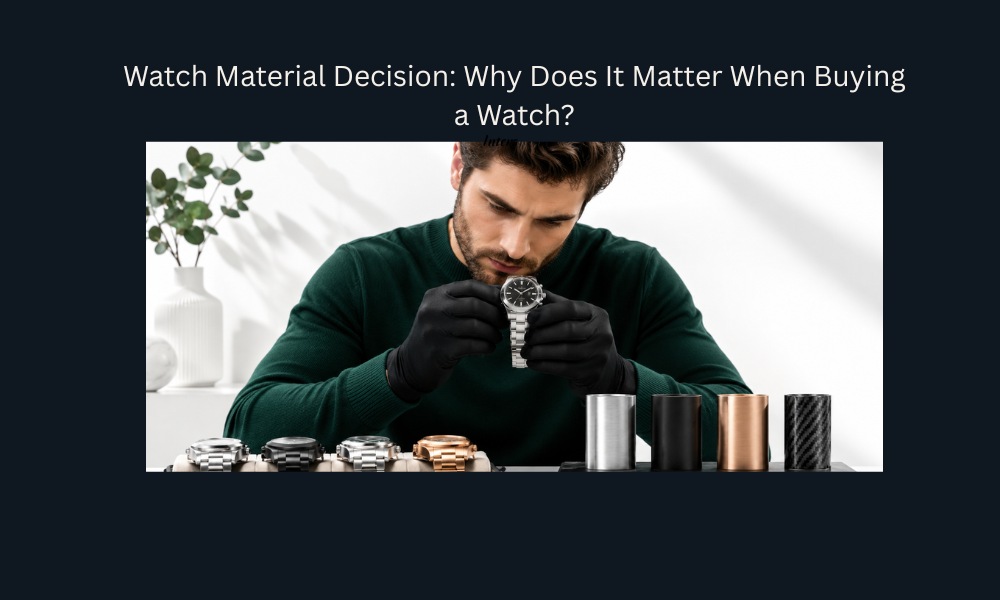
Watch Material Decision: Why Does It Matter When Buying a Watch?
Executing a sound Watch Material Decision requires a structured evaluation framework that prioritizes ergonomic weight, skin sensitivities, and physical durability over purely visual aesthetics. Choosing a watch based solely on appearance without understanding the underlying material science leads to severe wrist fatigue, skin reactions, and catastrophic shatter damage. This guide provides the framework for systematically evaluating watch materials—from standard 316L steel to advanced ceramics—and utilizing a quantitative scoring checklist to ensure maximum ergonomic utility.
How to define the core purpose of your Watch Material Decision
Defining the core purpose of your Watch Material Decision establishes the primary environment and utility of the timepiece before evaluating specific metals or composites.
Rule: Material must match the lifestyle.
Reason: A heavy gold watch becomes a physical burden on a hike, while a lightweight resin watch looks completely out of place in a formal boardroom.
Example: Defining your purpose as “active outdoor daily wear” immediately prioritizes titanium or resin over soft precious metals.
Why does stainless steel anchor your Watch Material Decision
Understanding why stainless steel anchors your Watch Material Decision requires establishing the 316L and 904L alloys as the industry baseline for durability, weight, and polishability. Timepiece composition heavily relies on these alloys because they dictate the standard performance metric against which all other materials are judged. As the watch metal baseline, standard 316L provides the expected “heft” of a luxury watch while remaining highly resistant to standard corrosion, ensuring long-term structural integrity in varied environments.
What makes titanium different from steel for your Watch Material Decision
Determining what makes titanium different from steel for your Watch Material Decision involves weighing the extreme ergonomic benefits of titanium against the traditional heft and shine of stainless steel.
- Stainless Steel: Traditional heft, easily polished to a high shine, susceptible to deep scratches. → Result: Classic luxury feel.
- Titanium (Grade 2 or 5): $30\%$ to $40\%$ lighter, highly corrosion-resistant, darker matte grey finish. → Result: Ultimate ergonomic comfort and tool-watch utility.
Are ceramic and bronze viable for your Watch Material Decision
Evaluating if ceramic and bronze are viable for your Watch Material Decision requires determining your tolerance for materials that either actively change over time or remain permanently pristine. Alternative watch cases expand beyond traditional metals, making timepiece material selection a critical factor in predictive maintenance.
- Ceramic: Highly scratch-resistant, UV-resistant, retains a “day one” look forever. → Risk: Can shatter or chip upon hard impact.
- Bronze: Develops a unique oxidation patina based on your environment and sweat. → Risk: Leaves green residue on skin; requires specialized cleaning to reset the look.
Do precious metals impact your Watch Material Decision
Analyzing how precious metals impact your Watch Material Decision injects commercial realism by evaluating the extreme weight, material softness, and massive price premiums of gold and platinum.
If you are buying an $18\text{k}$ solid gold sports watch → Do acknowledge the heavy wrist fatigue and the fundamental softness of the metal → Result you accept that the watch will accumulate dents and scratches much faster than a steel equivalent.
Is assessing weight and skin allergies critical for your Watch Material Decision
Assessing weight and skin allergies is critical for your Watch Material Decision to prevent long-term ownership frustration and physical discomfort.
Rule: Comfort dictates wrist time.
Reason: If a watch causes a rash or feels too heavy after $4$ hours, it will become an unworn “ghost watch.”
Example: Opting for titanium or ceramic if you have a known nickel allergy, as standard 316L steel contains trace amounts of nickel that trigger contact dermatitis.
How to prevent scratch and shattering mistakes in your Watch Material Decision
Preventing scratch and shattering mistakes in your Watch Material Decision involves matching the material’s structural failure points to your daily physical clumsiness or activity level.
- The Risk: Dropping a ceramic watch on a hard bathroom tile. → The Reality: It will shatter, requiring a catastrophic, expensive case replacement.
- The Risk: Wearing a gold or PVD-coated watch during manual labor. → The Reality: Gold will dent easily, and black PVD coatings will scratch off to reveal the silver steel underneath, which cannot be polished out.
How to conclude your Watch Material Decision with this final execution checklist
Concluding your Watch Material Decision with this final execution checklist removes aesthetic emotion from the physical purchase by transforming material options into an actionable scoring system.
Rule: A scored checklist removes aesthetic emotion from the physical purchase.
Reason: Quantifying the material’s utility prevents costly ergonomic and financial regrets.
Example: Only finalizing the purchase if the material scores perfectly for your specific lifestyle.
Support Appendix: Watch Material Decision FAQ & Advanced Troubleshooting
This appendix resolves advanced material confusion and troubleshooting scenarios to ensure you confidently execute your Watch Material Decision without falling for marketing hype.
- Q: Is Rolex’s 904L steel actually better than standard 316L steel? A: It takes a slightly higher polish and is marginally more corrosion-resistant to harsh acids, but for $99\%$ of daily wearers, there is no functional durability difference. It is primarily a luxury differentiator.
- Q: What is the difference between PVD and DLC black coatings? A: DLC (Diamond-Like Carbon) is significantly harder and more scratch-resistant than standard PVD. If you want a black watch, always prioritize DLC to prevent the coating from easily scraping off.
- Q: Can a titanium watch be polished if it gets scratched? A: It is much more difficult. Standard titanium has a matte finish that cannot be polished like steel. However, some brands use proprietary hardening coatings (like Seiko’s Diashield) that resist scratches but are impossible to refinish once breached.