
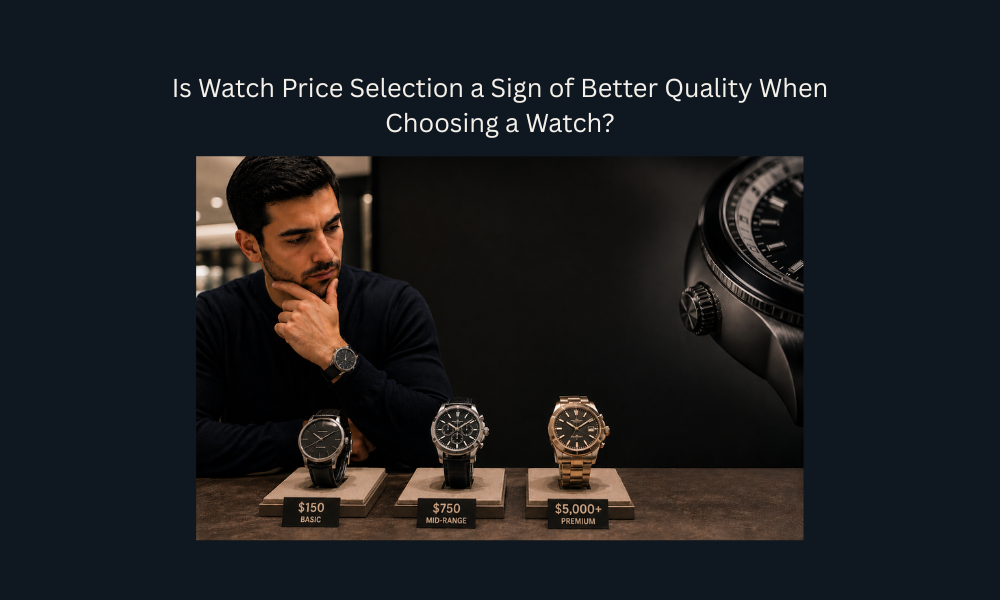
Is Watch Price Selection a Sign of Better Quality When Choosing a Watch?
Executing an objective Watch Price Selection requires a structured financial framework that prioritizes raw material specifications, finishing labor, and long-term maintenance costs over artificial retail markups.
Purchasing timepieces based on MSRP without evaluating their underlying technical and material specifications results in severe buyer’s remorse and underutilized capital. Relying solely on retail pricing mechanisms introduces extreme inefficiencies into portfolio allocation. This guide provides the framework for systematically analyzing watch manufacturing costs, separating logo markup from horological merit, and utilizing a quantitative scoring checklist to ensure maximum return-on-investment.
How to define the core purpose of your watch price selection
Establishing your Watch Price Selection requires aligning your target budget with actual utility goals rather than falling for marketing prestige or aesthetic hype.
- Rule: Diminishing returns hit mechanical watchmaking exceptionally early.
- Reason: A $5,000 watch is not ten times more structurally sound or accurate than a $500 watch; most of the price delta goes toward hand-finishing, legacy branding, and corporate marketing campaigns.
- Example: Defining your goal as “durable daily wear” immediately caps your budget, preventing you from overpaying for delicate, high-end luxury complications that do not support active physical lifestyles.
Why MSRP does not guarantee structural value in your watch price selection
Understanding why MSRP fails to guarantee structural value in your Watch Price Selection requires a clear distinction between a timepiece’s physical manufacturing cost and its synthetic retail markup.
To execute a logical timepiece cost evaluation, we must isolate the material inputs. High-grade stainless steel, sapphire crystals, and even industrial movements have highly predictable wholesale costs. Research and development investments, which can cost millions for new movements, often necessitate high retail pricing 1.
This dynamic is driven by the Veblen good effect. Luxury watches frequently act as status markers where demand increases as the price rises, allowing manufacturers to implement aggressive price increases that do not correlate with material or labor improvements. The consumer’s primary defense is recognizing that higher price tags often reflect synthetic exclusivity rather than a parallel rise in physical durability or mechanical utility.
What specifications separate budget tiers in your watch price selection
Analyzing your Watch Price Selection involves mapping out the exact physical features, finishing levels, and movement calibers that define each major pricing tier in the market.
Value Tier Specifications Matrix
Entry Tier ($<$500): Mineral or entry sapphire crystal, mass-produced quartz or basic mechanical movement (e.g., Seiko NH35), basic stamped clasps. → Value Expectation: Highly durable, simple aesthetics, functional accuracy.
Mid Tier ($500 – $2,000): Sapphire crystal with AR coating, regulated Swiss/Japanese movements (e.g., ETA, Sellita, Miyota 9000 series), milled clasps, and cleaner hand-applied dial markers. → Value Expectation: Excellent daily-wear longevity, reliable accuracy, refined finishing.
Luxury Tier ($2,000 – $10,000): In-house or heavily modified chronometer-certified movements, intricate hand polishing (e.g., Zaratsu), precious metals or high-grade alloys, premium brand heritage. → Value Expectation: Horological prestige, superior mechanical complexity, high resale potential.
Are microbrands outperforming legacy houses in your watch price selection
Determining your Watch Price Selection requires assessing whether your money is better spent on raw, specification-dense independent microbrands or the historic safety of established legacy houses. Microbrands often prioritize sapphire crystals, reliable Swiss movements, and transparent pricing by selling directly to consumers, redirecting funds typically used for advertising toward internal components 2.
Microbrand ($500): Sapphire, ceramic bezel, 300m water resistance, regulated movement, tool-free micro-adjust clasp. → Result: Maximum physical specifications-per-dollar; lacks mainstream brand recognition.
Legacy Brand ($1,500): Mineral crystal, aluminum bezel, 100m water resistance, basic movement, stamped clasp. → Result: Massive retail markup for the logo; offers high global brand awareness and historic trust.
Do luxury brand markups justify your watch price selection
Weighing the merits of a Watch Price Selection requires analyzing when a premium price actually translates to superior finish and design, versus when it is purely an artificial price-floor trap. Higher prices in luxury segments are often driven by intensive labor costs, where artisans spend extensive time on hand-finishing and assembly to reach top-tier standards 1.
If you are evaluating a luxury sports watch in the $5,000+ range → Do examine the case under a 10x loupe, testing bezel alignment, hand beveling, and movement decoration → Result you easily separate genuine haute horlogerie craftsmanship (such as hand-beveled anglage and flat-polished screws) from lazy assembly-line watches riding on brand name alone.
How to prevent “hype tax” overpayment in your watch price selection
Preventing overpayment in your Watch Price Selection demands protecting your capital from artificial waitlists, secondary-market bubbles, and status-driven pricing markup.
Hype vs. Real Value Depreciation
- The Risk: Paying a 100% aftermarket premium to bypass a retail waitlist (e.g., hot steel sports models). → The Reality: The bubble will eventually burst, locking you into a massive financial loss on a watch that physically belongs in a lower tier.
- The Risk: Assuming a high price tag guarantees strong future resale liquidity. → The Reality: Outside of a select few ultra-luxury models, most watches lose 20-40% of their retail value the second you walk out of the store.
Is auditing long-term maintenance costs critical to your watch price selection
Auditing maintenance within your Watch Price Selection is critical to preventing future financial shock by mapping out the mandatory 10-year servicing and repair costs associated with your chosen price point.
10-Year TCO Comparison
- Rule: The cheaper the mechanical watch, the more logical it is to replace rather than service.
- Reason: Servicing a basic $200 mechanical watch costs more than buying a brand-new replacement movement, whereas a $10,000 watch demands a $1,000 service overhaul every 5-7 years to maintain its value.
- Example: Factor in service costs early: if a $1,000 mechanical watch stretches your budget to its limit, a quartz or high-end solar model is the safer economic path.
How to conclude your watch price selection with this final execution checklist
Concluding your Watch Price Selection requires transforming the dynamic price-to-quality variables into a practical, quantifiable scoring system before making a purchase.
Score 5/5: Immediate Buy. The price matches the physical craftsmanship and fits your long-term budget perfectly.
Score 3-4/5: Pause. Identify where you are overpaying (e.g., paying a 30% premium strictly for brand history) and consciously accept that tradeoff before buying.
Score <3/5: Hard Pass. Do not buy; the extreme pricing markup guarantees massive buyer’s remorse once the initial honeymoon phase fades.
Support Appendix: Resolving advanced pricing anomalies in your watch price selection
Q: Why do some quartz watches cost thousands of dollars?
A: High-end quartz watches (HAQ) feature temperature-compensated quartz crystals accurate to ± 5 seconds per year, custom high-torque motors, and the exact same premium hand-finished cases as their mechanical counterparts.
Q: Can a watchmaker tell the difference between a $1,000 watch and a $10,000 watch?
A: Yes, instantly. Under magnification, the $10,000 watch will display flawless hand-beveled edges (anglage) on the movement plates, perfectly polished screw heads, and intricate dial details that automated machine assemblies on $1,000 watches cannot replicate.
Q: Is it always safer to buy pre-owned to avoid initial depreciation?
A: Generally, yes. Buying a pre-owned luxury watch allows the original owner to absorb the initial 20-40% drop in value. However, you must verify service history, as a pre-owned watch requiring an immediate $800 movement overhaul can quickly wipe out those savings.
Q: What is the “Veblen good” effect in luxury watch pricing?
A: In luxury horology, some watches act as Veblen goods, meaning demand actually increases as the price rises because the item is purchased as a status symbol. This market dynamic allows elite legacy brands to implement aggressive price increases that do not correlate with manufacturing cost improvements.
Q: How does bracelet and clasp engineering affect watch price selection?
A: Bracelet engineering is incredibly capital-intensive. Entry-tier watches often use cheap stamped metal clasps and hollow links that rattle. Mid-to-high tier pricing unlocks solid end-links, milled steel clasps, and on-the-fly micro-adjust mechanisms, which dramatically improve daily ergonomics and wearability.
Q: Does a COSC chronometer certification justify a higher watch price?
A: Partially. Obtaining a COSC certification requires sending the movement to an independent Swiss laboratory for 15 days of testing across five positions and three temperatures. While it guarantees an accuracy of ± 4/+6 seconds per day, the lab fees and associated administrative markups are passed directly to the buyer, raising the retail price.
Sources & References
Concluding your watch price selection with a value-first mindset
Concluding your Watch Price Selection with a value-first mindset ensures that your financial allocation remains rooted in objective data rather than temporary design hype.
By shifting from the illusion of retail MSRP to a strategic value assessment, an investor can clearly distinguish between marketing markup and mechanical excellence. Prioritizing objective specifications, material quality, and real-world comfort ensures you acquire a timepiece that delivers true value to your wrist, protecting your hard-earned budget from status-driven markup traps.