
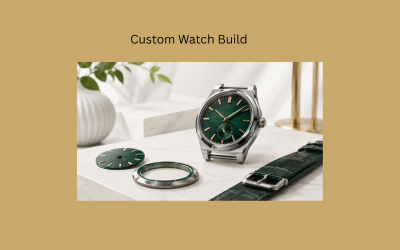
How to Plan a Custom Watch Build
Planning a custom watch build requires engineering a strict project charter that transforms individual horological components into a systematically assembled, high-performance mechanical instrument.
Utilizing a phase-gated methodology eliminates project overwhelm and mechanical failures like stack rubbing or isochronal drift. This P5 Project Protocol guide provides the framework for establishing your North Star, deconstructing the build into conceptual and technical gates, and verifying final regulation to achieve professional-grade results.
Live Build Performance Tracker
METROLOGY CONSOLE V1.0Establish the North Star for your Custom Watch Build
Understanding the North Star for your Custom Watch Build involves establishing a strict “Definition of Done” (DoD) to prevent scope-creep and design confusion before parts are ordered. The charter serves as a rigid technical contract between the builder and the project requirements, ensuring each component selection is justified by performance data.
Charter Component Matrix
| Component | Engineering Benchmark | Strategic Justification |
|---|---|---|
| Optical Standard | Double-Domed Sapphire | High scratch resistance; $10\text{x}$ clarity. |
| Accuracy Target | $\pm 5\text{ s/d}$ | Matches professional chronometer specifications. |
| Environmental Seal | $5\text{ ATM (50 meters)}$ | Verified via dry-pressure testing for daily immersion. |
Deconstruct the Custom Watch Build into the P5 Project Protocol
Deconstructing your Custom Watch Build into the P5 Project Protocol requires organizing the assembly into five gated phases to manage technical momentum and technical accountability. Each phase acts as a filter, preventing errors in procurement or preparation from cascading into the final assembly.
P5 Project Protocol Roadmap
Choose compatible components for your Custom Watch Build
Choosing compatible components for your Custom Watch Build necessitates the verification of exact mechanical dimensions to ensure total system harmony between the caliber and the case. The NH35A movement serves as the core engine, featuring $24$ jewels, a frequency of $21,600\text{ bph}$ ($3\text{ Hz}$), a $53^\circ$ lift angle, and the Magic Lever bidirectional winding system. Engineering success depends on matching these movement specs with $316\text{L}$ stainless steel casings and $150/90/21\text{ micron}$ standard ($1.50/0.90/0.21\text{ mm}$ arbors) hand sets.
Arbor Component Schematic
NH35A GEOMETRIC TOLERANCE (mm)
Fitting Force Table
| Hand Type | Fitting Force Benchmark | Consequence of Failure |
|---|---|---|
| Hour/Minute Hand | $< 50\text{ N}$ | Arbor deformation or movement seizure. |
| Second Hand | $< 30\text{ N}$ | Pivot fracture or pinion misalignment. |
Inspect & Prepare
Inspecting and preparing components for your Custom Watch Build requires a forensic audit under $10\text{x}$ magnification to identify defects before technical assembly commences. Metrological skepticism dictates that every part is assumed defective until verified. A Timegrapher baseline must be established to confirm movement health; a functional NH35A movement should exhibit an amplitude between $280^\circ$ and $320^\circ$. An amplitude recording below $230^\circ$ indicates the presence of dried factory lubricants.
Technical Assembly
Executing the technical assembly orchestration involves the metrological verification of component integration. This process is an audit of mechanical clearances, verifying parallel hand alignment via $10\text{x}$ loupe to prevent friction. The 12:00 Rule Validation ensures the “horological midnight” snap aligns precisely with the $12:00$ index.
Stem Integration Schematic (Iterative Sneak Up)
Regulate and verify Custom Watch Build performance
Regulating and verifying the performance involves testing the finished instrument against the original charter requirements using multi-positional timing analysis. Symmetry is achieved by adjusting the stud carrier to reach a beat error target of $\le 0.1\text{ ms}$, which is vital for maintaining isochronism. Environmental integrity is confirmed via ISO 22810 validation; this includes a dry-pressure vacuum phase to measure crystal warp. A condensation test—heating the watch to $45^\circ\text{C}$ and applying a cold drop to the crystal—is performed to detect residual moisture.
Multi-Positional Reference Map
Pressure Logic (Dry-Vacuum)
Analyze results via the Custom Watch Build post-mortem
Analyzing results via the Custom Watch Build post-mortem involves a technical debrief $48$ hours after initial wear to transform individual assemblies into a cumulative body of expertise. This phase identifies friction points in the workflow that may lead to component damage or calibration drift.
P5 Refinement Matrix
| What Went Well | What Went Wrong | Future Action |
|---|---|---|
|
Timegrapher check
|
Scratched hand finish | Upgrade to brass tweezers. |
|
Perfect 12:00 alignment
|
Dust under crystal | Implement ionized air blower. |
Custom Watch Build Checklist
Resolving common technical questions
Misaligned chapter ring?
This is a Phase 4 integration failure. Remove the movement and adjust dial feet or utilize dial dots for micro-adjustments before final casing to ensure index symmetry.
Tool selection requirements?
Professional results demand specific horological tools: press-style hand-setters, dedicated movement holders, and brass tweezers. Household tools increase the risk of preventable Phase 5 errors.
NH35 Regulation feasibility?
Achieving $\pm 5\text{ s/d}$ on an NH35 is realistic but requires multi-positional patience in Phase 5. Use a timegrapher and the “Counter-Balance” method to optimize beyond factory tolerances.