
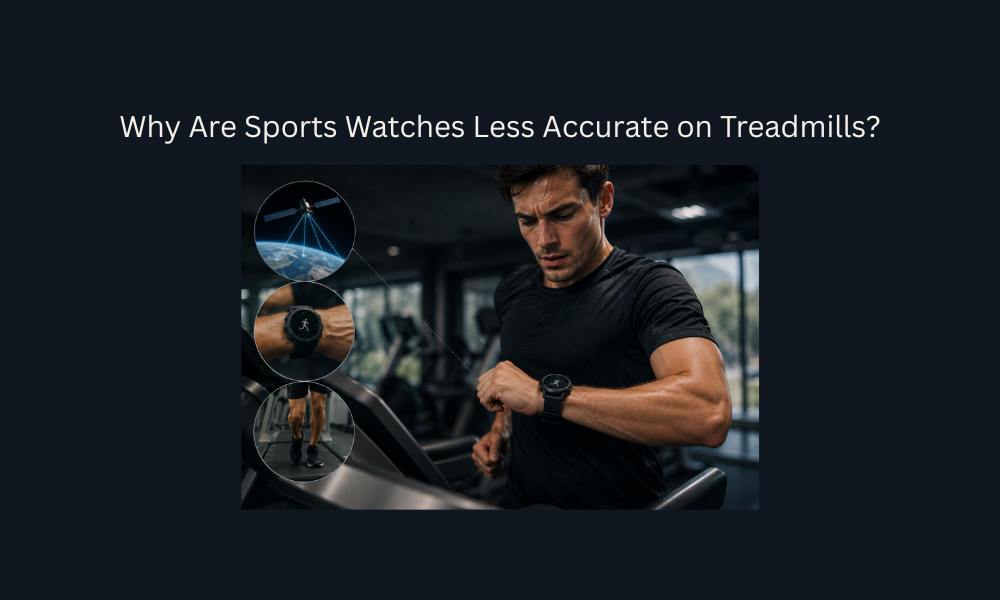
Why Are Sports Watches Less Accurate on Treadmills?
Executing a sound assessment of indoor biometric data requires a structured diagnostic framework that prioritizes Treadmill Tracking Accuracy, algorithmic stride estimation, and proper hardware calibration over blind reliance on wrist sensors. Relying on standard wrist accelerometers during indoor running leads to massive distance discrepancies, ruined pacing data, and skewed caloric burn metrics. This guide provides the framework for systematically diagnosing algorithmic limitations, assessing the necessity of external foot pods, and utilizing a quantitative scoring checklist to ensure maximum indoor data precision.
How to define the core mechanics of your treadmill tracking accuracy
Defining the core mechanics of your Treadmill Tracking Accuracy establishes the foundational shift from absolute outdoor satellite measurement (like Dual-Frequency GNSS accuracy) to indoor algorithmic estimation.
Rule: Indoor distance is a calculated guess, not a measurement.
Reason: When the watch loses its GPS connection indoors, it cannot track your actual physical displacement through space; instead, it must rely solely on an internal accelerometer to count your arm swings.
Example: Defining your baseline as “algorithmic stride estimation” immediately explains why a $5\text{-mile}$ run on the treadmill screen might only show as $3.5\text{ miles}$ on your wrist.
Why does arm swing anchor your treadmill tracking accuracy
Understanding why arm swing anchors your Treadmill Tracking Accuracy establishes how the internal accelerometer uses the rhythmic, pendulum-like motion of your arm to determine your cadence (steps per minute).
The hardware functions as an inertial measurement unit, detecting acceleration and deceleration at the extremity. To generate a functional indoor cadence estimation, the sensor measures these repetitive velocity changes. Establishing a clean wrist biomechanics baseline guarantees the calculation functions correctly. The device depends on uninterrupted kinetic energy; stalling arm motion immediately halts the data flow.
Kinetic Velocity Detection
The watch isolates the pendulum cycle of the wrist. Pausing arm motion drops kinetic detection to zero.
What algorithmic limitations define your treadmill tracking accuracy
Determining what algorithmic limitations define your Treadmill Tracking Accuracy involves weighing the fundamental flaw of accelerometer-based tracking: it assumes your stride length never changes, regardless of your speed.
Static Estimation vs. Dynamic Stride
Outdoor GPS Tracking
Measures exact start and end coordinates.
Indoor Accelerometer Tracking
Multiplies your step count by an average, pre-programmed stride length.
Are foot pod calibrations critical for your treadmill tracking accuracy
Evaluating if foot pod calibrations are critical for your Treadmill Tracking Accuracy requires determining the necessity of bypassing the wrist sensor entirely in favor of dedicated hardware mounted to your shoe. Injecting shoe-mounted sensor precision into the data stream replaces estimations with direct kinetic measurements. Implementing this stride calibration hardware isolates the foot strike geometry from the arm swing.
3D Foot Strike Isolation
Do incline metrics impact your treadmill tracking accuracy
Analyzing how incline metrics impact your Treadmill Tracking Accuracy injects commercial realism by explaining how indoor elevation changes completely break watch-based caloric and effort algorithms.
If you set the treadmill to a brutal $12\%$ incline and hike for $45\text{ minutes}$
→ Do recognize that the watch accelerometer only detects slow, short steps on a flat plane
→ Result the watch will massively underreport your distance, pace, and calories burned unless it is paired with an external heart rate monitor to prove the intense physical effort.
Is managing handrail contact essential to your treadmill tracking accuracy
Assessing if managing handrail contact is essential to your Treadmill Tracking Accuracy prevents total data failure by addressing the most common user error on indoor walking machines.
Rule: Accelerometers require continuous motion.
Reason: If you hold onto the treadmill handrails, your wrist remains perfectly static in space, completely deadening the accelerometer.
Example: Opting to completely release the handrails and allow a natural, rhythmic arm swing to ensure the watch actually registers your steps.
How to prevent stride length mistakes in your treadmill tracking accuracy
Preventing stride length mistakes in your Treadmill Tracking Accuracy involves matching your watch’s calibration settings to your specific biomechanics to avoid wildly inaccurate treadmill data.
How to conclude your treadmill tracking accuracy with this final execution checklist
Concluding your Treadmill Tracking Accuracy with this final execution checklist provides a strong, execution-oriented closure that transforms the algorithmic limitations into an actionable pre-run audit.
Rule: A scored checklist separates clean indoor data from useless, uncalibrated guesses.
Reason: Quantifying your arm swing, calibration, and hardware ensures you get credit for your indoor miles.
Example: Only finalizing your workout data if your setup scores perfectly on the indoor tracking audit.
Pre-Run Execution Checklist
- Arm Swing Audit: Committed to running completely hands-free, avoiding the handrails at all times.
- Calibration Check: Completed at least $3$ outdoor GPS runs recently to allow the watch to learn your natural stride length.
- Hardware Enhancement: Paired a dedicated foot pod if precision interval tracking is required indoors.
- Incline Awareness: Accepted that the watch cannot independently detect or calculate the extra effort of a steep treadmill incline.
- Post-Run Sync: Utilized the “Calibrate & Save” feature on the watch at the end of the run to manually enter the treadmill’s distance.
Support Appendix: Advanced Treadmill Tracking FAQ
This appendix integrates troubleshooting seamlessly into the task flow to resolve advanced tracking confusion and data friction regarding your Treadmill Tracking Accuracy.
Q: Why does my watch ask me to “Calibrate & Save” at the end of a treadmill run?
A: Modern sports watches allow you to manually enter the distance displayed on the treadmill console before saving the activity. This not only fixes the current workout’s data but also subtly adjusts the internal algorithm for your next indoor run.
Q: Can I put my watch in my pocket if I want to hold the handrails?
A: Yes. If you must hold the handrails (e.g., during a steep walking hike), placing the watch in your pocket allows the accelerometer to track the distinct up-and-down motion of your hips/legs, resulting in a much more accurate step count than a static wrist.
Q: Are treadmill screens actually accurate?
A: Rarely. Unless rigorously maintained and calibrated by the gym staff weekly, treadmills suffer from “belt slippage.” Every time your foot strikes the belt, friction slows it down microscopically. A treadmill often claims you ran $5\text{ miles}$ based on motor rotations, but you actually covered $4.8\text{ miles}$ of physical belt space.
References & Sources
Conclusion
By systematically understanding the hard shift from satellite precision to algorithmic accelerometer estimation, mastering the absolute necessity of uninterrupted arm swing, and acknowledging the profound benefits of a calibrated foot pod, you elevate your indoor training through masterful Treadmill Tracking Accuracy. Recognizing that your sports watch is essentially “blind” indoors ensures you take the proper physical and hardware steps to guarantee every single mile, sprint, and calorie is accurately recorded.