
How Does the Seiko Presage Compare to the Orient Bambino?
A structured evaluation framework for the sub-$<\$500$ entry-level automatic dress watch market.
Executing a precise Presage vs Bambino Comparison requires a structured evaluation framework that prioritizes dial execution, mechanical reliability, and commercial value over arbitrary brand loyalty. Forcing a choice between the two titans of entry-level Japanese watchmaking without understanding their distinct design philosophies leads to acquiring a piece that clashes with the wearer’s wardrobe and budget. This guide provides the framework for systematically evaluating dial artistry, assessing in-house mechanical calibers, and utilizing a quantitative scoring checklist to finalize your entry-level dress watch acquisition.
How to define the core framework of your Presage vs Bambino comparison
Defining the core framework of your Presage vs Bambino Comparison establishes the foundational battleground of the sub-$<\$500$ entry-level automatic dress watch market and what buyers are actually seeking.
- Rule: Value is defined by execution, not just price.
- Reason: Both watches offer in-house Japanese mechanical movements, meaning the true decision rests on aesthetic execution and daily wearability.
- Example: Defining your goal as “finding the ultimate entry-level dress watch” frames the comparison perfectly between Seiko’s artistic flair and Orient’s vintage minimalism.
Why does dial finishing anchor your Presage vs Bambino comparison
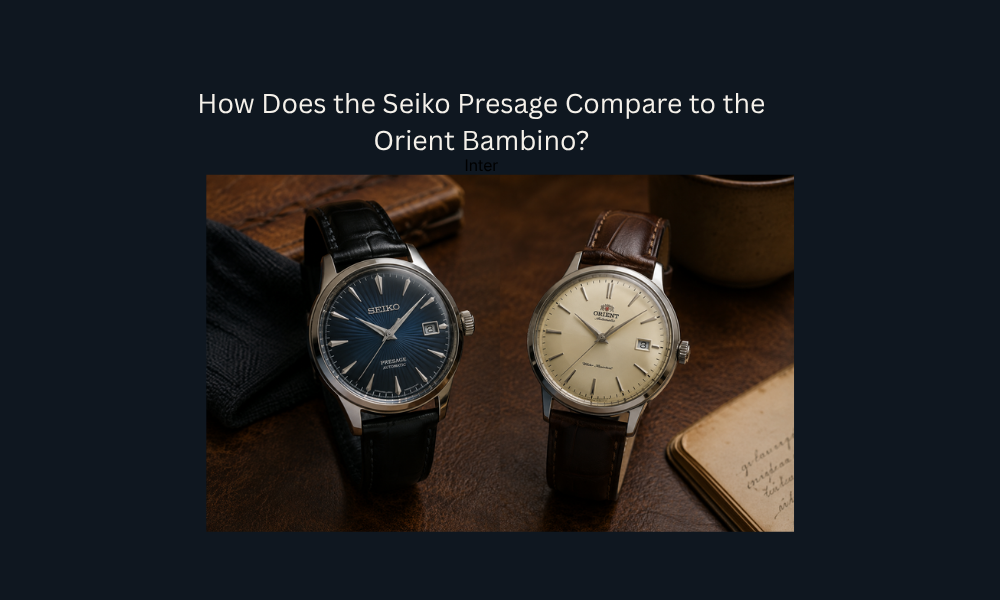
Understanding why dial finishing anchors your Presage vs Bambino Comparison requires establishing how the stark contrast in dial manufacturing philosophies immediately separates the target audience for each watch. Entry-level dial aesthetics dictate the visual hierarchy of the timepiece. Seiko utilizes complex, stamped textures—such as the sunburst pattern found on the Seiko Presage Cocktail Time—to bend light and maximize surface interest. In direct contrast, Orient relies on clean, domed simplicity. Sub-$<\$500$ watch finishing rarely diverges so sharply, positioning the Orient Bambino as a masterclass in understated elegance against Seiko’s dynamic flash.
What mechanical movements define your Presage vs Bambino comparison
Determining what mechanical movements define your Presage vs Bambino Comparison involves weighing the performance, finishing, and reliability of the respective entry-level in-house Japanese calibers.
- Seiko Presage (Caliber 4R35): Features hacking, hand-winding, and a decorated gold-tone rotor visible through an exhibition case back. $\rightarrow$ Result: Offers excellent visual appeal for beginners who want to see the mechanics of their watch.
- Orient Bambino (Caliber F6724): Upgraded to feature hacking and hand-winding, housed behind a solid steel case back. $\rightarrow$ Result: Utilitarian and highly durable, keeping costs down while matching Seiko’s core functionality.
Are case dimensions critical for your Presage vs Bambino comparison
Evaluating if case dimensions are critical for your Presage vs Bambino Comparison demands determining how the varying diameters and crystal shapes impact traditional formalwear rules and cuff clearance. Dress watch proportions govern wearability, requiring a strict dimension compatibility analysis to ensure the case fits securely against the wrist.
- Seiko Presage (typically $40.5\text{mm}$): Slightly larger, modern proportions with a boxed hardlex crystal. $\rightarrow$ Result: Highly visible and flashy; leans slightly toward a “statement” dress watch rather than pure traditional understatement.
- Orient Bambino ($38\text{mm}$ & $40.5\text{mm}$ options): Features an iconic, aggressively domed mineral crystal. $\rightarrow$ Result: The $38\text{mm}$ version provides perfect, historically accurate vintage sizing that slides effortlessly under tight cuffs.
While the stated $38\text{mm}$ or $40.5\text{mm}$ diameters offer a reliable starting point for formalwear compatibility, understanding how either timepiece will actually sit on your wrist requires looking beyond horizontal width, as the effective case footprint and overhang risk are ultimately dictated by the vertical span across your arm.
Do price differences impact your Presage vs Bambino comparison
Analyzing how price differences impact your Presage vs Bambino Comparison injects commercial realism by evaluating whether the Seiko’s premium price tag justifies its upgrades over the hyper-affordable Orient.
If you have a strict budget of under $<\$200$ for your first formal watch $\rightarrow$ Do immediately prioritize the Orient Bambino $\rightarrow$ Result you secure a universally respected, in-house mechanical dress watch without paying the $\$350+$ premium demanded by the Seiko Presage.
Is assessing strap quality essential to your Presage vs Bambino comparison
Assessing if strap quality is essential to your Presage vs Bambino Comparison prevents immediate buyer frustration by addressing the notorious shared weakness of both entry-level Japanese watches.
- Rule: Entry-level factory leather is a placeholder.
- Reason: To keep the retail prices low, both brands equip these watches with stiff, plasticky leather straps that degrade quickly.
- Example: Opting to budget an extra $\$30$ to $\$50$ for an aftermarket suede or calfskin strap the moment you purchase either watch.
How to prevent stylistic mismatch in your Presage vs Bambino comparison
Preventing stylistic mismatch in your Presage vs Bambino Comparison involves matching the specific watch vibe (flashy vs. subdued) to your actual wardrobe to avoid buying a piece that clashes with your daily style.
- The Risk: Buying a vibrant, sunburst-blue Seiko Presage Cocktail Time for a somber, ultra-conservative corporate environment. $\rightarrow$ The Reality: The highly reflective dial draws massive attention, violating the core rule that formal watches should be understated.
- The Risk: Buying a vintage-styled Orient Bambino with Roman numerals to wear with casual streetwear. $\rightarrow$ The Reality: The strict mid-century design language severely clashes with modern casual clothing, creating a confusing aesthetic.
How to conclude your Presage vs Bambino comparison with this final execution checklist
Concluding your Presage vs Bambino Comparison with this final execution checklist provides a strong, execution-oriented closure that transforms the technical comparison into an actionable scoring system.
- Rule: A scored checklist ensures you buy the watch that matches your specific lifestyle.
- Reason: Quantifying dial preference, budget, and size prevents buyer’s remorse.
- Example: Only finalizing the purchase if the chosen watch scores perfectly against your budget and wardrobe.
Execution Checklist
Scoring Interpretation:
Score $5/5$: Immediate Buy. You have clearly identified the champion that fits your budget and formalwear needs.
Score $3-4/5$: Pause. Identify the hesitation (e.g., you want the Seiko dial but only have the Orient budget) and wait before purchasing.
Score $<3/5$: Hard Pass. Do not buy either; your budget or taste requires a Swiss watch or a sapphire crystal, meaning both Japanese entry-level options will disappoint you.
Support Appendix: Advanced Presage & Bambino Troubleshooting & FAQ
This appendix integrates troubleshooting seamlessly into the task flow to resolve advanced buying friction and hardware confusion regarding your Presage vs Bambino Comparison.
Conclusion
By systematically evaluating the intricate, cocktail-inspired dial artistry of the Seiko against the timeless, ultra-affordable vintage charm of the Orient, you elevate your purchase decision through a precise Presage vs Bambino Comparison. Both timepieces represent the absolute pinnacle of entry-level in-house watchmaking; your final choice simply dictates whether you are willing to pay a premium for flashy dial finishing or prefer the unbeatable value of pure, understated mid-century minimalism.