
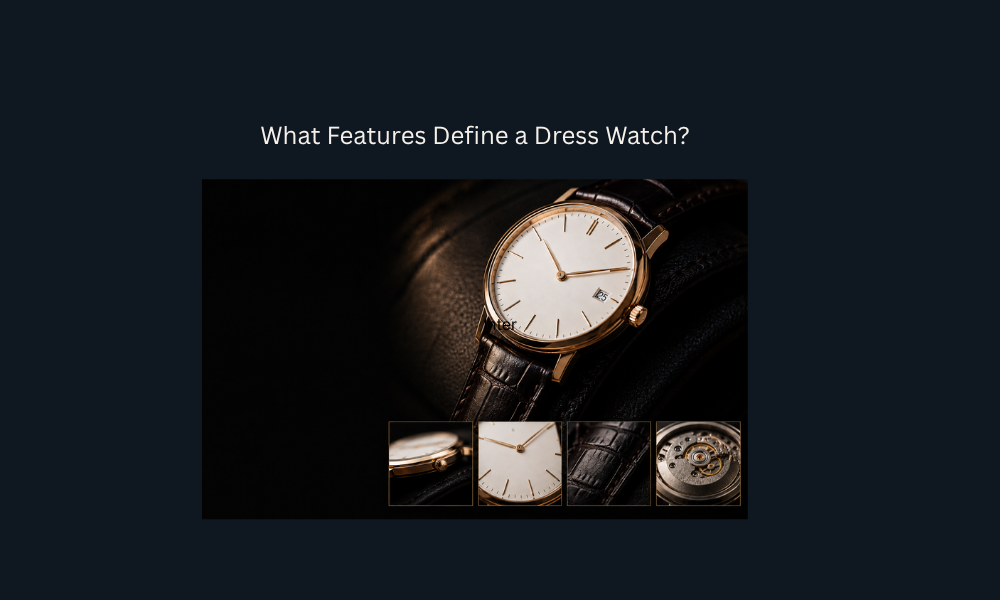
What Features Define a Dress Watch?
Executing a true standard of formal elegance requires a structured Dress Watch Feature Evaluation that prioritizes slim case profiles, absolute dial minimalism, and strict sartorial coordination over impulsive, status-driven flashiness. Wearing oversized, highly complicated sports watches with formalwear blatantly breaks fundamental styling rules and visually ruins the line of a suit. This guide provides the framework for systematically evaluating case thickness, dial purity, and material coordination, utilizing a quantitative scoring checklist to finalize your formal acquisition.
How to define the core purpose of your dress watch feature evaluation
Defining the core purpose of your Dress Watch Feature Evaluation establishes the foundational philosophy that formal timepiece features are designed to complement formal attire rather than draw attention.
- Rule: Restraint defines elegance.
- Reason: A formal timepiece must disappear gracefully under a fitted French cuff and only be noticed when deliberately checking the time.
- Example: Defining your goal as “unobtrusive sophistication” immediately eliminates thick dive bezels and neon chronographs from your selection parameters.
Why does dial minimalism anchor your dress watch feature evaluation
Understanding why dial minimalism anchors your Dress Watch Feature Evaluation requires establishing how clean, uncluttered dials provide the visual purity required for formal environments. Formal timepiece aesthetics demand a distinct absence of visual noise. The classic watch definition centers entirely on legibility and grace. By utilizing time-only or simple date layouts, you actively prevent the visual distraction associated with complex tool watches, ensuring the eye remains focused on the precision of the entire outfit rather than a singular accessory.
What makes a slim profile essential in your dress watch feature evaluation
Determining what makes a slim profile essential in your Dress Watch Feature Evaluation involves weighing the necessity of a thin case against thicker sports watch designs to ensure proper cuff clearance.
- Ultra-Thin ($<6\text{mm}$): Requires specialized, highly fragile movements. → Result: The pinnacle of haute horlogerie; slides invisibly under the tightest tuxedo cuffs.
- Classic Thin ($6\text{mm} – 10\text{mm}$): Standard formal profile. → Result: Effortlessly clears business shirt cuffs while maintaining structural daily durability.
- Sport Profile ($12\text{mm}+$): Bulky and top-heavy. → Result: Will catch on fitted sleeves, ruining the drape of the jacket and breaking formal etiquette.
Are traditional case dimensions viable for your dress watch feature evaluation
Evaluating if traditional case dimensions are viable for your Dress Watch Feature Evaluation requires determining the appropriate case diameter to ensure the watch remains proportional and subservient to the wrist. Formal watch sizing dictates that the lugs should never overhang the wristbone. Mastering timepiece dimension selection guarantees a seamless integration with formal garments.[1]
- Classic/Vintage Proportions ($34\text{mm} – 36\text{mm}$): The historical standard for formal wear. → Result: Highly understated; perfect for black-tie events.
- Modern Dress Proportions ($38\text{mm} – 40\text{mm}$): The contemporary sweet spot. → Result: Balances wrist presence with elegance, transitioning easily to business casual.
- Oversized ($42\text{mm}+$): Too large for traditional dress standards. → Risk: Creates a “dinner plate” effect that draws unwanted attention at formal gatherings.
Do leather straps and precious metals impact your dress watch feature evaluation
Analyzing how leather straps and precious metals impact your Dress Watch Feature Evaluation injects styling realism by explaining why high-quality leather and polished metals are the historical standards over metal bracelets.[2] Sourcing the correct material texture, such as a premium alligator leather strap, elevates the entire ensemble.
- If you are attending a strict formal or black-tie event → **Do** prioritize a black leather strap with a simple pin buckle on a polished gold or steel case → **Result** you maintain classic elegance and avoid the sporty, heavy visual distraction of metal links.
Is assessing complication limits critical for your dress watch feature evaluation
Assessing complication limits is critical for your Dress Watch Feature Evaluation to prevent aesthetic clutter by understanding why traditional dress watches omit seconds hands, chronographs, and rotating bezels.
- Rule: Excess features ruin formal simplicity.
- Reason: In classic high-society etiquette, tracking the exact second implies you are rushing or bored.
- Example: Opting for a simple two-hand (hours and minutes) layout to project an aura of calm, unhurried sophistication.
How to prevent stylistic clashing in your dress watch feature evaluation
Preventing stylistic clashing in your Dress Watch Feature Evaluation involves matching the watch’s formality level to your actual wardrobe to avoid blatant fashion errors.
- The Risk: Forcing a thick, steel dive watch into a strict black-tie tuxedo event. → The Reality: It violates formal etiquette and looks entirely out of place.
- The Risk: Wearing an ultra-thin, highly polished gold watch on alligator leather with a t-shirt. → The Reality: The delicate luxury aesthetic severely clashes with the casual clothing.
Securing a timepiece with the correct proportions and aesthetic purity is only the first phase of sartorial execution. To maximize the visual impact of these minimal features, you must systematically navigate occasion-based watch selection to ensure your hardware aligns perfectly with the specific dress codes of your calendar.
How to conclude your dress watch feature evaluation with this final execution checklist
Concluding your Dress Watch Feature Evaluation with this final execution checklist provides a strong, execution-oriented closure that transforms the aesthetic rules into an actionable scoring system.
- Rule: A scored checklist ensures adherence to formal tradition.
- Reason: Quantifying minimalism prevents the accidental purchase of a sporty hybrid.
- Example: Only finalizing the purchase if the thickness, dial, and strap score perfectly for your formal needs.
- Thickness Audit: Verified the case is under $10\text{mm}$ thick to easily clear tight shirt cuffs.
- Minimalism Check: Confirmed the dial is free of unnecessary text, chronographs, or rotating bezels.
- Proportion Match: The case diameter remains under $40\text{mm}$ to maintain a subtle footprint.
- Strap Coordination: Selected a high-quality leather strap rather than a sporty metal bracelet.
- Material Acceptance: Budgeted appropriately for polished steel or a traditional precious metal.
- Score $5/5$: Immediate Buy. The watch perfectly embodies elegant restraint for formal attire.
- Score $3-4/5$: Pause. Identify the compromised factor (e.g., a slightly busy dial) and decide if it limits your specific formal use-case.
- Score $<3/5$: Hard Pass. Do not buy; the watch is too thick, too busy, or too sporty to function as a true dress piece.
Support Appendix: Advanced Dress Watch Features FAQ
This appendix integrates troubleshooting seamlessly into the task flow to resolve advanced styling confusion and formal etiquette regarding your Dress Watch Feature Evaluation.
-
Q: Can a dress watch have Arabic numerals?
A: While modern dress watches sometimes use Arabic numerals (1-12), traditional horological etiquette dictates that applied baton indices or Roman numerals are far more formal and elegant. -
Q: Do I need a mechanical movement for a dress watch?
A: No. While mechanical movements offer prestige, high-end quartz movements are incredibly thin, allowing manufacturers to create ultra-slim cases that perfectly fulfill the physical requirements of a dress watch. -
Q: Can I wear a dress watch every day?
A: Yes, especially in office environments. A simple dress watch pairs beautifully with business casual attire. However, its low water resistance and scratch-prone polished case make it unsuitable for weekend sports or heavy labor.
Concluding your dress watch feature evaluation with intentional restraint
By systematically evaluating the precise dimensions, dial simplicity, and refined hardware of a timepiece, you elevate your selection into a comprehensive Dress Watch Feature Evaluation. Prioritizing a slim profile and uncompromised minimalism ensures that the watch acts as a seamless, sophisticated extension of your formal wardrobe. A true dress watch delivers timeless elegance that never screams for attention.
References & Citations
- Davosa Watches. “Watch Size Guide.” https://davosa-usa.com/blogs/story-time/watch-size-guide
- WatchPilot. “Leather vs. Metal Band: Which is Right for You?” https://www.watchpilot.com/blogs/news/leather-vs-metal-band