
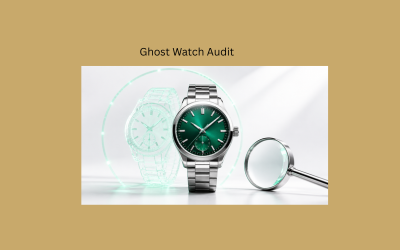
The “Ghost Watch”
Audit Strategy
Transition from emotional attachment to a quantitative diagnostic process that identifies underperforming capital based on friction data.
Executing a Ghost Watch audit strategy requires a transition from emotional attachment to a quantitative diagnostic process that identifies underperforming capital based on friction data. An unworn “safe queen” represents a failure in financial efficiency, costing the owner between $\$350$ and $\$800$ per year in hidden maintenance alone.[1] This guide provides the framework for identifying a Ghost Watch, calculating your $CPW$ using service projections, and executing a 7-day diagnostic protocol to maximize wrist-time utility.
How do you define a Ghost Watch within a collection?
Understanding the Ghost Watch requires defining it as a high-value horological asset that remains unworn for upwards of $350$ days per year despite possessing no functional defects.
How does a Ghost Watch impact portfolio efficiency?
Analyzing the impact of a Ghost Watch reveals a state of financial stagnation, particularly when holding assets from depreciating brands during a market consolidation. Used watch prices rose by $1.9\%$ in late 2025,[2] but this growth was unevenly distributed across the secondary market. A $\$10,000$ watch worn once per year incurs a prorated ownership cost of approximately $\$27$ per day when accounting for basic opportunity costs.
Market Consolidation Matrix (2025)
| Brand | Annual Delta % | Position |
|---|---|---|
| Patek Philippe | $+12.1\%$ | Strengthening |
| Rolex | $+4.6\%$ | Stable |
| Grand Seiko | $+1.6\%$ | Growing |
| Blancpain | $-12.6\%$ | Depreciating |
| Jaeger-LeCoultre | $-8.5\%$ | Depreciating |
Figure A: Asset Liquidity Quadrant
How do you calculate the Ghost Watch wrist-time utility?
Calculating the Ghost Watch wrist-time utility involves applying a refined Cost Per Wear formula that amortizes professional servicing costs over the ownership period.
$$CPW = \frac{\text{Price} + \text{Maint.}}{\text{Days Worn}}$$
What are the Projected Maintenance Costs?
The Utility-to-Value ratio is further skewed by Projected Maintenance figures. Owners must account for these rising costs when determining if an asset justifies its position in the safe.
| Watch Category | Standard Service (USD) | Range Incl. Parts |
|---|---|---|
| Rolex Submariner | $\$800 – \$1,100$ | $\$1,200+$ |
| Rolex Daytona | $\$1,300 – \$1,600$ | $\$2,000+$ |
| Patek Nautilus | $\$3,500 – \$8,000$ | Variable |
| Omega Co-Axial | $\$700$ | $\$900+$ |
What friction variables prevent Ghost Watch integration?
Independent Variables: Mass and Density
The physical weight of an asset is often the primary driver of under-utilization. An $18\text{k}$ gold Submariner weighs between $238.9\text{g} – 296\text{g}$, whereas the stainless steel equivalent remains at a manageable $155\text{g}$.[3] Transitioning to Titanium offers a $40\%$ weight reduction, significantly lowering the barrier to daily wear.
Confounding Variables: Biology and Social Pressure
Heat edema—thermal expansion caused by dilated blood vessels in high humidity—can make a fixed-link bracelet intolerable. Additionally, social etiquette obligations or outdated dress codes can prevent certain tool watches from being utilized in professional settings.
How do you run the 7-day diagnostic protocol? Audit Lab v3.2
Running the 7-day Ghost Watch diagnostic protocol provides the raw data needed to identify the delta between visual appeal and physical haptic comfort. Use the interactive log below to track real-time friction analytics.
Friction Trend Analysis
| Day | Strap Type | Outfit Type | Comfort (1-10) | Style Match (1-10) | Total Friction | Action |
|---|
Scale: $1 = \text{Effortless}; 10 = \text{High Friction}$.
How can you diagnose ergonomic friction through troubleshooting?
Diagnosing ergonomic Ghost Watch friction involves applying the “Golden Rule of Overhang” to determine if the lug-to-lug span exceeds the flat width of the wrist. Lug-to-lug distance is a more accurate predictor of comfort than case diameter.
How can you solve under-utilization using data analysis?
Solving Ghost Watch under-utilization requires a binary decision-making process based on the results of a $30\text{-day}$ follow-up wear experiment.
The Hypothesis
Replacing the $75\text{g}$ steel bracelet with an FKM rubber strap will increase wear frequency by $50\%$ due to weight reduction and improved flexibility.The Experiment
Equipping the asset with FKM (Fluoroelastomer) for its resistance to UV and heat to mitigate the effects of heat edema during a month of consistent environmental exposure.The Result
If wear remains at zero after the 30-day rule period, the watch is confirmed as a lifestyle mismatch, regardless of its horological significance.How do you resolve technical hurdles and behavioral biases?
| Question | Answer / Guidance |
|---|---|
| How often should you perform the audit? | Perform a full portfolio audit every six months. This accounts for shifts in professional formality and seasonal changes in wrist circumference. |
| How can you cure friction for free? | Prioritize personal satisfaction over subjective peer validation from insiders; ignore outdated social rules regarding diver/suit pairings. |
| What is the 30-Day Rule? | If an asset hasn’t been worn for a full month, it has effectively moved out of active rotation and into the Ghost Watch category. |
| What is the Red Line for Liquidation? | If the Friction Score remains above $7/10$ after three different strap swaps and two outfit tests, the asset is considered dead capital. |
Are you ready to conclude your audit? (Final Checklist)
Rule: Success is measured by actual daily wrist-time rather than marketing specifications.
Reason: By prioritizing wrist-time over aesthetic perfection, you ensure capital is never trapped in underperforming assets.