

What Does the Term “B-Uhr” Mean?
B-Uhr is an abbreviation of the German term Beobachtungs-uhr, meaning “observation watch.”
Historically, the term did not describe a general style of pilot watch.
It referred to a highly specific military navigation instrument produced during World War II under German aviation requirements and identified by the FL 23883 specification.
These watches were created for navigational work inside military aircraft, particularly for crew members who needed an extremely legible and accurate timekeeper for flight calculations.
That distinction is important.
A historical B-Uhr was not simply a large black-dial watch worn by a pilot. It was standardized military equipment with defined dimensions, dial layouts, movement requirements, case markings, and operational procedures.
Its most recognizable characteristics included:
- a massive 55mm case,
- a black high-contrast dial,
- oversized Arabic numerals,
- a prominent triangle at 12 o’clock,
- a large onion or diamond-shaped crown,
- hacking seconds for precise synchronization,
- and an extra-long leather strap designed for wear over flight clothing.
Two major dial configurations were produced: Type A (Baumuster A) and Type B (Baumuster B).
Together, these specifications created one of the most influential visual templates in aviation-watch history.
Defining the Literal Translation and Military Purpose of the B-Uhr
Understanding the B-Uhr begins with the name itself.
The term describes what the watch was expected to do rather than how it was intended to look.
How “Beobachtungs-uhr” directly translates from German to “observation watch”
“B-Uhr” is the shortened form of Beobachtungs-uhr.
In English, the term translates as observation watch.
That translation reflects the instrument’s role.
The watch was intended to support observation, timing, and navigation rather than function primarily as a personal accessory.
Its large dial, prominent markings, and highly visible hands were all consistent with that operational purpose.
The historical B-Uhr should therefore be understood first as a navigational instrument.
Its recognizable appearance came from the requirements of that role.
Why the B-Uhr functioned as a strictly issued navigational flight instrument rather than a personal pilot’s watch
A historical B-Uhr was not necessarily owned by the person wearing it.
Under the military system described in the brief, the watches were government equipment.
They were issued to navigators before missions and returned after use.
That separates them from the modern idea of a privately owned pilot watch.
The intended wearer was also significant.
Despite the modern tendency to classify every aviation watch as a “pilot watch,” the B-Uhr was closely associated with the navigator.
The navigator needed precise time information to support flight calculations.
The B-Uhr therefore functioned more like cockpit equipment temporarily worn on the wrist than a conventional personal wristwatch.
How the FL 23883 engraving on the case identified the B-Uhr as official military navigation equipment
Historical B-Uhr cases carried the designation FL 23883.
This marking identified the watch as part of the German military aviation equipment system.
Within the specification described in the brief, FL identified aviation equipment, while the numerical classification placed the watch within the navigation-instrument category.
The engraving was therefore more than decorative text.
It connected the individual watch to an official military equipment standard.
This is one reason an authentic historical B-Uhr should not be defined solely by its dial appearance.
The category was tied to a specification.
How the German Aviation Ministry Standardized the B-Uhr in World War II
The recognizable B-Uhr design emerged from standardization.
Manufacturers were not simply asked to make large watches that looked similar.
They were required to produce instruments that conformed to detailed aviation specifications.
How the Reichsluftfahrtministerium (RLM) created strict timekeeping requirements for bomber navigators
The Reichsluftfahrtministerium, or German Aviation Ministry, established the technical requirements that governed B-Uhr production.
The purpose of standardization was consistency.
If watches from several manufacturers were going to serve the same navigational role, their essential functionality needed to remain comparable.
- case size,
- dial layout,
- legibility,
- movement behavior,
- crown accessibility,
- synchronization capability,
- and military identification markings.
The resulting design was therefore shaped less by brand identity than by government requirements.
Different manufacturers produced the watches, but the military specification defined the product category.
Why navigators required a highly accurate timekeeper to calculate location and fuel drops without visual landmarks
Accurate timing was an important part of airborne navigation.
When visual landmarks were unavailable—particularly at night, over water, or in poor visibility—the navigator could not depend entirely on what was visible outside the aircraft.
Time became part of the navigational calculation.
By combining known speed, direction, and elapsed time, the navigator could estimate distance traveled and position.
The usefulness of that calculation depended on the accuracy of the time source.
A timing error could propagate into a navigation error.
The B-Uhr was therefore designed as a precision instrument whose accuracy supported broader flight-navigation procedures.
How the navigator synchronized the B-Uhr with aircraft chronometers before every flight mission
The B-Uhr was designed to be synchronized precisely before operational use.
Before a mission, the navigator received the watch and aligned its time with an official reference chronometer.
The hacking-seconds function was especially useful for this task.
When the crown was pulled, the seconds hand could be stopped.
That allowed the watch to be set to an exact reference time rather than approximately aligned.
Once synchronized, the watch could serve as the navigator’s wrist-mounted timing reference during the mission.
The Required Physical Specifications That Characterized a B-Uhr
The historical B-Uhr is immediately recognizable because many of its physical characteristics were unusually extreme.
Those characteristics were functional responses to military requirements.
Why the massive 55mm case allowed the B-Uhr to utilize highly accurate pocket-watch movements
Historical B-Uhr watches used a 55mm case.
By modern wristwatch standards, that is extremely large.
The size was not simply intended to make the watch visually imposing.
The large case allowed manufacturers to use substantial pocket-watch movements suited to the accuracy requirements of the specification.
Large movements also provided a strong mechanical foundation for the instrument.
The oversized case had a second advantage: it created room for an exceptionally large dial.
That increased the available space for numerals, minute markings, and luminous hands.
The B-Uhr’s size therefore supported both mechanical requirements and rapid visual reading.
How the oversized onion crown enabled navigators to set the B-Uhr while wearing heavy leather flight gloves
The crown was also enlarged dramatically.
Historical B-Uhr watches commonly used a large onion-shaped or diamond-shaped crown that projected noticeably from the case.
This was a functional interface.
Aircraft crews operating in cold environments could be wearing heavy gloves.
A small conventional crown would have been difficult to grip and manipulate without removing those gloves.
The oversized crown provided a larger surface that could be handled more easily.
The B-Uhr’s large crown reflected a broader principle behind oversized pilot-watch crowns , where a larger control surface improves grip and operability when gloves restrict fine finger movement.
Its exaggerated shape therefore reflected the operating environment rather than decorative styling.
Why the extra-long riveted strap allowed the B-Uhr to be worn securely over a thick flight jacket
The historical B-Uhr strap was much longer than a normal wristwatch strap.
That was necessary because the watch could be worn over substantial flight clothing rather than directly against bare skin.
A conventional short strap would not provide enough circumference.
The extra-long leather strap solved that problem.
Metal rivets reinforced the construction, while the length allowed the large case to be secured over a thick sleeve or flight jacket.
The strap was therefore part of the overall specification logic: the watch had to remain usable in the environment where the navigator actually worked.
Official B-Uhr Specification Checklist
- Diameter: 55mm case.
- Movement: Large pocket-watch caliber with Breguet overcoil and balance spring.
- Synchronization: Hacking seconds for precise time setting.
- Crown: Large diamond or onion-shaped profile suitable for gloved operation.
- Markings: FL 23883 military designation on the case or caseback.
- Display: High-contrast black dial with prominent luminous markings.
- Strap: Extra-long riveted leather construction for wear over flight clothing.
Comparing the Type A and Type B Dial Variations of the B-Uhr
Not every historical B-Uhr used the same dial arrangement.
Two major standardized layouts emerged: Baumuster A and Baumuster B.
The difference between them reflects an evolution in information priority.
How the original Type A dial prioritized a clean layout with standard Arabic numerals and a triangle at 12 o’clock
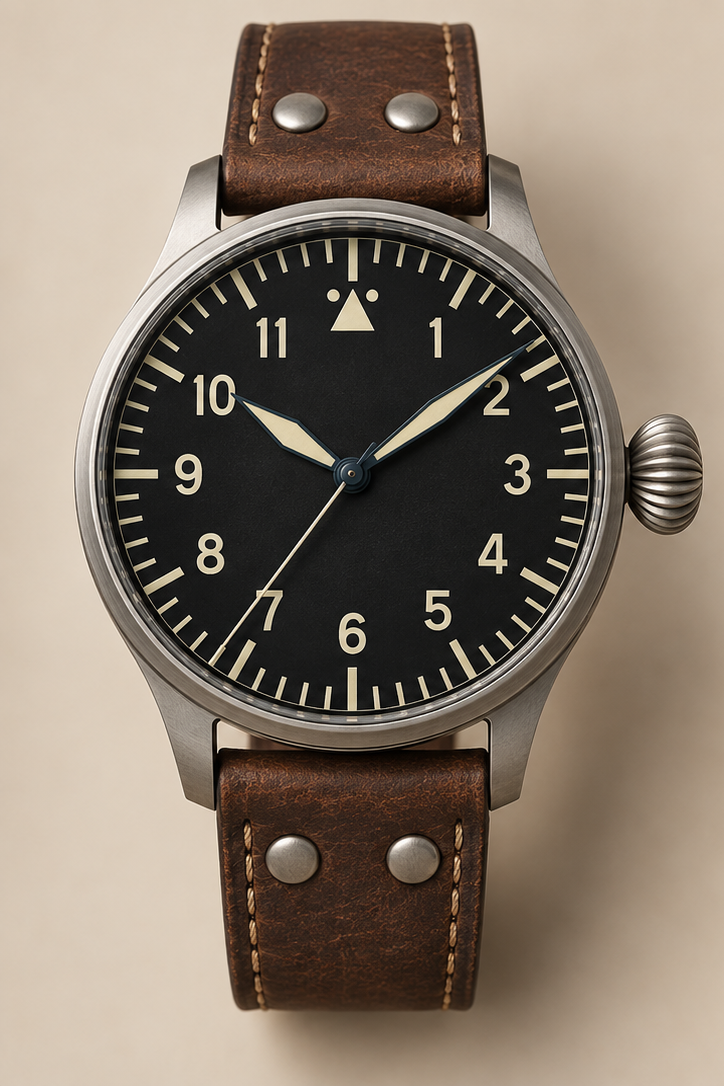
The Type A, or Baumuster A, layout appeared around 1940.
Its organization was relatively straightforward.
Arabic numerals marked the hours from 1 through 11 around the dial.
At the 12 o’clock position, a prominent upward-pointing triangle provided immediate orientation.
Two dots were commonly associated with that upper marker.
An outer minute track surrounded the primary hour numerals.
The result was a very clear and familiar time display.
The navigator could identify the orientation of the watch quickly and read hours and minutes without interpreting a complex layout.
Why the later Type B dial moved hours to an inner ring to prioritize minute-reading for precise navigation
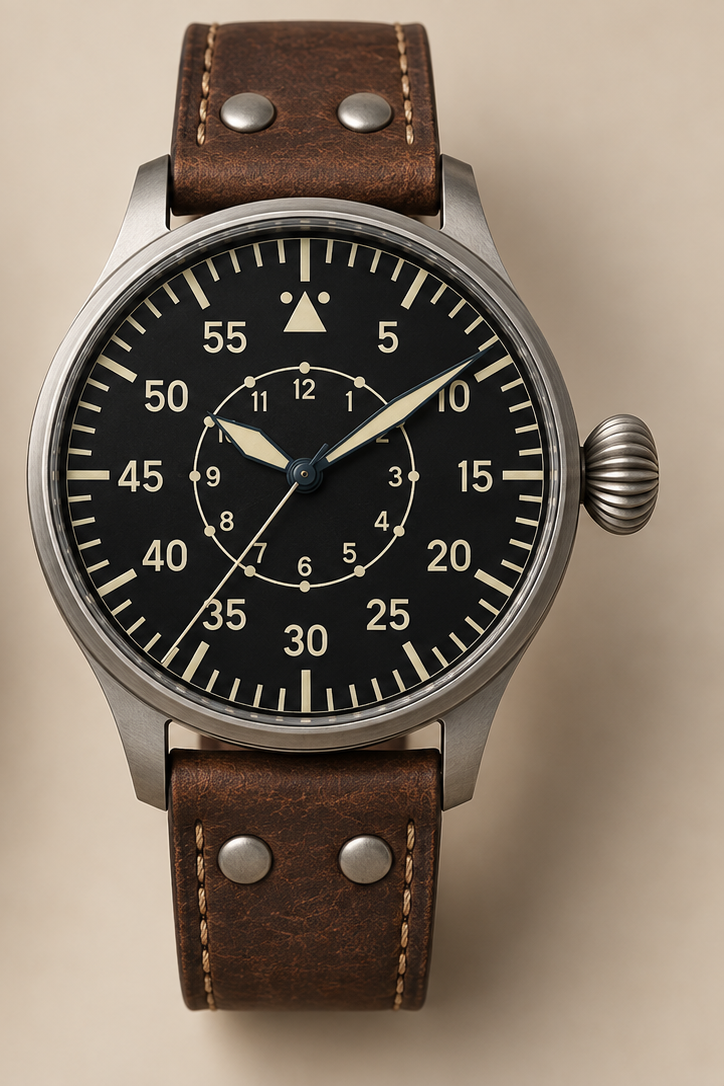
The Type B, or Baumuster B, layout reorganized the dial.
Instead of giving the largest visual emphasis to the hours, the outer track displayed minutes and seconds in five-minute increments: 5, 10, 15, 20, and so on through 55.
The hour numerals moved inward to a smaller central ring.
This changed the visual hierarchy.
Minutes became the dominant information on the dial.
That organization aligned with the navigator’s need to track relatively short periods accurately during flight calculations.
The watch still displayed conventional hours, but minute-reading became more visually prominent.
How intense radium luminescence on both variations ensured the B-Uhr remained legible during night missions
Both Type A and Type B dials were designed for strong visibility in darkness.
Large hands and dial markings received luminous material.
Historically, radium-based luminous compounds were used to produce sustained glow.
This mattered during night operations and blackout conditions where normal ambient lighting could be limited.
The watch needed to remain readable without forcing the navigator to study the dial for an extended period.
High contrast was therefore fundamental.
A dark dial, bright numerals, large hands, and luminous markings allowed important information to be identified rapidly.
| Dial Feature | Type A (Baumuster A) | Type B (Baumuster B) |
|---|---|---|
| Production Era | Circa 1940 | Circa 1941 onward |
| Primary Numerals — Outer Track | 1 through 11 hours | 5 through 55 minutes/seconds |
| Inner Track | None | 1 through 12 hours |
| 12 O’Clock Marker | Triangle with two dots | Triangle, often replacing the 60 marker |
| Visual Priority | Conventional hour reading | Rapid minute/second reading |
| Primary Functional Emphasis | Clean general time display | Navigation-oriented elapsed-time reading |
The Type B layout did not create a completely different watch category.
It represented a refinement within the same B-Uhr specification family.
The Five Original Watchmakers Authorized to Produce the B-Uhr
Because the B-Uhr was defined by a military specification rather than a single commercial brand, several manufacturers produced watches to the required standard.
Five names are traditionally associated with original B-Uhr production.
How A. Lange & Söhne, Laco, Stowa, and Wempe manufactured the majority of the B-Uhr military contract
Four German manufacturers form the domestic core of the original production group:
- A. Lange & Söhne
- Laco
- Stowa
- Wempe
These companies manufactured watches according to the standardized requirements rather than independently inventing different pilot-watch designs.
That distinction is important when identifying historical B-Uhr heritage.
The specification came first.
The manufacturers executed it.
Individual watches could contain differences in movement sourcing and production details, but the core visual and functional requirements remained controlled by the military specification.
Why IWC was the only Swiss manufacturer authorized to produce the standard B-Uhr
The fifth member of the recognized original group was IWC, or International Watch Company.
Unlike the four German manufacturers, IWC was Swiss.
Its involvement demonstrates that the B-Uhr specification was not simply a stylistic tradition associated with German watch brands.
The defining factor was authorization to produce watches meeting the required military standard.
- A. Lange & Söhne
- Laco
- Stowa
- Wempe
- IWC
These are the brands with the direct production heritage attached to the historical B-Uhr specification described here.
How these five brands sourced and modified massive pocket-watch movements to meet the military’s accuracy thresholds
The B-Uhr’s 55mm case allowed the use of large movements derived from pocket-watch architecture.
Different manufacturers did not necessarily use identical calibers.
What united them was the requirement that the movements meet demanding timekeeping expectations.
The movements were prepared for navigational use and incorporated features such as precise regulation and hacking seconds.
Large movement architecture also complemented the oversized case.
This combination created a watch that was mechanically much closer to a portable navigation instrument than to a small civilian wristwatch.
The B-Uhr’s distinctive dimensions therefore followed the needs of both its movement and its user interface.
The Lasting Horological Legacy of the B-Uhr Design
The original B-Uhr belonged to a very specific wartime context.
Its visual influence, however, lasted far beyond that context.
Many watches now marketed as Flieger watches borrow directly from the historical B-Uhr design language.
That does not make them historical B-Uhrs.
It means the specification became the visual foundation for a broader civilian watch category.
Why the historical B-Uhr established the foundational blueprint for the modern Flieger watch category
Several B-Uhr features became strongly associated with aviation watches:
- matte black dials,
- white Arabic numerals,
- strong minute tracks,
- large luminous hands,
- an orientation triangle at 12 o’clock,
- oversized crowns,
- and simple, high-contrast displays.
These characteristics were originally functional.
They existed because military navigators needed information to be immediately readable.
Over time, that function-created appearance became recognizable as an aesthetic.
Modern watch enthusiasts often identify a watch as a “Flieger” based largely on this visual vocabulary.
The historical relationship should nevertheless remain clear.
Flieger is now used much more broadly for aviation-inspired watches.
They overlap visually, but they are not interchangeable historical terms.
How modern watchmakers adapt the oversized B-Uhr aesthetic into wearable civilian-sized timepieces
An authentic historical B-Uhr at 55mm is extremely large for ordinary modern wrist wear.
Modern manufacturers therefore often preserve the design language while reducing the dimensions.
Cases around 39mm to 43mm can retain the black dial, Arabic numerals, triangular 12 o’clock marker, and large crown without reproducing the original scale.
This is adaptation rather than literal replication.
The civilian watch keeps the visual DNA.
The military dimensions are relaxed.
That distinction explains why a modern “B-Uhr-inspired” or Flieger-style watch can look historically familiar while being far easier to wear than the original navigation instrument.
Summarizing how a strict military tool became one of horology’s most recognizable and replicated designs
The B-Uhr is a strong example of form following function.
Its large case existed because the movement and dial needed space.
Its onion crown existed because gloved hands needed to operate it.
Its long strap existed because the watch had to fit over flight clothing.
Its luminous black-and-white dial existed because navigators needed immediate legibility.
Its Type B layout emphasized minutes because minute-level information was operationally important.
None of those characteristics needed to become fashionable.
They became recognizable because the underlying specification produced a coherent visual language.
That visual language survived the military context that created it.
Today, countless pilot watches borrow from the same combination of large Arabic numerals, dark dial, luminous hands, triangular orientation marker, and functional crown design.
But historically, the meaning of B-Uhr remains much narrower.
Its importance lies not simply in its appearance.
The B-Uhr became an enduring watch archetype because nearly every visible feature originated from a specific operational requirement.