
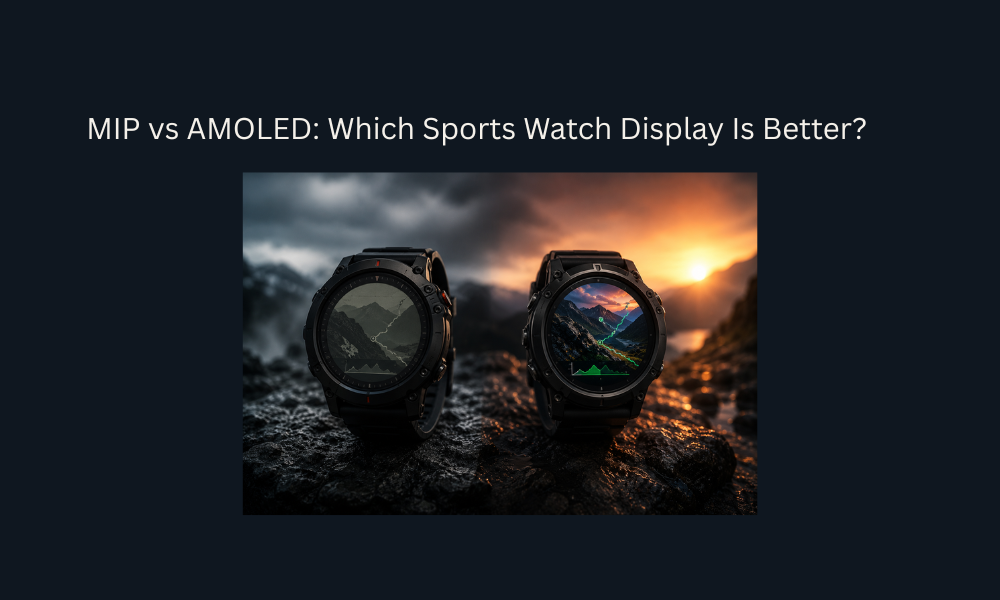
MIP vs AMOLED: Which Sports Watch Display Is Better?
Executing a sound Sports Watch Display Comparison requires a structured diagnostic framework that prioritizes ambient light conditions, battery efficiency, and environmental durability over impulsive aesthetic trends. Purchasing sports watches without systematically evaluating screen technology frequently leads to acquiring devices that are completely unreadable in the blazing sun, or finding your watch dead due to heavy GPS tracking when you need it most. This guide provides the framework for systematically evaluating ambient light interaction, assessing battery lifecycle constraints, and utilizing a quantitative scoring checklist to finalize your wearable technology selection.
How to define the core framework of your sports watch display comparison
How to define the core framework of your Sports Watch Display Comparison requires establishing the fundamental tradeoff in modern wearable technology between battery-draining visual brilliance and ultra-efficient outdoor visibility.
-
✓
Rule: The environment dictates the screen technology.
-
✓
Reason: A display that looks incredible in a dark gym might become completely invisible under the blazing desert sun, while an ultra-efficient screen might look dull indoors.
-
✓
Example: Defining your goal as “matching screen tech to your primary lighting conditions” immediately frames why neither display is objectively “best” without context.
Why does ambient light anchor your sports watch display comparison
Understanding why ambient light anchors your Sports Watch Display Comparison requires establishing how sunlight affects both technologies in completely opposite ways (AMOLED must fight the sun; MIP utilizes the sun).
Establishing a wearable screen visibility baseline relies entirely on optical physics. Active-Matrix panels emit light, meaning they require massive energy spikes to remain visible outdoors, battling direct solar interference. Conversely, athletic display light reflection is the primary mechanical advantage of MIP screens. These panels capture incoming photons and bounce them back through the screen layer, meaning visibility aggressively improves as sunlight becomes harsher.
Active Emission (AMOLED)
Pixels must overdrive to fight incoming solar photons.
Reflective Utilization (MIP)
Incoming photons bounce off the memory layer to the eye.
What visual metrics define your sports watch display comparison
Determining what visual metrics define your Sports Watch Display Comparison involves weighing the vibrant, high-refresh-rate beauty of AMOLED screens against the pixelated, muted utility of MIP (Memory in Pixel) displays.
- AMOLED (Active-Matrix Organic Light-Emitting Diode): Emits its own light, offering rich blacks, high resolutions, and millions of colors.
- → Result: Visually stunning, high-definition mapping, and smartphone-like fluidity.
- MIP (Memory in Pixel): Reflects ambient light and locks static pixels in place without drawing power.
- → Result: Highly pixelated, limited color palette (often $64$ colors), and visually dull indoors without an activated backlight.
Are battery life constraints critical to your sports watch display comparison
Evaluating if battery life constraints are critical to your Sports Watch Display Comparison determines how the extreme power draw of illuminated OLED pixels versus static memory pixels completely dictates your charging lifestyle.
Evaluating timepiece power endurance requires calculating long-term screen battery consumption under active athletic loads.
Battery Drain Trajectory
- AMOLED Battery Draw: Requires massive power to light individual pixels, especially outdoors where it must boost brightness to maximum to combat the sun.
- → Result: Typically yields $5$ to $14\text{ days}$ of battery life, or significantly less if using GPS continuously.
- MIP Battery Draw: Consumes virtually zero power to display a static image, and uses the sun to illuminate the screen rather than a battery-draining backlight.
- → Result: Yields massive battery life ranging from $30\text{ days}$ to virtually infinite (when paired with solar charging).
Do “Always-On” features impact your sports watch display comparison
Analyzing how “Always-On” features impact your Sports Watch Display Comparison injects commercial realism by evaluating the physical annoyance of “gesture wake” screens versus the passive reliability of a permanent display.
-
•
If you are gripping mountain bike handlebars or holding a heavy barbell and need to glance at your heart rate
-
→
Do acknowledge that waiting for an AMOLED screen to “wake up” via a wrist flick is highly frustrating compared to a MIP display
-
→
Result you realize that MIP’s permanent, always-on visibility provides superior passive utility during intense physical movement.
Is surviving condensation test verification essential to your sports watch display comparison
Assessing if surviving condensation test verification is essential to your Sports Watch Display Comparison prevents catastrophic electronic failure by understanding how extreme temperature shifts affect delicate screens.
-
✓
Rule: A brilliant display is useless if moisture shorts the motherboard.
-
✓
Reason: Sports watches endure massive thermal shocks—from freezing winds to hot showers—which can cause internal moisture to form and destroy the delicate ribbon cables of an AMOLED or MIP screen.
-
✓
Example: Opting only for GPS watches that have successfully passed strict condensation test verification to guarantee the display assembly is hermetically sealed against the elements.
Understanding how manufacturers execute rigorous water-resistance verification guarantees the internal case integrity remains intact, preventing moisture from destroying the display under extreme thermal stress.
How to prevent visibility mistakes in your sports watch display comparison
Preventing visibility mistakes in your Sports Watch Display Comparison involves matching the specific display technology to your actual primary training environment to avoid the “washed out” screen trap.
- The Risk: Buying a MIP display watch for a lifestyle that is $95\%$ indoors (office, dark gyms, night running).
- → The Reality: Without the sun to light it, the MIP screen will look incredibly dark, dull, and outdated, forcing you to constantly press the backlight button.
- The Risk: Buying an AMOLED watch for a $100\text{-mile}$ ultra-marathon in the summer.
- → The Reality: The screen will have to run at maximum brightness to fight the sun while running continuous GPS, likely killing the battery before you cross the finish line.
How to conclude your sports watch display comparison with this final execution checklist
Concluding your Sports Watch Display Comparison with this final execution checklist provides a strong, execution-oriented closure that transforms the technological specs into an actionable purchasing audit.
-
✓
Rule: A scored checklist separates aesthetic desire from athletic reality.
-
✓
Reason: Quantifying your lighting environment and charging tolerance ensures you buy the correct screen.
-
✓
Example: Only finalizing the purchase if the display technology scores perfectly for your specific outdoor or indoor routine.
Execution Checklist
Scoring Interpretation
You have selected the exact display technology optimized for your visual and athletic needs.
Identify the compromised variable (e.g., you bought AMOLED but hate charging) and accept the tradeoff before buying.
Do not buy; the screen technology fundamentally clashes with your lighting environment and battery needs.
Support Appendix: Advanced MIP and AMOLED FAQ
Resolving advanced screen confusion and technical friction seamlessly integrates troubleshooting into your Sports Watch Display Comparison.
- Q: Why do AMOLED sports watches suffer from “burn-in”?
- * A: Because AMOLED screens emit their own light, displaying a static image (like a watch face) at maximum brightness for long periods can permanently degrade the organic pixels, leaving a “ghost” image. Manufacturers use “pixel shifting” software to combat this.
- Q: Do MIP displays have touchscreens?
- * A: Yes, many modern MIP watches (like the Garmin Fenix series) feature highly responsive touch layers over the MIP screen, combining massive battery life with modern tactile navigation.
- Q: Is “Sapphire Solar” worth it on an AMOLED watch?
- * A: Generally, no. Solar charging rings are highly effective on ultra-low-power MIP displays, but an AMOLED screen draws so much power that a tiny solar ring cannot realistically keep up with the drain, making it mostly a marketing gimmick on OLED models.
Conclusion
By systematically evaluating the massive battery endurance of reflective Memory-in-Pixel technology against the stunning, high-definition vibrancy of Active-Matrix OLEDs, you elevate your purchase from brand hype to a masterful Sports Watch Display Comparison. Recognizing that the “best” screen is entirely dictated by ambient sunlight, charging tolerance, and the rigorous environmental protection proven by condensation test verification, ensures you secure a reliable data instrument perfectly optimized to your training lifestyle.