
How Does the Condensation Test Verify Water Resistance?
Executing a sound assessment of aquatic safety instruments requires a structured diagnostic framework that prioritizes thermodynamics, atmospheric humidity, and extreme thermal contrast over basic static pressure limits.
Relying solely on dry pressure testing without executing a thermal shock protocol leaves a watch vulnerable to hidden, microscopic humidity that will inevitably rust the mechanical gears. This guide provides the framework for systematically executing thermal shock diagnostics, assessing internal fogging thresholds, and utilizing a quantitative scoring checklist to finalize your equipment validation.
How to define the core framework of your condensation test verification
Defining the core framework of your Condensation Test Verification establishes the foundational physics of why manipulating temperature is the most effective way to expose a microscopic breach in a watch’s waterproof seal.
Rule: Pressure tests alone do not prove a perfect seal.
Reason: A watch might survive a static pressure chamber, but if microscopic moisture has already entered the case during manufacturing or through a faulty gasket, the movement will rust from the inside out.
Example: Defining your goal as “exposing hidden atmospheric moisture” perfectly frames why applying extreme thermal contrast is a mandatory, life-saving diagnostic tool.
Why does thermal contrast anchor your condensation test verification
Understanding why thermal contrast anchors your Condensation Test Verification requires establishing how forcing the internal air of the watch to hit its dew point physically forces hidden moisture to reveal itself against the crystal.
To conduct an accurate thermal moisture diagnostic, we must observe how heated air possesses a higher capacity to suspend water vapor than cold air. By elevating the internal temperature, trapped microscopic water molecules are vaporized. Subsequently, rapid cooling at a localized point on the external glass forces the adjacent internal air below its dew point. This suspends the vapor into visible droplets, establishing a strict submersible fogging baseline for objective visual inspection.
What specific laboratory steps define your condensation test verification
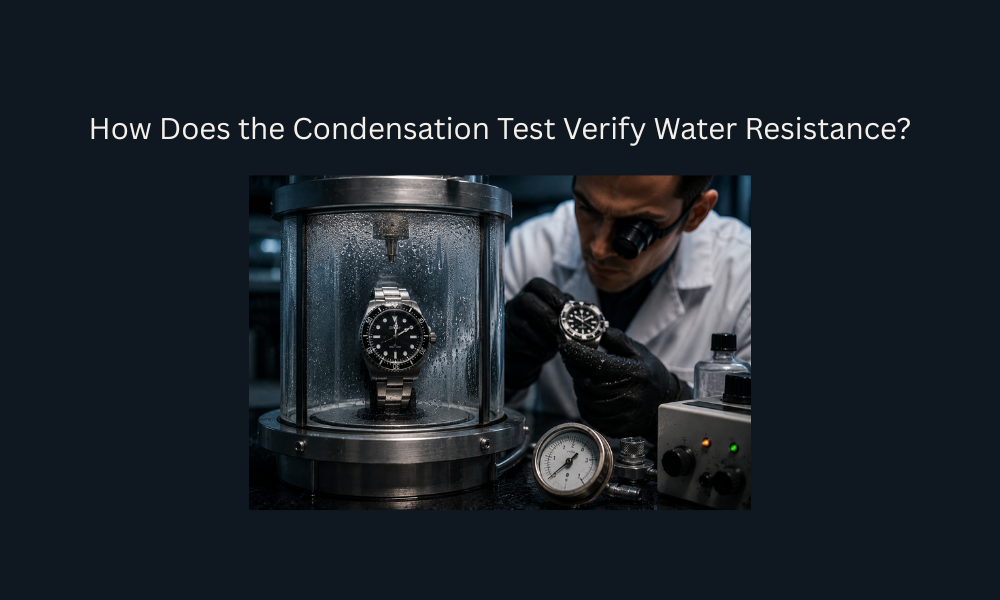
Determining what specific laboratory steps define your Condensation Test Verification maps the exact, uncompromising sequence of heating and rapid localized cooling that forms the industry-standard procedure.
Phase 1: Heating ($40^\circ\text{C} – 45^\circ\text{C}$): The watch is placed on a heated plate until the case and internal air reach a uniform, elevated temperature. → Result: Vaporizes any hidden, microscopic moisture trapped inside the case.
Phase 2: Thermal Shock (Cold Water): A single drop of chilled water ($18^\circ\text{C} \text{ to } 25^\circ\text{C}$) is placed directly on the exterior center of the crystal for one minute. → Result: Creates a massive temperature differential, turning the crystal into a cold condenser plate.
Phase 3: Observation: The water is wiped away and the internal glass is inspected. → Result: Any moisture suspended inside the heated watch will immediately condensate on the cold underside of the crystal.
Are strict fogging limits critical to your condensation test verification
Evaluating if strict fogging limits are critical to your Condensation Test Verification determines the exact threshold between a perfectly sealed watch and a compromised, failing movement. Establishing the correct moisture failure threshold requires strict adherence to internal fogging limitations during visual inspection.
The Pass (Crystal Clear): The inside of the glass remains perfectly transparent after the cold drop is wiped away. → Result: Absolute proof that the internal atmospheric humidity is at a safe, near-zero baseline and the gaskets are perfectly sealed.
The Fail (Persistent Fog): A white, cloudy mist or distinct water droplets form on the inside of the crystal. → Result: Catastrophic failure; the watch contains excess moisture and will inevitably rust if not immediately opened and serviced.
Do ISO 6425 certification tests mandate your condensation test verification
Analyzing if ISO 6425 Certification Tests mandate your Condensation Test Verification injects commercial realism by establishing how this specific thermal diagnostic fits into the grueling gauntlet of global dive watch standards.
If you are buying a watch with the word “DIVER’S” legally printed on the dial → Do trust that it has individually passed the ISO 6425 Certification Tests → Result you have a $100\%$ guarantee that before leaving the factory, your specific watch survived the condensation test and is free of internal moisture, validating its reliability as a survival instrument.
While surviving extreme thermal contrast proves the absolute integrity of the internal atmospheric seal, this specific diagnostic is merely one phase of a broader laboratory validation sequence. To fully appreciate the engineering tolerances required to earn the “DIVER’S” designation, it is useful to review the complete certification process required for professional dive watches, which mandates concurrent overpressure, magnetic, and mechanical shock assessments.
Is assessing gasket degradation essential to your condensation test verification
Assessing if gasket degradation is essential to your Condensation Test Verification prevents long-term movement failure by explaining how this test is used by watchmakers during routine service to detect aging rubber seals.
Rule: Rubber gaskets degrade over time.
Reason: Exposure to UV light, saltwater, and sunscreen causes the O-rings around the crown and case back to dry rot and crack, allowing humidity to sneak in long before a major flood occurs.
Example: Opting to run a condensation test annually on an older dive watch to catch failing gaskets before the humidity rots the mechanical gears.
How to prevent misinterpreting dial moisture in your condensation test verification
Preventing misinterpreting dial moisture in your Condensation Test Verification involves matching the physical behavior of the condensation to the severity of the leak to avoid panicking over normal thermodynamic behavior.
Assuming a tiny, momentary haze that vanishes in seconds means the watch is flooded.
→ The Reality:Air is never $100\%$ dry. A microscopic, fleeting haze that dissipates instantly upon the removal of the cold source is often acceptable under standard testing. It is only persistent, droplet-forming fog that indicates a true failure.
Trying to “burn off” condensation by leaving the watch in the hot sun.
→ The Reality:You are creating an oven. The heat will turn the moisture into a highly corrosive steam that will rapidly destroy the dial paint, luminescent material, and steel pinions. A fogged watch must be opened by a professional immediately.
How to conclude your condensation test verification with this final execution checklist
Concluding your Condensation Test Verification with this final execution checklist provides a strong, execution-oriented closure that transforms the laboratory procedure into an actionable understanding of watch reliability.
Rule: A scored checklist separates reliable instruments from compromised liabilities.
Reason: Quantifying the test methodology proves that a watch is truly sealed against its environment.
Example: Only finalizing a dive watch service or purchase if the timepiece scores perfectly on this critical thermal diagnostic.
Execution Checklist & Scoring Interpretation
Score $5/5$: Flawless Seal. The watch has zero trapped moisture and the gaskets are functioning perfectly.
Score $3-4/5$: Pause. Identify a fleeting haze that disappears instantly; while not a total failure, it suggests a service may be due soon.
Score $<3/5$: Hard Pass/Immediate Service. Do not dive with the watch; persistent condensation proves the seal has failed and the movement is actively rusting.
Support Appendix: Advanced Condensation Test FAQ
This appendix integrates troubleshooting seamlessly into the task flow to resolve advanced diagnostic confusion and real-world moisture scares.
Q: Why did my watch fog up when I stepped out of an air-conditioned hotel into tropical heat?
* A: This is normal thermodynamics, not necessarily a leak. The sudden shift from an $18^\circ\text{C}$ ($64^\circ\text{F}$) room into $35^\circ\text{C}$ ($95^\circ\text{F}$) high-humidity air can cool the watch crystal enough to cause external moisture in the air to condense on the outside of the glass. Simply wipe it off. If the fog is inside the glass, the seal has failed.
Q: Do I need expensive machinery to perform this test at home?
* A: No. While professionals use calibrated hot plates, you can perform a basic “DIY” check by wearing the watch under a warm sweater to heat it to body temperature, then placing an ice cube directly on the crystal for a minute to see if internal fog appears.
Q: If my watch fails the condensation test, is it ruined?
* A: Not if you act quickly. If you pull the crown out to stop the movement and immediately take it to a watchmaker, they can open the case, dry the components under a heat lamp, and replace the failing gaskets before any permanent rust sets in.
Conclusion
By systematically understanding the thermodynamic power of the heating plate, the critical shock of the chilled water drop, and the strict zero-tolerance policy for persistent fogging, you elevate your horological knowledge through a masterful understanding of Condensation Test Verification. Recognizing that this test is a mandatory, uncompromising pillar of the ISO 6425 Certification Tests ensures you fully appreciate the rigorous scientific lengths manufacturers go to in order to guarantee a dive watch is a true, life-saving instrument.
References & Citations
-
Precision Watches. Water Resistance Testing for Dive Watches. Retrieved from
https://precisionwatches.com/journal/water-resistance-testing-dive-watch/ -
NAWCC Message Board. Condensation test for water-resistant watches – dry air. Retrieved from
https://mb.nawcc.org/threads/condensation-test-for-water-resistant-watches-dry-air.136345/