
Why Is a Unidirectional Dive Bezel a Critical Safety Feature?
Executing an assessment of submersible equipment requires a structured diagnostic framework that prioritizes the Dive Bezel Safety Utility, mechanical fail-safes, and tactical ergonomics over impulsive aesthetic trends.
Purchasing aquatic timepieces without a structured protocol for the bezel leads to acquiring inadequate hardware, resulting in catastrophic oxygen mismanagement or fatal decompression errors. This guide provides the framework for systematically evaluating the mechanical fail-safes of the bezel, assessing ISO visibility standards, and utilizing a quantitative scoring checklist to ensure maximum aquatic utility.
How to define the core framework of your dive bezel safety utility
Defining the core framework of your Dive Bezel Safety Utility establishes the foundational, life-or-death engineering problem of tracking elapsed time and limited oxygen while submerged underwater.
Rule: Survival requires foolproof time management.
Reason: Unlike running on a track, losing track of elapsed time underwater directly leads to decompression sickness or oxygen depletion.
Example: Defining your goal as “uncompromising aquatic safety” immediately explains why the dive bezel is a functional instrument first and an aesthetic feature second.
Why does elapsed time tracking anchor your dive bezel safety utility
Understanding why elapsed time tracking anchors your Dive Bezel Safety Utility requires establishing how aligning the bezel’s zero-marker (the pip) with the minute hand creates an instant, highly visible analog stopwatch.
Applying Submersible timing mechanics demands physical precision. By aligning the luminous marker with the current position of the minute hand immediately before submersion, the diver establishes an Aquatic oxygen tracking baseline. This simple but critical action of zeroing the bezel before the descent generates a clear measurement of the exact length of the dive against limited oxygen reserves. The mechanics dictate that as the minute hand advances, it points directly to the elapsed minutes on the bezel scale.
What mechanical fail-safes define your dive bezel safety utility
Determining what mechanical fail-safes define your Dive Bezel Safety Utility involves weighing the historical engineering evolution that transitioned early bi-directional bezels into the mandatory, ratcheting unidirectional standard.
Bi-Directional Bezel (Early $1950\text{s}$): Rotates freely in both directions. → Risk: If bumped against a rock or coral, the bezel can move clockwise, deceiving the diver into thinking they have more oxygen left than they actually do, leading to a fatal error.
Unidirectional Ratcheting Bezel: Only rotates counter-clockwise (typically $120\text{ clicks}$). → Result: The ultimate fail-safe; if bumped, the bezel can only subtract from the remaining dive time. The diver will safely surface early rather than dangerously late.
Are luminescent markers mandatory for your dive bezel safety utility
Evaluating if luminescent markers are mandatory for your Dive Bezel Safety Utility requires determining why a glowing marker at the zero-position is a non-negotiable requirement for a watch to be legally classified as a dive watch.
Achieving strict Underwater visual clarity dictates that hardware must perform independently of external light sources. Meeting strict Submersible visibility requirements ensures the operative timing components remain legible at extreme depths.
The Luminescent Pip: A heavily lumed dot or triangle at the $60\text{-minute}$ mark. → Result: Allows the diver to instantly locate the start of their timing interval in murky water, deep wrecks, or zero-light conditions.
Unmarked Bezels: Engraved metal without luminescent fill. → Risk: Fails the ISO 6425 dive watch standard, rendering the bezel useless as a primary safety tool in low-visibility environments.
While securing low-visibility legibility is crucial for the bezel, it represents just one phase of the broader mechanical validation. Understanding how strict compliance testing defines professional dive watch standards ensures you can confidently identify a fully certified aquatic instrument.
Do cinematic trends like the James Bond styling influence impact your dive bezel safety utility
Analyzing how cinematic trends like the James Bond Styling Influence impact your Dive Bezel Safety Utility injects commercial realism by evaluating how pop culture transformed a life-saving tool into a luxury fashion prop, and why the mechanical integrity must still remain intact.
Is assessing tactile grip critical to your dive bezel safety utility
Assessing if tactile grip is critical to your Dive Bezel Safety Utility prevents underwater manipulation failure by evaluating coin-edge versus scalloped bezel grips when operating the watch under physical constraints.
Rule: A safety tool is useless if it cannot be operated.
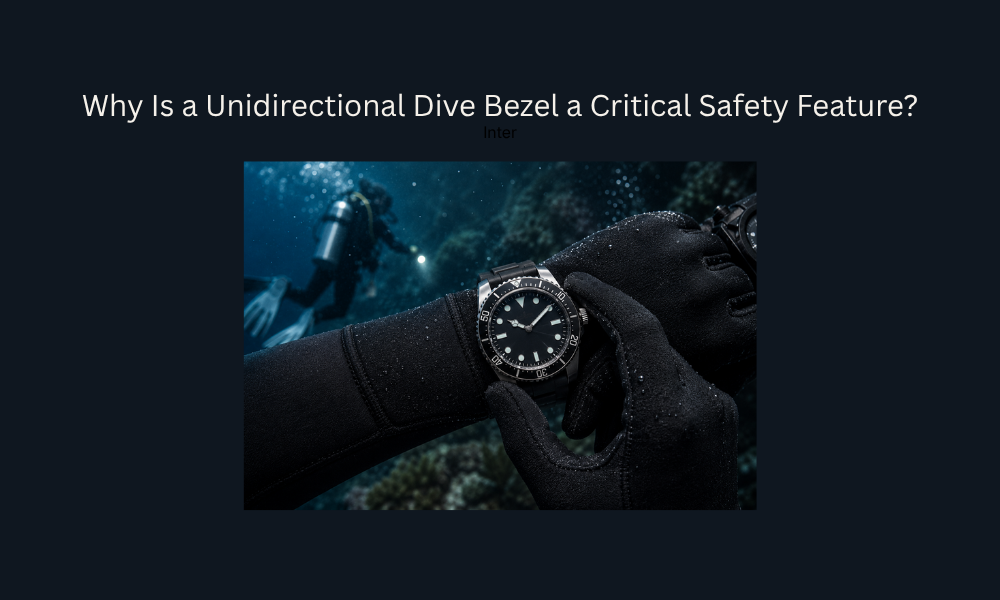
Reason: Setting a bezel with bare hands in a boutique is vastly different than gripping it with $5\text{mm}$ thick neoprene dive gloves in freezing saltwater.
Example: Opting to test the sharp coin-edge grip of a bezel to ensure it provides enough tactile feedback and resistance to be set accurately while wearing heavy gear.
How to prevent timing miscalculations in your dive bezel safety utility
Preventing timing miscalculations in your Dive Bezel Safety Utility involves strictly matching the physical operation of the bezel to pre-dive routines to avoid catastrophic oxygen mismanagement or decompression errors.
The Risk: Setting the dive bezel after initiating the descent into the water.
The Reality: You have already lost track of your exact starting surface time. The bezel must be set precisely on the boat or dock immediately before breaking the surface.
The Risk: Relying on a loose bezel that spins too freely.
The Reality: A weak bezel spring will result in constant accidental adjustments throughout the day. A true safety bezel requires deliberate, forceful clicks to turn.
How to conclude your dive bezel safety utility with this final execution checklist
Concluding your Dive Bezel Safety Utility with this final execution checklist provides a strong, execution-oriented closure that transforms the engineering features into an actionable scoring system for a true dive watch.
Rule: A scored checklist separates certified diving instruments from desk-diving fashion watches.
Reason: Quantifying the ratcheting system, lume, and grip ensures the watch can actually save your life.
Example: Only finalizing the purchase of a dive watch if the bezel passes all critical physical safety checks.
Score $5/5$: Dive Ready. The bezel is a flawless, highly reliable safety instrument built for the ocean.
Score $3-4/5$: Pause. Identify the vulnerability (e.g., poor tactile grip) and relegate the watch to casual swimming or desk-diving rather than scuba use.
Score $<3/5$: Hard Pass. Do not dive with this watch; a bi-directional or freely spinning bezel is a severe liability that could lead to fatal timing errors.
Support Appendix: Advanced Dive Bezel Troubleshooting & FAQ
This appendix resolves advanced mechanical confusion and historical trivia to ensure you confidently finalize your Dive Bezel Safety Utility assessment.
Q: Why do most dive bezels have 120 clicks instead of 60?
* A: A $120\text{-click}$ bezel allows for half-minute precision when setting the elapsed time. More importantly, the finer teeth in a $120\text{-click}$ mechanism often provide a smoother, more secure ratcheting action that feels highly premium and prevents backlash.
Q: Who invented the unidirectional dive bezel?
* A: Blancpain. The brand patented the unidirectional bezel mechanism in $1952$ for the original Fifty Fathoms dive watch. Because of this patent, early competitors (including Rolex with the original Submariner) had to use less safe, bi-directional bezels until the patent expired in the $1980\text{s}$.
Q: What are the first 15 or 20 minutes on the bezel usually highlighted in a different color?
* A: This highlighted sector (often in red or orange) is a visual aid for timing standard decompression stops during an ascent, which traditionally take $15$ to $20\text{ minutes}$ to complete safely before breaking the surface.