
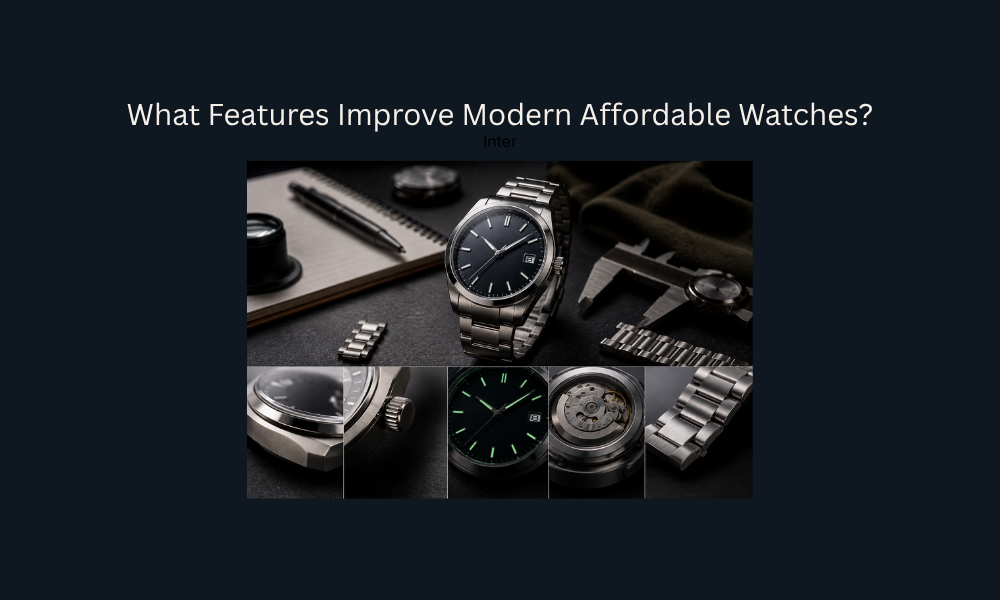
What Features Improve Modern Affordable Watches?
Executing a sound Affordable Watch Feature Evaluation requires a structured diagnostic framework that prioritizes scratch-resistant materials, upgraded movement technology, and superior machined hardware over brand-name marketing. Purchasing budget timepieces without understanding modern manufacturing capabilities leads to accepting hollow bracelets, easily scratched glass, and cheap movements when much better options exist for the exact same price. This guide provides the framework for systematically evaluating modern manufacturing baselines, assessing critical hardware upgrades, and utilizing a quantitative scoring checklist to finalize your high-value acquisition.
How to define the core framework of your affordable watch feature evaluation
Defining the core framework of your Affordable Watch Feature Evaluation establishes how modern CNC manufacturing and open-source movements have completely bridged the gap between entry-level prices and premium specifications.
- Rule: Value is defined by execution, not just the brand name.
- Reason: Modern microbrands and entry-level giants can now source the same highly durable materials that were once strictly reserved for $\$2,000+$ luxury watches.
- Example: Defining your goal as “maximizing the dollar-to-spec ratio” immediately frames why you should demand more from a sub-$\!\$500$ watch today than you did a decade ago.
Why does crystal material anchor your affordable watch feature evaluation
Understanding why crystal material anchors your Affordable Watch Feature Evaluation requires establishing how the shift from easily scratched mineral glass to virtually scratch-proof sapphire crystal became the ultimate baseline for modern affordability. Budget timepiece enhancements start directly above the dial, protecting the fragile timekeeping elements beneath. Accepting anything less than sapphire on a modern everyday watch is an unnecessary compromise in the current market. These entry-level watch upgrades drastically extend the physical lifespan of the instrument, securing your financial layout against daily impact damage.
Mohs Hardness Scale: Crystal Materials
What movement upgrades define your affordable watch feature evaluation
Determining what movement upgrades define your Affordable Watch Feature Evaluation involves weighing the massive improvements in accessible automatic and hybrid quartz movements that provide luxury-level reliability.
- The Hacking & Hand-Winding Automatic (e.g., Seiko NH35): The modern entry-level workhorse. → Result: Allows the user to manually wind the watch and stop the seconds hand to set the exact time, features previously absent in budget automatics.
- The High-Beat Automatic (e.g., Miyota 9000 Series): Ticks at $28,800\text{ BPH}$. → Result: Provides a much smoother, luxury-like sweeping seconds hand and a thinner profile for sub-$\!\$500$ dress watches.
- Mecha-Quartz (e.g., Seiko VK64): Blends quartz accuracy with a mechanical chronograph module. → Result: Offers the satisfying mechanical “snap” and sweep of a traditional stopwatch without the massive $\$1,000+$ mechanical service costs.
Oscillation Frequency: Visualizing BPH Sweep Smoothness
Are solid bracelet links viable in your affordable watch feature evaluation
Evaluating if solid bracelet links are viable in your Affordable Watch Feature Evaluation requires determining how modern affordable brands have eradicated the era of lightweight, hair-pulling, hollow metal bracelets. Affordable hardware improvements focus directly on the structural integrity of the mounting system. Executing a proper budget strap and bracelet analysis separates disposable fashion accessories from permanent tools.
- Solid End-Links (SELs): The piece connecting the bracelet to the watch case is machined from a solid block of steel. → Result: Eliminates the cheap, “rattly” sound and secures the heavy watch head firmly against the wrist.
- Milled Clasps vs. Stamped Clasps: Replacing folded sheet metal (stamped) with solid machined steel (milled). → Result: The clasp feels heavy, locks securely, and balances the weight of the watch perfectly on the underside of the wrist.
Do finishing techniques impact your affordable watch feature evaluation
Analyzing how finishing techniques impact your Affordable Watch Feature Evaluation injects commercial realism by evaluating how the transition between brushed and polished surfaces elevates a cheap case into a premium accessory.
- If you are evaluating a $\$300$ sports watch → Do inspect the lugs for sharp, crisp transitions between the matte brushed surfaces and the shiny polished bevels → Result you successfully identify a watch that catches the light like a luxury piece rather than looking like a soft, melted block of generic steel.
Is assessing luminescent quality critical for your affordable watch feature evaluation
Assessing if luminescent quality is critical for your Affordable Watch Feature Evaluation prevents dark-environment disappointment by identifying the exact feature where many budget brands still actively cut corners.
- Rule: A good spec sheet requires good application.
- Reason: A watch brand might boast about using premium “Swiss Super-LumiNova,” but if they only apply a paper-thin layer, it will fade in $5\text{ minutes}$.
- Example: Opting to thoroughly check enthusiast reviews and nighttime photos before buying to ensure the lume actually lasts through the night.
How to prevent “spec monster” mistakes in your affordable watch feature evaluation
Preventing “spec monster” mistakes in your Affordable Watch Feature Evaluation involves matching the hunt for premium specifications to actual daily wearability, avoiding ugly watches that just look good on paper.
- The Risk: Buying a watch from a generic internet brand simply because it offers a ceramic bezel, sapphire crystal, and an automatic movement for $\$120$. → The Reality: The “spec monster” trap. The watch may have great parts, but if the case is $15\text{mm}$ thick and the dial design is an unbalanced, ugly homage, you will never actually want to wear it.
- The Risk: Insisting on $300\text{m}$ of water resistance for a daily office watch. → The Reality: You are paying for a massive, thick case that won’t fit under your cuff. A well-made $100\text{m}$ water-resistant watch is vastly superior for affordable everyday wear.
This industry-wide pivot toward versatile, everyday utility isn’t limited to the budget sector. As buyers increasingly expect their timepieces to seamlessly transition from the office to the weekend, these shifting consumer expectations have heavily influenced modern watch aesthetics across all price points, prompting even legacy houses to adapt their premium styling for casual environments.
How to conclude your affordable watch feature evaluation with this final execution checklist
Concluding your Affordable Watch Feature Evaluation with this final execution checklist provides a strong, execution-oriented closure that transforms the upgraded features into an actionable scoring system for your next budget purchase.
- Rule: A scored checklist separates genuine affordable quality from cheap, corner-cutting alternatives.
- Reason: Quantifying the crystal, bracelet, and movement ensures your money stretches as far as possible.
- Example: Only finalizing the purchase if the affordable watch scores perfectly on modern baseline specifications.
Execution Checklist & Scoring Interpretation:
Score $5/5$: Immediate Buy. The watch represents the absolute pinnacle of modern affordable value and rivals entry-level luxury.
Score $3-4/5$: Pause. Identify the cut corner (e.g., it has a stamped clasp instead of milled) and decide if you can easily replace it with a leather strap.
Score $<3/5$: Hard Pass. Do not buy; the watch relies on outdated manufacturing, hollow bracelets, and mineral glass, offering terrible value for your money.
Support Appendix: Advanced Affordable Watch Features FAQ
This appendix integrates troubleshooting seamlessly into the task flow to resolve advanced spec confusion and budget buying friction.
- Q: What is the difference between Sapphire crystal and Hardlex? A: Sapphire is a synthetic crystal that is virtually impossible to scratch with anything other than a diamond. Hardlex is Seiko’s proprietary hardened mineral glass; it is more shatter-resistant than sapphire, but it will pick up hairline scratches over time.
- Q: Are microbrands better than legacy brands for affordable features? A: Often, yes. Because microbrands operate direct-to-consumer with low overhead, they routinely offer superior specifications (sapphire, milled clasps, high-beat Miyota movements) at the $\$350-\$500$ mark, whereas legacy brands often charge $\$800+$ for the same specs.
- Q: What is a ceramic bezel and why is it an upgrade? A: Older affordable dive watches used printed aluminum bezel inserts, which scratch easily and fade in the sun. Ceramic bezels are highly scratch-resistant, never fade, and provide a glossy, premium look previously reserved for luxury watches like the Rolex Submariner.
Conclusion
By systematically demanding scratch-proof sapphire crystals, rejecting the rattly hollow bracelets of the past in favor of milled clasps, and prioritizing highly durable hacking movements, you elevate your purchasing power through a precise Affordable Watch Feature Evaluation. Recognizing that modern manufacturing has democratized premium specifications allows you to build a highly capable, durable, and beautiful watch collection without ever paying luxury brand premiums.