
How Do Case Design and Clasps Affect Comfort?
Executing a sound assessment of Watch Ergonomic Comfort requires a structured diagnostic framework that prioritizes wrist anatomy, case geometry, and ergonomic seating over impulsive aesthetic trends. Purchasing timepieces without evaluating case geometry and clasp mechanics leads to severe physical fatigue, painful pressure points, and expensive buyer’s remorse. This guide provides the framework for systematically evaluating lug architecture, assessing weight counterbalances, and utilizing a quantitative scoring checklist to ensure maximum wrist-time utility.
How to define the core framework of your watch ergonomic comfort
Defining the core framework of your Watch Ergonomic Comfort establishes the foundational truth that a watch is a physical object strapped to a moving joint, meaning geometry and hardware dictate wearability far more than aesthetic design.
- Rule: Wearability is dictated by physics, not diameter.
- Reason: If a watch has a flat case back, straight lugs, and a stiff clasp, it will create pressure points and pain, regardless of whether it is a small $36\text{mm}$ or a large $44\text{mm}$.
- Example: Defining your goal as “seamless physical integration” immediately explains why a heavily curved dive watch can wear more comfortably than a flat, rigid dress watch.
Why does case back profile anchor your watch ergonomic comfort
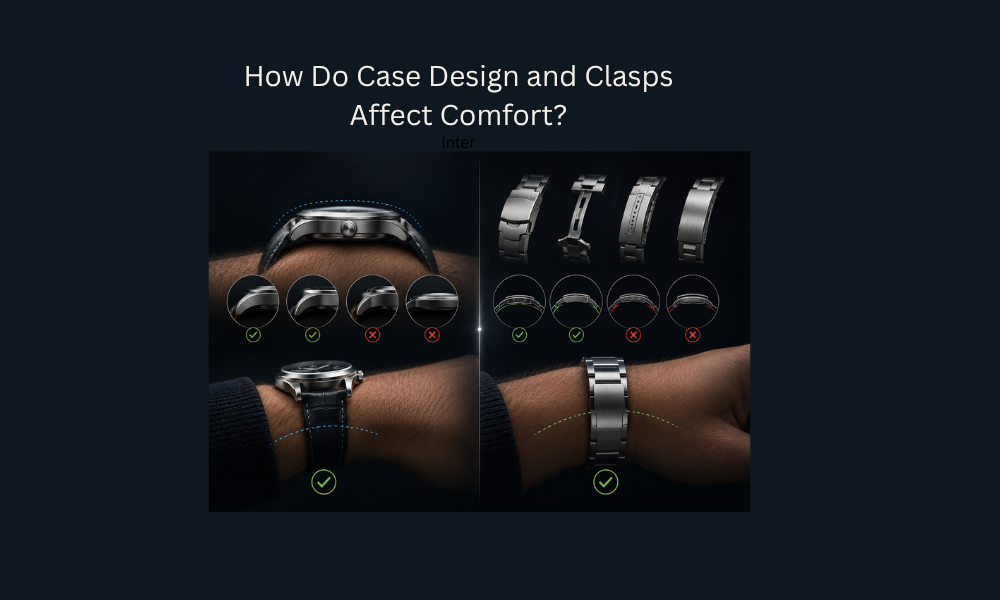
Understanding why case back profile anchors your Watch Ergonomic Comfort requires establishing how a protruding or flat case back dictates how the watch seats itself into the soft tissue of the wrist. Timepiece physical integration depends heavily on this exact contact patch. A domed or bubble-shaped case back acts as a pivoting fulcrum, causing the watch head to slide erratically across the bone. Conversely, a flat or anatomically contoured case back establishes a stable wearability baseline, locking the instrument firmly in place and preventing friction during daily arm movement.
What makes weight distribution essential to your watch ergonomic comfort
Determining what makes weight distribution essential to your Watch Ergonomic Comfort involves weighing the ergonomic disaster of a top-heavy watch head against the balanced, locked-in feel of a properly counterweighted bracelet. A centralized center of gravity prevents the physical exhaustion associated with fighting the mass of the timepiece.
- Top-Heavy (Thick watch, light strap): A heavy $15\text{mm}$ steel dive watch mounted on a thin nylon NATO strap. → Result: The watch constantly flops side-to-side, requiring the strap to be worn uncomfortably tight just to keep the dial centered.
- Balanced (Counterweighted): A heavy steel watch mounted on an equally heavy, solid steel bracelet. → Result: The weight of the clasp at the bottom of the wrist perfectly counterbalances the watch head, anchoring it securely without needing to strangle the wrist.
Are lug curvature and geometry viable in your watch ergonomic comfort
Evaluating if lug curvature and geometry are viable in your Watch Ergonomic Comfort requires determining how downward-curving lugs physically hug the wrist bone, effectively shortening the lug-to-lug span and wrapping the arm. Superior case profile ergonomics demand this downward trajectory to bridge the gap between metal and skin. Applying rigorous watch geometry analysis to your lug geometry confirms that the angle of the metal dictates spatial integration far more than the raw case width.
- Flat/Straight Lugs: Project horizontally out from the case mid-frame. → Risk: Acts like a stiff board resting on top of the wrist; highly prone to creating awkward “overhang” gaps in the air.
- Curved/Downward Lugs: Machined to drop dramatically downward toward the case back line. → Result: The lugs wrap around the natural curvature of the wrist, securely locking the case in place and significantly boosting daily comfort.
Do clasp designs impact your watch ergonomic comfort
Analyzing how clasp designs impact your Watch Ergonomic Comfort injects commercial realism by evaluating how the locking mechanism under your wrist dictates your comfort as your arm swells throughout the day.
- If your wrist swells in the summer heat and the steel bracelet becomes painfully tight → Do prioritize a micro-adjustment clasp with “on-the-fly” toolless mechanisms → Result you can instantly expand the bracelet by $2\text{mm}$ to $5\text{mm}$ to relieve pressure without taking the watch off or needing a screwdriver.
Is assessing crown placement critical for your watch ergonomic comfort
Assessing crown placement is critical for your Watch Ergonomic Comfort to prevent physical pain by understanding the phenomenon of “crown dig” and how case design mitigates it.
- The Risk: Buying a watch with a thick, hidden butterfly clasp (double deployant) on a metal bracelet. → The Reality: Butterfly clasps completely lack micro-adjustment holes. If you are between link sizes, the watch will forever be either painfully tight or annoyingly loose.
- The Risk: Ignoring the thickness of the case back in relation to the lugs. → The Reality: A massive, bubble-shaped case back will push the watch high off the wrist, causing the lugs to float in the air rather than resting securely against your skin.
How to conclude your watch ergonomic comfort with this final execution checklist
Concluding your Watch Ergonomic Comfort with this final execution checklist provides a strong, execution-oriented closure that transforms the physical data into an actionable scoring system for your next purchase.
Before applying this scorecard to a potential acquisition, cross-referencing the timepiece’s exact lug-to-lug span and case thickness through a structured wearability validation bridges the gap between theoretical geometry and actual anatomical fit.
- Rule: A scored checklist separates aesthetic desire from physical reality.
- Reason: Quantifying lug geometry, clasp utility, and weight distribution ensures the watch will actually be worn.
- Example: Only finalizing the purchase if the clasp and case geometry score perfectly for your specific wrist anatomy.
Interactive Execution Checklist
Your Ergonomic Score
Support Appendix: Advanced Watch Ergonomics FAQ
This appendix integrates troubleshooting seamlessly into the task flow to resolve advanced comfort confusion and hardware friction regarding your Watch Ergonomic Comfort.
- Q: Why does my wrist swell and shrink so much during the day? A: Human wrists naturally expand and contract based on temperature, hydration, physical activity, and even altitude. A bracelet that fits perfectly at $8:00\text{ AM}$ in air conditioning can feel like a tourniquet by $3:00\text{ PM}$ in the summer heat, which is why micro-adjust clasps are vital.
- Q: What is a “Milled” clasp vs. a “Stamped” clasp? A: A stamped clasp is made of thin, folded sheet metal (common on vintage or budget watches) and feels light and rattly. A milled clasp is machined from solid blocks of steel, providing superior structural rigidity, a premium feel, and better counterweighting for the watch head.
- Q: Can a watch be too light to be comfortable? A: For some, yes. While titanium watches are incredibly light and prevent fatigue, some wearers find that watches that are too light feel “cheap” or fail to provide the tactile reassurance that the watch is securely strapped to the wrist. It is highly subjective.