
How Should a Watch Match the Formality of an Outfit?
Executing true Watch Formality Coordination requires a structured aesthetic framework that prioritizes accessory synchronization, strict dress code adherence, and physical cuff clearance over impulsive, status-driven flashiness. Wearing oversized, highly complicated sports watches with formal clothing breaks fundamental styling rules and visually ruins the line of a fitted suit. This guide provides the framework for systematically evaluating dress codes, coordinating leathers and metals, and utilizing a quantitative scoring checklist to finalize your daily outfit integration. As an objective horological stylist, I present these protocols to eliminate guesswork. Precision dictates elegance.
How to define the core philosophy of your watch formality coordination
Defining the core philosophy of your Watch Formality Coordination establishes the foundational mindset that a timepiece must serve as a seamless extension of the wardrobe’s overarching dress code, rather than a distracting focal point.
- Rule: A cohesive outfit demands synchronized accessories.
- Reason: Pairing a rugged digital sports watch with a tuxedo creates visual dissonance, whereas matching styles projects intentionality.
- Example: Defining your goal as “seamless aesthetic integration” ensures your timepiece complements your clothing rather than fighting it.
Why does occasion etiquette anchor your watch formality coordination
Understanding why occasion etiquette anchors your Watch Formality Coordination requires establishing how traditional dress codes create the structural framework for selecting a timepiece. Attire dress codes dictate the acceptable parameters for every accessory you equip. A formal Black-Tie event demands absolute minimalism. The wardrobe styling baseline for business professional environments allows for slightly more complexity, such as a subtle date complication, yet still requires strict restraint. Smart casual settings offer flexibility for larger cases, while rugged casual environments prioritize durability over refinement. Each tier enforces specific physical requirements on your watch selection.
What timepiece categories fit your watch formality coordination
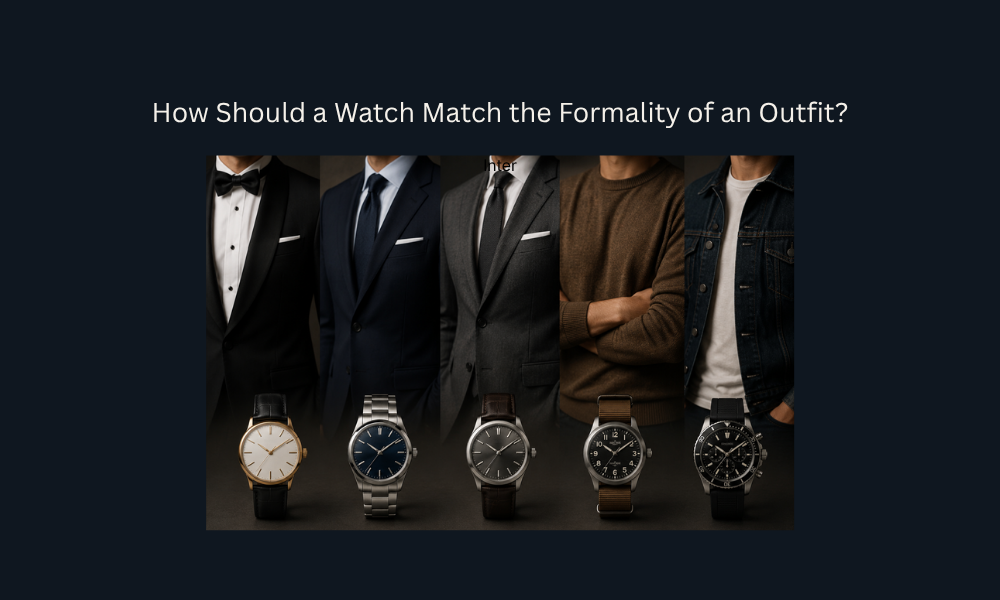
Determining what timepiece categories fit your Watch Formality Coordination involves mapping specific watch archetypes to their appropriate wardrobe formality levels to eliminate daily styling guesswork.
Strict Formal / Black-Tie
Tuxedos and dark fitted suits.
→ Match: Ultra-thin, time-only dress watch on a black leather strap (e.g., Cartier Tank, Patek Philippe Calatrava).
Business Professional
Daily office suits and formal blazers.
→ Match: Classic dress watch, sophisticated GMT, or slim integrated-bracelet steel watch (e.g., Rolex Datejust).
Smart Casual / Weekend
Chinos, polo shirts, premium denim.
→ Match: Steel dive watches, chronographs, or field watches on metal or leather.
Rugged / Athletic
Gym wear, hoodies, heavy outdoor gear.
→ Match: G-Shocks, digital trackers, or heavy matte titanium tool watches.
Are specific strap materials essential to your watch formality coordination
Evaluating if specific strap materials are essential to your Watch Formality Coordination demands determining how swapping the strap material drastically alters the watch’s inherent formality and adaptability. Timepiece band coordination dictates the immediate visual impact of the case. Mastering accessory material styling allows a single watch to transition between different dress codes simply by changing its mount.
- Glossy Alligator/Crocodile Leather: The highest level of formality; strictly reserved for suits and evening wear.
- Matte Calfskin / Suede: The perfect smart-casual bridge; dresses down formal watches and elevates field watches.
- Steel Bracelets: Highly versatile business-to-casual workhorses; perfectly acceptable for the office but traditionally inappropriate for black-tie.
- Rubber / NATO Nylon: Strictly casual and athletic; completely unviable for fitted suits.
Do metal and leather color pairings impact your watch formality coordination
Analyzing how metal and leather color pairings impact your Watch Formality Coordination injects commercial realism by explaining the unbreakable rules of matching watch leathers to shoes, and case metals to belt buckles.
- If you are wearing black oxford dress shoes and a black leather belt with a charcoal suit → Do select a watch with a black leather strap and a silver/steel case to match a silver belt buckle → Result you create a perfectly unified, professional silhouette without jarring color clashes.
Is assessing case proportions critical to your watch formality coordination
Assessing if case proportions are critical to your Watch Formality Coordination prevents physical wardrobe malfunctions by understanding how case thickness interacts with fitted shirt cuffs. Cuff clearance dictates how gracefully your jacket sleeve falls.
- Rule: Formality requires a clean, unbroken silhouette.
- Reason: A massive $15\text{mm}$ thick dive watch will snag on a fitted French cuff, forcing the sleeve to bunch up and ruining the drape of the suit jacket.
- Example: Opting to wear a watch strictly under $10\text{mm}$ thick when wearing a button-down dress shirt to ensure the cuff slides freely over the dial.
Beyond merely clearing the shirt sleeve, mastering this physical integration requires ensuring the overall dimensions of a formal timepiece remain proportionate to your wrist, preserving the understated elegance demanded by strict dress codes.
How to prevent “under-dressing” mistakes in your watch formality coordination
Preventing “under-dressing” mistakes in your Watch Formality Coordination involves matching the watch’s visual weight and category to your specific event to avoid looking disrespectful or stylistically ignorant.
Wearing a massive, bright orange dive watch with a navy business suit to a serious client pitch. → The Reality: The vibrant colors and bulky size draw the eye away from your face, undermining a serious, professional demeanor.
Wearing an ultra-delicate, diamond-set gold dress watch with gym shorts and a t-shirt. → The Reality: The watch looks absurdly out of place, creating a confusing, forced “high-low” fashion clash that rarely works.
How to conclude your watch formality coordination with this final execution checklist
Concluding your Watch Formality Coordination with this final execution checklist provides a strong, execution-oriented closure that transforms the styling guidelines into an actionable daily outfit audit.
- Rule: A scored checklist ensures your accessories flatter rather than detract from your outfit.
- Reason: Quantifying the coordination guarantees you consistently respect the dress code.
- Example: Only leaving the house if the strap, case thickness, and watch category score perfectly against your attire.
Interactive Execution Matrix
Score Evaluation Panel
- Score $5/5$: Immediate Wear. The watch flawlessly integrates into your outfit, providing subtle, intentional elegance.
- Score $3-4/5$: Pause. Identify the mismatched variable (e.g., a brown strap with black shoes) and correct it before leaving.
- Score $<3/5$: Leave It Behind. Do not wear it; the watch actively fights the formality of your clothing and ruins the silhouette.
Support Appendix: Advanced Watch Formality Troubleshooting & FAQ
This appendix integrates troubleshooting seamlessly into the task flow to resolve advanced styling confusion and etiquette friction regarding your Watch Formality Coordination.
-
Q: Can I wear a smartwatch with a formal suit?
* A: From a traditional etiquette standpoint, no. A glowing black screen breaks the aesthetic continuity of a fitted suit and signals that you are distracted. If you must wear one, pair it with a subtle leather strap and turn off the “always-on” display.
-
Q: Do I have to match my watch metal to my wedding ring?
* A: No. A wedding ring is considered an exempt, permanent accessory. It is perfectly acceptable to wear a stainless steel watch while wearing a gold wedding band. Your watch should ideally match your belt buckle and cufflinks.
-
Q: Can a metal bracelet ever be considered formal?
* A: While traditionalists argue that only leather is truly formal, modern etiquette accepts highly polished, slim metal bracelets (like the Jubilee on a Datejust or a fine Milanese mesh) in business-professional and some black-tie environments.