
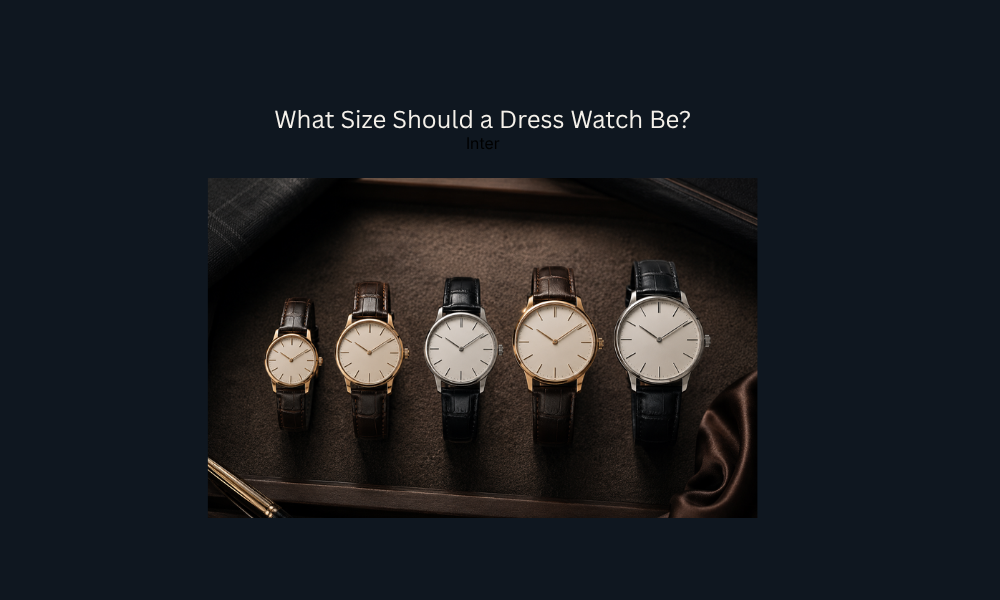
What Size Should a Dress Watch Be?
Executing a true standard of formal elegance requires a structured Dress Watch Sizing protocol that prioritizes slim case profiles, anatomical wrist matching, and intentional understatement over modern oversized trends. Applying sports-watch sizing expectations to formal timepieces breaks fundamental styling rules and physically ruins the line of a fitted suit jacket. This guide provides the framework for systematically evaluating cuff clearance, mapping historical diameter constraints to your specific wrist, and utilizing a quantitative scoring checklist to finalize your formal acquisition.
How to define the core principles of your dress watch sizing
Defining the core principles of your Dress Watch Sizing establishes the foundational philosophy that a formal watch must complement, not dominate, your attire.
- Rule: A formal watch must complement, not dominate.
- Reason: Large cases create visual imbalance with formal attire and overwhelm the refinement of a fitted suit.
- Example: Defining your goal as “intentional understatement” immediately excludes sport-sized cases over $40\text{mm}$.
Why does case thickness anchor your dress watch sizing
Understanding why case thickness anchors your Dress Watch Sizing requires establishing how cuff clearance dictates the viability of a formal timepiece far more than its diameter. Formal timepiece dimensions prioritize vertical minimalism over all other variables. To respect strict dress watch profile constraints, evaluate your selection against this standard:
- Ideal / Ultra-Thin ($5\text{mm} – 8\text{mm}$): The pinnacle of formal design. → Result: Slides effortlessly beneath a tightly buttoned cuff without catching or bulging.
- Acceptable ($8\text{mm} – 10\text{mm}$): The standard modern profile. → Result: Maintains visual refinement and functions with most standard dress shirts.
- Avoid ($10\text{mm}+$): Top-heavy and prominent. → Result: Forces the cuff to stretch uncomfortably or catches with every gesture, breaking formal etiquette.
What diameters are appropriate for your dress watch sizing
Determining what diameters are appropriate for your Dress Watch Sizing involves mapping the acceptable $34\text{mm}$ to $40\text{mm}$ range against formal expectations and historical standards. Proper timepiece dimension selection relies on understanding the visual weight of formal watch proportions on the wrist.
- Classical Sizing ($34\text{mm} – 36\text{mm}$): Traditional, highly understated (e.g., Cartier Tank, classic Rolex Datejust). → Result: Perfect proportion for black-tie elegance.
- Contemporary Sizing ($37\text{mm} – 40\text{mm}$): Modern presence while retaining formal restraint. → Result: The current market sweet spot for versatile formal wear.
- Sport Territory ($40\text{mm}+$): Overly prominent and visually loud. → Risk: Blurs the line between dress and sport, often projecting too much visual mass for a fitted suit.
Do lug-to-lug measurements impact your dress watch sizing
Analyzing how lug-to-lug measurements impact your Dress Watch Sizing injects anatomical realism by evaluating how the vertical length of the case must remain within the strict bounds of the wrist.
If you are evaluating a watch with a modest $36\text{mm}$ diameter but exceptionally long lugs → Do verify that the lug-to-lug measurement remains strictly under $46\text{mm}$ → Result you ensure the watch disappears smoothly under the cuff rather than spanning awkwardly across your wrist bone.
Are wrist size variations critical for your dress watch sizing
Evaluating if wrist size variations are critical for your Dress Watch Sizing demands segmenting acceptable dimensions based on actual wrist circumference to prevent disproportionate aesthetics.
Is assessing visual mass necessary in your dress watch sizing
Assessing visual mass is necessary in your Dress Watch Sizing to prevent mistakes by understanding how dial color, bezel thickness, and case shape radically alter perceived dimensions.
- Rule: Square cases have more surface area than round cases.
- Reason: A $35\text{mm}$ square watch will wear significantly larger and command more visual mass than a $35\text{mm}$ round watch.
- Example: Downsizing by $2\text{mm}$ to $3\text{mm}$ when purchasing a rectangular or tonneau-shaped formal watch.
How to prevent proportion mistakes in your dress watch sizing
Preventing proportion mistakes in your Dress Watch Sizing involves actively mitigating the temptation to apply sport-watch expectations to formal attire.
The Risk: Applying the “it feels too small” mindset when trying on a $36\text{mm}$ dress piece. → The Reality: A formal watch is supposed to feel unobtrusive; a deliberately understated watch signals refinement, not inadequacy.
The Risk: Ignoring case thickness while fixating only on diameter. → The Reality: A $38\text{mm}$ watch at $12\text{mm}$ thick creates far more formalwear problems than a $40\text{mm}$ watch at $7\text{mm}$ thick.
Mastering visual balance relies on strictly compartmentalizing your timepiece collection. While a robust, oversized sports watch provides the appropriate presence for weekend utility, applying those same dimensional expectations to formalwear guarantees a sartorial failure. Establishing a baseline for context-dependent watch choices allows you to isolate your dress pieces and protect the integrity of a tailored cuff.
How to conclude your dress watch sizing with this final execution checklist
Concluding your Dress Watch Sizing with this final execution checklist provides a strong, objective closure that transforms the dimensional guidelines into an actionable scoring system.
- Rule: A scored checklist ensures adherence to formal tradition.
- Reason: Quantifying proportions prevents the accidental purchase of a sporty hybrid.
- Example: Only finalizing the purchase if the thickness and lug-to-lug score perfectly for your cuff and wrist.
Execution Checklist & Scoring Interpretation
- Thickness Audit: Verified the case is under $10\text{mm}$ thick (ideally $<8\text{mm}$) to easily clear tight shirt cuffs.
- Diameter Match: The case diameter remains within the $34\text{mm}-40\text{mm}$ formal sweet spot.
- Lug-to-Lug Verification: Confirmed the vertical length does not exceed $46\text{mm}$ (or the width of your wrist).
- Visual Mass Awareness: Adjusted sizing expectations if selecting a square or rectangular case shape.
- Wrist Proportion Acceptance: Resisted the urge to “size up,” accepting the elegance of intentional understatement.
- Score $5/5$: Immediate Buy. The dimensions perfectly embody elegant restraint for formal attire.
- Score $3-4/5$: Pause. Identify the compromised factor (e.g., thickness slightly over $10\text{mm}$) and decide if it limits your specific formal shirts.
- Score $<3/5$: Hard Pass. Do not buy; the watch is too thick or too broad to function as a true dress piece.
Support Appendix: Advanced Dress Watch Sizing Troubleshooting & FAQ
This appendix integrates troubleshooting seamlessly into your task flow to resolve advanced dimensional confusion and formal sizing etiquette.
Q: Why do vintage dress watches seem so small (e.g., $32\text{mm}$ to $34\text{mm}$)?
A: Historically, miniaturization was a sign of horological mastery. A smaller, thinner watch demonstrated superior watchmaking skill compared to bulky pocket watch conversions, establishing $34\text{mm}$ as a classic standard for gentlemen.
Q: Can a large wrist (over $8\text{ inches}$) wear a $36\text{mm}$ dress watch?
A: Yes. While it will appear quite compact, this is a historically accurate and sophisticated look for formalwear. Muhammad Ali famously wore a $34\text{mm}$ Cartier Tank on his large wrist, perfectly demonstrating the power of understated elegance.
Q: Does the strap affect the sizing of a dress watch?
A: A thick, heavily padded leather strap can make a slim watch sit higher on the wrist, negating its ultra-thin profile. Always pair a slim dress watch with an equally slim, unpadded alligator or calfskin strap to maintain its proper proportions.
Conclusion
By systematically evaluating critical dimensions—prioritizing sub-$10\text{mm}$ thickness, respecting the $34\text{mm}-40\text{mm}$ diameter boundary, and matching the lug-to-lug footprint to your specific anatomy—you elevate your purchase into a precise Dress Watch Sizing execution. Embracing the philosophy of intentional understatement ensures your timepiece slides effortlessly beneath a fitted cuff, serving as a seamless extension of formal elegance rather than a bulky distraction.
References & Further Reading
- Time+Tide Watches: Understanding the Importance of Lug-to-Lug Measurements
- Armitron: Comprehensive Watch Sizes Guide & Anatomical Matching