
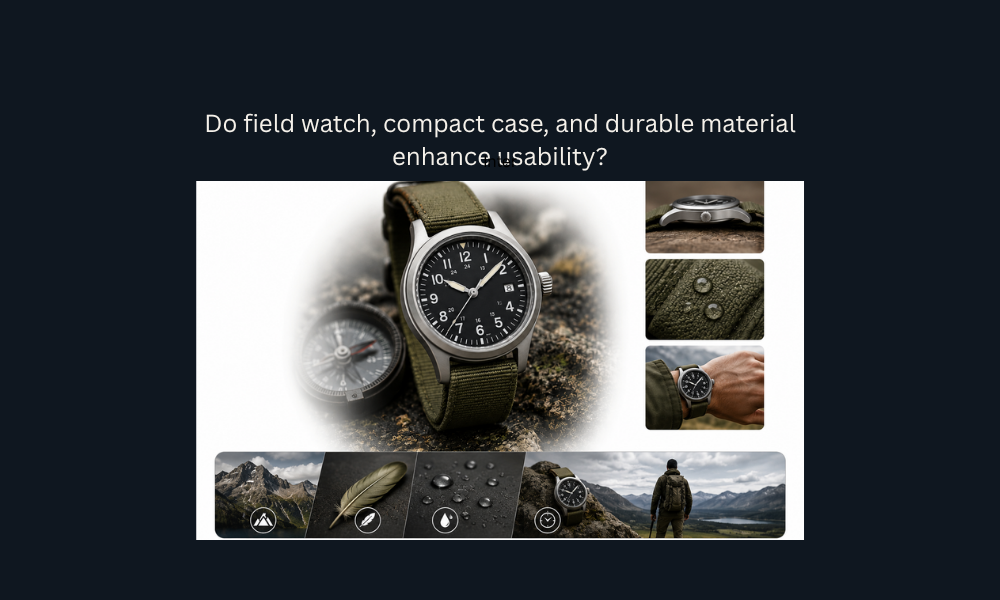
Do Field Watch, Compact Case, and Durable Material Enhance Usability?
Executing an assessment of Field Watch Usability requires a structured diagnostic framework that prioritizes compact ergonomics, matte metallurgy, and high-contrast optics over impulsive aesthetic trends. Purchasing tactical timepieces without evaluating physical dimensions or material reflectivity leads to acquiring bulky, high-glare watches that snag on equipment and fail their primary utilitarian purpose. This guide provides the framework for systematically evaluating compact case geometries, assessing optical and material durability, and utilizing a quantitative scoring checklist to finalize your outdoor equipment selection.
How to define the core purpose of your field watch usability
Defining the core purpose of your Field Watch Usability establishes the rugged outdoor environment and tactical heritage that demand an unobtrusive, highly functional timepiece.
Rule: Military heritage demands unobtrusive utility.
Reason: Soldiers, hikers, and explorers need to read the time instantly without a heavy watch snagging on gear or causing fatigue.
Example: Defining your goal as “tactical outdoor functionality” immediately prioritizes a \(38\text{mm}\) matte steel watch over a bulky \(44\text{mm}\) dive watch.
Before advancing to physical dimensions, grounding your evaluation in these military utility principles guarantees that every subsequent hardware choice serves a strictly functional objective.
Why does a compact case profile anchor your field watch usability
Understanding why a compact case profile anchors your Field Watch Usability requires establishing how smaller dimensions (\(36\text{mm}\) to \(40\text{mm}\)) physically prevent the watch from catching on clothing, backpacks, or equipment. Tactical timepiece ergonomics dictate that thin case profiles ensure the watch remains tight to the wrist. Eliminating excess vertical height avoids the hazardous leverage and physical instability common in top-heavy designs. Superior outdoor watch wearability relies on this low-profile architecture to maintain continuous mobility without physical interference.
While eliminating vertical height prevents snag hazards, true operational usability also requires evaluating how crown ergonomics and structural controls interact with the case profile to prevent physical interference during extreme wrist flexion.
What makes durable materials essential to your field watch usability
Determining what makes durable materials essential to your Field Watch Usability involves weighing the scratch resistance, physical weight, and anti-reflective properties of brushed metals and composites against outdoor hazards.
Brushed Stainless Steel: Highly durable, hides hairline scratches, subdues light reflection. → Result: The traditional, rugged military standard for enduring physical abuse.
Titanium (Grade 2/5): \(30\%\) lighter than steel, dark matte grey finish, highly corrosion-resistant. → Result: The ultimate material for eliminating wrist fatigue on long treks.
Resin/Polycarbonate: Ultra-lightweight, high shock absorption. → Result: Ideal for extreme impact environments where metal cases might transfer shock to the movement.
Are 24-hour dials and high contrast viable for your field watch usability
Evaluating if 24-hour dials and high contrast are viable for your Field Watch Usability requires determining the necessity of inner military-time tracks, massive Arabic numerals, and matte backgrounds for instant reading. Timepiece visual clarity relies entirely on rapid data transmission. A high-contrast dial guarantees numerical information is processed immediately under duress. Optimal tactical dial legibility mandates the complete elimination of distracting elements from the visual field.
Matte Black Dial with White Arabic Numerals: Zero light reflection, maximum contrast. → Result: The historical standard for instant time acquisition under any weather condition.
Sunburst or Polished Dials: Reflects and plays with light. → Risk: Creates severe glare outdoors and compromises the stealth, unobtrusive nature required in the field.
Do specialized NATO straps impact your field watch usability
Analyzing how specialized NATO straps impact your Field Watch Usability injects commercial realism by evaluating how fabric or nylon straps provide security and comfort that metal bracelets cannot match outdoors.
If you are hiking in high humidity and sweat heavily → Do prioritize a woven nylon NATO strap or canvas strap → Result the strap breathes, can be easily washed, and will keep the watch attached to your wrist to prevent total loss even if a single spring-bar failure occurs during a fall.
Securing the case to the wrist effectively concludes the immediate physical evaluation, though studying rugged strap construction methods across varied tactical applications provides deeper context on why continuous-loop retention remains the strict outdoor standard.
Is assessing movement resilience critical for your field watch usability
Assessing movement resilience is critical for your Field Watch Usability to prevent catastrophic failure by understanding the shock limits of mechanical gears versus the invulnerability of quartz oscillators.
Rule: Field watches must survive sudden blunt force.
Reason: Chopping wood, firing a weapon, or hammering tent pegs will shatter the delicate balance staff of a standard mechanical watch.
Example: Opting for a movement powered by a high-quality quartz oscillator if your outdoor activities involve intense, sudden G-forces.
How to prevent ergonomic and glare mistakes in your field watch usability
Preventing ergonomic and glare mistakes in your Field Watch Usability involves strictly matching the watch’s physical vulnerabilities to your specific outdoor behavior to avoid fatigue and visibility loss.
The Risk: Buying a field watch with a highly polished, mirror-finish steel case. → The Reality: The polished case will flash brilliantly in the sun, blinding you outdoors and accumulating highly visible, ugly scratches.
The Risk: Choosing a thick, heavy steel bracelet for a multi-day hiking trip. → The Reality: Your wrist will swell from exertion and temperature changes, causing the steel bracelet to restrict blood flow and create severe discomfort.
How to conclude your field watch usability with this final execution checklist
Concluding your Field Watch Usability with this final execution checklist provides a strong, objective closure that transforms tactical features into an actionable scoring system.
Rule: A scored checklist separates actual outdoor tools from fashion-oriented field watches.
Reason: Quantifying durability and dimensions ensures the watch will actually survive your lifestyle.
Example: Only finalizing the purchase if the size, material, and legibility score perfectly for your specific needs.
Score \(5/5\): Immediate Buy. The watch is a true tactical tool perfectly optimized for outdoor environments.
Score \(3-4/5\): Pause. Identify the vulnerability (e.g., polished case instead of matte) and consciously accept the usability tradeoff before buying.
Score \(<3/5\): Hard Pass. Do not buy; the watch is a “field watch” in name only and will fail under actual physical pressure.
Support Appendix: Advanced Field Watch Troubleshooting & FAQ
This appendix resolves advanced tactical confusion and buying friction to ensure you confidently finalize your Field Watch Usability assessment.