
Why Does Watch Legibility Matter When Choosing a Watch?
Executing a sound Watch Legibility Decision requires a structured evaluation framework that prioritizes visual contrast, optical physics, and environmental lighting over impulsive aesthetic trends. Purchasing timepieces without evaluating visual ergonomics leads to severe frustration, constant squinting, and unworn watches that fail their primary mechanical purpose. This guide provides the framework for systematically evaluating core dial contrast, assessing advanced illumination technologies, and utilizing a quantitative scoring checklist to finalize your visual selection.
How to define the core purpose of your watch legibility decision
Defining the core purpose of your Watch Legibility Decision establishes the primary lighting environment and physical distance from which you will typically read the time.
- Rule: A watch must tell time instantly.
- Reason: If you have to squint or twist your wrist to catch the light, the watch fails its primary functional requirement.
- Example: Defining your purpose as “quick glances during outdoor runs” immediately prioritizes high-contrast matte dials over highly reflective sunburst finishes.
Why does lifestyle alignment anchor your watch legibility decision
Understanding why lifestyle alignment anchors your Watch Legibility Decision requires establishing how daily activities, eyesight acuity, and environmental lighting dictate the overarching dial layout of the watch. Timepiece readability depends entirely on these factors. Establishing a solid Watch visibility baseline prevents the acquisition of cluttered or low-contrast pieces that cannot be read during the wearer’s typical week. An analytical evaluation of visual exposure allows you to filter out designs that perform well in a jewelry case but fail under actual environmental conditions.
What makes dial contrast essential in your watch legibility decision
Determining what makes dial contrast essential in your Watch Legibility Decision involves weighing the everyday readability of high-contrast color schemes against the stylistic appeal of monochromatic or busy dials.
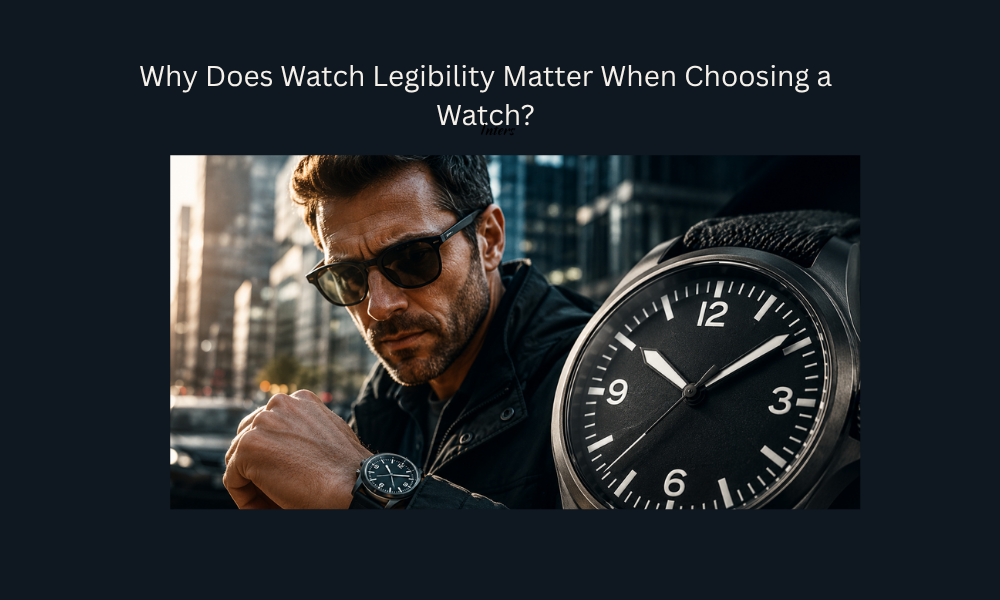
- High Contrast (e.g., White hands on Matte Black dial): Maximum visibility at a single glance. → Result: Ultimate daily utility for pilot and field watches.
- Low Contrast (e.g., Silver hands on Silver dial): Sleek, elegant appearance. → Result: Difficult to read in direct sunlight or dim environments.
- Busy Dials (e.g., Skeletonized or Multi-subdial): Visually complex and mechanically interesting. → Result: The hands often blend into the background machinery, severely reducing instant legibility.
Are luminescent coatings and backlights viable for your watch legibility decision
Evaluating if luminescent coatings and backlights are viable for your Watch Legibility Decision requires determining your actual need for specialized nighttime visibility, such as Super-LumiNova or tritium gas tubes. Alternative lighting solutions should be selected based on the specific usage case. Choosing the right Timepiece illumination selection ensures functionality persists long after sunset.
- Super-LumiNova (Photoluminescent): Charges in ambient sunlight and glows brightly initially. → Risk: Fades over a few hours; requires prior light exposure to function effectively.
- Tritium Gas Tubes (Radioluminescent): Glows continuously for up to 25 years without needing a light charge. → Risk: Not as initially bright as freshly charged Super-LumiNova; eventually dies completely.
Do anti-reflective coatings and crystal shapes impact your watch legibility decision
Analyzing how anti-reflective coatings and crystal shapes impact your Watch Legibility Decision injects commercial realism by evaluating how external hardware handles severe glare.
If you frequently work under harsh overhead office lights, do prioritize a flat sapphire crystal with several layers of inner AR (anti-reflective) coating. The result is that you accept a slightly less “vintage” aesthetic in exchange for a dial that looks like there is no glass covering it at all.
Is assessing hand size and shape critical for your watch legibility decision
Assessing hand size and shape is critical for your Watch Legibility Decision to prevent long-term ownership frustration by understanding how physical dimensions affect reading speed.
- Rule: Hand size dictates visual processing speed.
- Reason: Thin, elegant dress hands (like Feuille or Breguet) are significantly harder to locate instantly than thick, lumed sword or Mercedes hands.
- Example: Opting for broad, prominent hands if you have declining eyesight or need to check the time during intense physical activity.
How to prevent glare and clutter mistakes in your watch legibility decision
Preventing glare and clutter mistakes in your Watch Legibility Decision involves strictly matching the watch’s visual vulnerabilities to your lifestyle to avoid constant squinting and buyer’s remorse.
- The Risk: Buying a highly polished dial with polished hands and no AR coating. → The Reality: The watch will act like a mirror outdoors, reflecting the sky or your face instead of showing the time.
- The Risk: Choosing a chronograph with identical hand colors for the main time and the sub-dials. → The Reality: Your eyes will struggle to quickly differentiate the current time from the running stopwatch seconds.
How to conclude your watch legibility decision with this final execution checklist
Concluding your Watch Legibility Decision with this final execution checklist provides a strong, execution-oriented closure that transforms visibility options into an actionable scoring system.
Evaluation Checklist
Score 5/5: Immediate Buy.
Score 3-4/5: Pause. Identify the vulnerability.
Score <3/5: Hard Pass.
Support Appendix: Advanced Watch Legibility Troubleshooting & FAQ
This appendix integrates troubleshooting seamlessly into the task flow to resolve advanced visibility confusion and buying friction to ensure you confidently execute your Watch Legibility Decision.
- Q: Why do some luxury watches omit luminescent paint entirely? → A: Lume degrades over decades. Many high-end dress watches avoid it to ensure the dial remains pristine.
- Q: Does AR (Anti-Reflective) coating scratch easily? → A: Outer AR coating can scratch, but Inner AR coating is protected and provides excellent glare reduction.
- Q: Why are pilot watches known for the best legibility? → A: Historic pilot watches were designed with massive, high-contrast white Arabic numerals on matte black dials.
Citations
- aBlogtoWatch: Legibility is the Most Important Part of Watch Design
- The Escapement Room: Does Lume Matter on a Watch?
- First Luxury Watch Guide: Hands 101
Conclusion
By systematically evaluating specific dial contrast, luminescent technology, and crystal clarity, you elevate your purchase from a purely aesthetic impulse to a strategic Watch Legibility Decision. Prioritizing the visual specifications you actually need—while avoiding overly cluttered or reflective designs—ensures maximum daily utility and guarantees you can always answer the simple question: “What time is it?”