
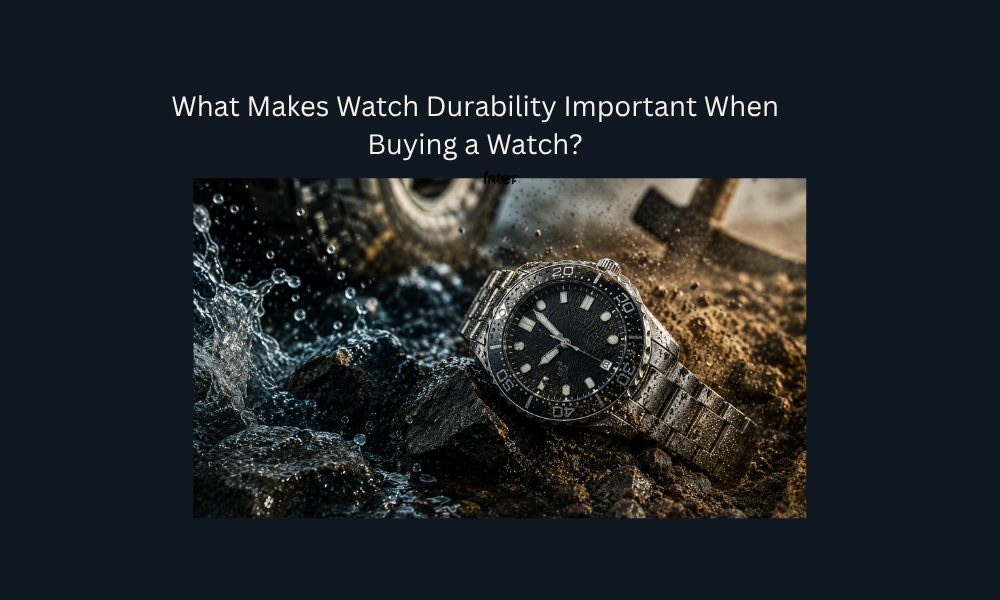
What Makes Watch Durability Important When Buying a Watch?
Executing a sound Watch Durability Selection requires a structured evaluation framework that prioritizes structural resilience, material science, and physical lifestyle alignment over impulsive aesthetic trends. Purchasing timepieces without understanding their physical vulnerabilities leads to catastrophic movement failure, shattered cases, and severe financial regret. This guide provides the framework for systematically evaluating core protective features, assessing material thresholds, and utilizing a quantitative scoring checklist to finalize your structural selection.
How to define the core purpose of your watch durability selection
Defining the core purpose of your Watch Durability Selection establishes your actual physical environment and daily hazard exposure before evaluating specific protective materials.
Rule: Form follows function.
Reason: Buying a delicate, ultra-thin mechanical watch for a construction job guarantees catastrophic movement failure.
Example: Defining your purpose as “heavy outdoor labor” immediately prioritizes a shock-resistant resin case over precious metals.
Why does lifestyle alignment anchor your watch durability selection
Understanding why lifestyle alignment anchors your Watch Durability Selection requires establishing how daily activities, occupational hazards, and clumsiness dictate the overarching structural integrity of the watch. Timepiece toughness requires an analytical evaluation of physical exposure. This objective assessment prevents the acquisition of fragile pieces that cannot survive the wearer’s typical week. Establishing a strict watch protection baseline ensures you map specific horological materials directly to actual daily impacts rather than idealized wearing scenarios.
What makes sapphire crystals essential in your watch durability selection
Determining what makes sapphire crystals essential in your Watch Durability Selection involves weighing the everyday scratch resistance of sapphire against the impact resistance of mineral or acrylic alternatives.
- Acrylic/Hesalite: Highly shatter-resistant, scratches very easily. → Result: Excellent for vintage aesthetics or extreme impact (e.g., space travel), but requires frequent buffing with Polywatch.
- Mineral Glass: Moderate scratch and impact resistance. → Result: Standard on entry-level watches; cannot be polished once scratched.
- Sapphire Crystal: Nearly impossible to scratch, but can shatter under extreme, direct impact. → Result: The ultimate daily standard for luxury and long-term legibility.
Are shock absorbers and anti-magnetic shields viable for your watch durability selection
Evaluating if shock absorbers and anti-magnetic shields[1] are viable for your Watch Durability Selection requires determining your actual need for specialized internal protections like silicon hairsprings and Faraday cages. When executing your timepiece structural selection, these alternative physical protections dictate the survivability of the movement against invisible environmental hazards.
- Anti-Magnetic Shielding: Protects the hairspring from laptops and speakers. → Risk: Adds thickness to the case (if using a soft-iron inner cage) or significant cost (if using a silicon escapement).
- Shock Absorbers (e.g., Incabloc): Protects the balance wheel pivots from drops. → Risk: Standard on modern mechanicals, but still cannot survive the extreme G-forces of a golf swing or jackhammer.
Do case materials and bezel inserts impact your watch durability selection
Analyzing how case materials and bezel inserts[2] impact your Watch Durability Selection injects commercial realism by evaluating how external metals and ceramic inserts handle daily desk-diving and blunt force.
If you frequently bump your wrist against door frames and brick walls → Do prioritize a ceramic bezel insert and a tegimented/hardened titanium case → Result you accept a darker, matte aesthetic in exchange for a watch that looks brand new after years of abuse.
Is assessing mechanical fragility critical for your watch durability selection
Assessing mechanical fragility[3] is critical for your Watch Durability Selection to prevent long-term ownership frustration by understanding the inherent physical vulnerabilities of hundreds of microscopic moving gears compared to a solid-state circuit board.
Rule: Mechanical watches are inherently fragile.
Reason: Dropping an automatic watch onto a hardwood floor can instantly snap the balance staff, stopping the movement entirely.
Example: Opting for a digital quartz watch if you plan to mountain bike or chop wood while wearing it.
How to prevent shatter and scratch mistakes in your watch durability selection
Preventing shatter and scratch mistakes in your Watch Durability Selection involves strictly matching the watch’s physical vulnerabilities to your lifestyle to avoid catastrophic case damage and expensive repairs.
- The Risk: Wearing a full-ceramic watch case over a tile floor. → The Reality: While it will never scratch, a single drop onto tile will shatter the ceramic lugs, requiring a total case replacement that costs thousands.
- The Risk: Wearing an $18\text{k}$ solid gold sports watch for daily active wear. → The Reality: Gold is incredibly soft; it will accumulate deep dents and gouges that cannot be polished out without destroying the case shape.
How to conclude your watch durability selection with this final execution checklist
Concluding your Watch Durability Selection with this final execution checklist provides a strong, execution-oriented closure that transforms the durability options into an actionable scoring system.
Rule: A scored checklist removes aesthetic hype from physical realities.
Reason: Quantifying structural toughness prevents costly repair regrets.
Example: Only finalizing the purchase if the durability specifications score perfectly for your hazard exposure.
- [ ] Purpose Match: The toughness level directly supports your primary environment (e.g., Steel for the office, Resin for the job site).
- [ ] Crystal Audit: Verified the crystal material (Sapphire, Mineral, Acrylic) matches your scratch tolerance.
- [ ] Movement Check: Confirmed you aren’t exposing a delicate mechanical movement to high-impact sports (like golf or tennis).
- [ ] Material Acceptance: Accepted the specific vulnerabilities (scratching vs. shattering) of your chosen case material.
- [ ] Magnetic Awareness: Budgeted for or verified anti-magnetic protections if you work heavily with electronics.
- Score $5/5$: Immediate Buy. The durability rating is perfectly optimized for your wrist and physical lifestyle.
- Score $3-4/5$: Pause. Identify the vulnerability (e.g., an unprotected mineral crystal) and consciously accept the scratch risk before buying.
- Score $<3/5$: Hard Pass. Do not buy; the durability mismatch guarantees this watch will either break in your care or sit unworn out of fear.
Support Appendix: Advanced Watch Durability Troubleshooting & FAQ
This appendix integrates troubleshooting seamlessly into the task flow to resolve advanced toughness confusion and buying friction to ensure you confidently execute your Watch Durability Selection.
- Q: Can I wear my mechanical watch while playing golf or tennis?
A: It is highly advised not to. The sudden, extreme G-forces of a club or racket striking a ball can damage the rotor bearing or snap the balance staff of a mechanical watch. Wear a quartz watch instead. - Q: Why do some luxury watches still use easily scratched acrylic crystals?
A: Acrylic (often called Hesalite) has a warm, vintage distortion that collectors love. More importantly, it will not shatter into dangerous microscopic shards under extreme pressure, which is why NASA mandated it for the Omega Speedmaster in space. - Q: Will a scratched sapphire crystal need to be fully replaced?
A: Yes. Because sapphire is so incredibly hard, it cannot be buffed or polished out like acrylic. If you manage to scratch or chip it, the only solution is a full crystal replacement.