
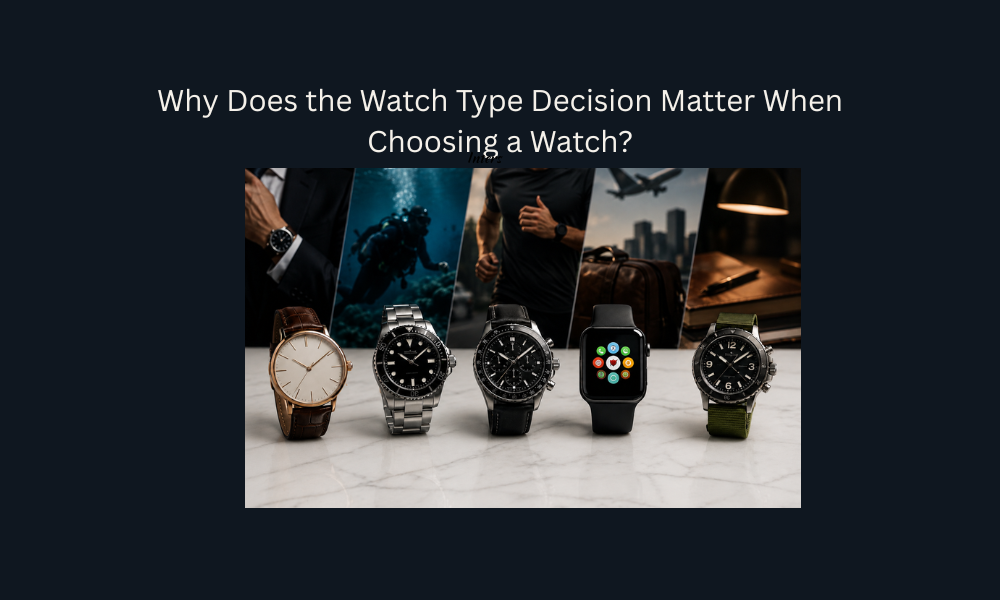
Why Does the Watch Type Decision Matter When Choosing a Watch?
Executing a sound Watch Type Decision requires a structured evaluation framework that prioritizes daily utility, wardrobe versatility, and functional ergonomics over impulsive aesthetic trends. Purchasing timepieces without understanding categorical limitations leads to severe buyer’s remorse and unworn watches that clash with the wearer’s daily life. This guide provides the framework for systematically comparing core horological archetypes, assessing functional complications, and utilizing a quantitative scoring checklist to finalize your category selection. By moving past surface-level aesthetics, you build a functional acquisition strategy optimized for long-term wear.
How to define the core purpose of your Watch Type Decision
Defining the core purpose of your Watch Type Decision establishes the primary environment and utility of the timepiece before looking at specific models. Form follows function. A Dress Watch serves a completely different physical and environmental need than a Dive Watch. Defining your purpose as “office daily wear” immediately eliminates bulky sports watches from your search radius.
To systematically approach this, identify your primary wearer persona. Beginners typically require versatile “GADA” (Go Anywhere, Do Anything) wearers that cover multiple bases. Professionals working in formal corporate sectors need subdued dress watches that communicate quiet competence. Outdoor Users demand specialized tool watches engineered for legibility and physical endurance. Finally, Collectors often base their acquisitions on historical pedigree and mechanical innovation rather than strict daily utility.
Persona to Watch Type Mapping
Why does lifestyle alignment anchor your Watch Type Decision
Understanding why lifestyle alignment anchors your Watch Type Decision requires assessing how daily activities and wardrobe dictate the overarching category of the watch. A thorough analysis of your baseline routine determines the appropriate Timepiece category. An analytical evaluation of daily physical activity prevents the acquisition of fragile pieces for active environments. If your week involves desk work followed by weekend hiking, your Watch style baseline must account for potential kinetic shock and environmental exposure. Ignoring your actual lifestyle in favor of an idealized lifestyle results in a misaligned horological acquisition.
What makes a dive watch different from a dress watch in your Watch Type Decision
Determining what makes a dive watch different from a dress watch in your Watch Type Decision involves weighing the rugged utility of a diver against the formal elegance of a traditional dress watch. This is the most common cross-roads in a Watch Type Decision.
1 Dive Watch
- • High water resistance
- • Rotating bezel
- • Luminous hands
2 Dress Watch
- • Slim profile
- • Minimal dial
- • Precious metals
Evaluating these attributes clarifies the functional divide. A diver is a tool; a dress watch is an accessory. The decision hinges entirely on which environment you occupy most frequently.
Are field watches and chronographs viable for your Watch Type Decision
Evaluating if field watches and chronographs are viable for your Watch Type Decision requires determining your operational need for specialized tool watches focused on timing and extreme legibility. Before expanding your search into Alternative watch styles, assess the practical application of these specialized pieces. Timepiece category selection beyond the basics requires a clear use-case.
Functional Trade-off Analysis
Both categories offer distinct advantages, but their specialized nature means they carry specific environmental limitations.
Do specific complications impact your Watch Type Decision
Analyzing how specific complications impact your Watch Type Decision injects commercial realism by evaluating if you actually require the complex features typical to specific watch categories. Mechanical complexity increases purchase price and maintenance overhead.
If you are buying a pilot’s GMT watch → Do acknowledge you are paying a premium for dual time-zone functionality → Result you accept the busier dial and higher price point for a travel utility you will actually use. Applying this logic to every complication—from a simple date window to a complex moon phase—forces a critical assessment of mechanical necessity versus aesthetic preference.
Is assessing wardrobe versatility critical for your Watch Type Decision
Assessing wardrobe versatility is critical for your Watch Type Decision to prevent long-term ownership frustration by auditing the watch type directly against your daily clothing choices. Versatility dictates wrist time. If a watch category clashes with $90\%$ of your wardrobe, it will inevitably become an unworn “ghost watch.” Opting for a minimalist everyday watch if your attire constantly shifts between tailored suits and casual t-shirts ensures maximum utility. A highly specialized tool watch paired with a strict formal wardrobe creates a visual dissonance that undermines both the watch and the outfit.
How to prevent “one-watch collection” mistakes in your Watch Type Decision
Preventing “one-watch collection” mistakes in your Watch Type Decision involves strictly matching the watch category’s limitations to avoid forcing one watch to do everything. No single timepiece excels in every possible scenario.
Category Collision Vectors
-
The Risk:
Forcing a thick dive watch into a formal tuxedo event.
→ The Reality: It will not fit under the cuff and breaks formal etiquette. -
The Risk:
Wearing a delicate vintage dress watch to the gym.
→ The Reality: Sweat and kinetic shock will destroy the movement and leather strap.
Acknowledging these boundaries is essential for strategic portfolio curation. Attempting to force a single category to cover all bases inevitably leads to compromised utility and aesthetic failure.
How to conclude your Watch Type Decision with this final execution checklist
Concluding your Watch Type Decision with this final execution checklist provides a strong, objective closure that transforms categorical options into an actionable scoring system. A scored checklist removes aesthetic emotion from the physical purchase. Quantifying the category’s utility prevents costly aesthetic regrets. Only finalizing the purchase if the specific type scores perfectly for your lifestyle parameters ensures a sound investment.
- Score $5/5$: Immediate Buy. The watch type is perfectly optimized for your wrist and lifestyle.
- Score $3-4/5$: Pause. Identify the missing tradeoff (e.g., lack of water resistance on a dress watch) and consciously accept it before buying.
- Score $<3/5$: Hard Pass. Do not buy; the category mismatch guarantees this watch will be uncomfortable or sit unworn in a safe.
Support Appendix: Advanced Watch Type Decision Troubleshooting & FAQ
This appendix resolves advanced category confusion and buying friction to ensure you confidently finalize your Watch Type Decision.
- Q: Can an everyday watch serve as both a dress and sport watch? A: Yes. “GADA” (Go Anywhere, Do Anything) watches bridge the gap between categories by offering high water resistance with a clean, smooth-bezel aesthetic.
- Q: Do I really need a dive watch if I don’t scuba dive? A: No, but the sealed build, waterproof nature, and casual styling make them perfect, highly durable everyday “beater” watches for active lifestyles.
- Q: Are chronographs more expensive to maintain than field watches? A: Yes. Chronographs possess significantly more moving parts, which increases both the initial purchase price and the recurring routine mechanical servicing costs.
Conclusion of your Watch Type Decision
Executing this protocol ensures your Watch Type Decision remains rooted in objective data rather than temporary design hype. By systematically evaluating the specific utilities, limitations, and aesthetic boundaries of different watch categories, you elevate your purchase from a purely emotional choice to a strategic, data-driven acquisition. Matching the right category (diver, dress, field, or chrono) to your lifestyle ensures maximum versatility, eliminates wardrobe clashes, and guarantees your timepiece gets the wrist time it deserves.